The Introductory House Tour is temporarily unavailable as we prepare the house for Yuletide. We invite you to enjoy one of our specialty tours during your visit. Explore Tours »
Elissa Edwards combines historic music and sounds from nature to create a unique soundtrack.
While researching the wide range of historical scores in the Winterthur Library, Elissa Edwards found many pieces that celebrated the rich tradition of nature-themed music.
“I just wanted to look at everything,” Edwards says. “I dug deeply into the music collections and really took a lot of notes, documenting what was there because I was delighted to find this wonderful collection and knew I wanted to revisit it.”
Edwards is an operatically trained exponent of early music, who has a particular interest in historical music manuscript collections owned by women as well as historical music made by women, both of which she wants to raise awareness among modern audiences. Edwards breathed new life into forgotten works from the Winterthur Library by weaving parts of them with sounds from nature to create a soundtrack for the exhibition Outside In: Nature-inspired Design. Her musical creation is part of the Transformations installation of works by contemporary artists.
Transformations highlights work by Winterthur’s Maker-Creator Fellows, who get special access to the collections and staff for research and inspiration. The installations in Transformations celebrate how Winterthur’s landscape and material culture moved the Maker-Creator Fellows to turn their impressions of the past into artistic and experiential representations that comment on the present. Outside In, with its display of bird nests, seashells, and other natural objects, explores how objects from nature inform design motifs of wallpapers, textiles, China, furniture carving, and more, and the ways those themes are integrated into interior designs.
To create the Outside In soundtrack, Edwards first selected the scores from the Winterthur collection that she wanted to record, intending to convey some sense of the breadth of the Winterthur collection. Dr. Basil Considine, a renowned musicologist and former Winterthur fellow, transcribed hand-written scores into modern editions, which made for an effortless collaboration between the musicians.
“I also knew that I wanted to work with female collaborators, then create a variety of different instrumental textures to express the playfulness of the different characteristics that you hear in the music,” she says. These included mimicking birdsong with a flute or plucking the strings of a harpsichord.
“I love the idea of using the harp because there is a beautiful early pedal harp in the Winterthur collection, and while we recorded on a modern harp, I think the sound of the harp has such an alluring quality and really highlights the sumptuousness of the collection,” Edwards says.
In various outdoor locations at Winterthur, Edwards and her husband, Jeremy Sheeler, of Awarehouse Productions, recorded the nature soundscape, capturing the burbling of Clenny Run, the buzzing of insects, and breezes blowing through the trees and meadows. He also recorded Edwards singing, embellished with baroque ornamentation techniques. They were all mixed into the soundtrack by Edwards’s brother, Ryan Edwards, of Coincident Sound.
“I approached the project as if I were the listener, thinking about what would be emotionally gripping to someone who is experiencing all of this for the first time,” Edwards says. “I think the sensory experience of that Brandywine Valley area, being by the river, takes you out of your day-to-day self and allows you to come into a place with a more thoughtful approach to what you’re doing. It’s my hope that the music transports visitors to a place of heightened historical whimsy, this kind of pastoral romanticism, which is experienced whenever you walk the Winterthur grounds and garden. It’s an absolutely delightful place to experience, and I wanted the music to have unique surprises and to captivate the listener.”
Hear Edwards’s composition in Outside In: Nature-inspired Design at Winterthur.See the work of the other Transformations artists in the galleries area.
The Winterthur landscape inspires Nottene’s redesign of the galleries lounge.
Kimberly Hall and Justin Hardison of the artist studio Nottene were looking for a way to expand their pattern design business when they decided to explore wallpaper. They both grew up in houses with wallpaper and had built memories around the images and motifs, and they carried those memories with them into the new venture. They liked wallpaper. They knew how it was made.
“But outside of that, we didn’t the history of it and why people had it,” Hardison says. “We wanted to know more.”
Online searches for more information revealed only one book. Then Hall saw a posting for the Winterthur Maker-Creator Fellowship at the Office of Research at Maryland Institute College of Art, where she is on the faculty. “The idea of being able to use the Winterthur archive and learn about old wallpaper was really appealing,” Hall says. “We found there was so much more to discover.”
Sample books and business records in the Winterthur Library quickly became key sources for understanding the history, design, and trade of wallpaper. Pennsylvania German art and Fraktur became important inspirations, as did frequent walks in the Winterthur Garden, which was a sanctuary to the young family during the Covid-19 pandemic.
“There were just endless things to discover,” Hardison says. “We spent tons of time in the research library, in the collections, going into the galleries, walking the grounds, in the storage areas. Everything felt inspiring.”
The result of their research is reflected in a redesign of the West Galleries Lounge, part of the Transformationsinstallation of works by contemporary artists. Transformations highlights work by Winterthur’s Maker-Creator Fellows, who receive special access to the collections and staff for research and inspiration. The work in Transformationscelebrates how Winterthur’s landscape and material culture moved the Maker-Creator Fellows to turn their impressions of the past into artistic and experiential representations that comment on the present.
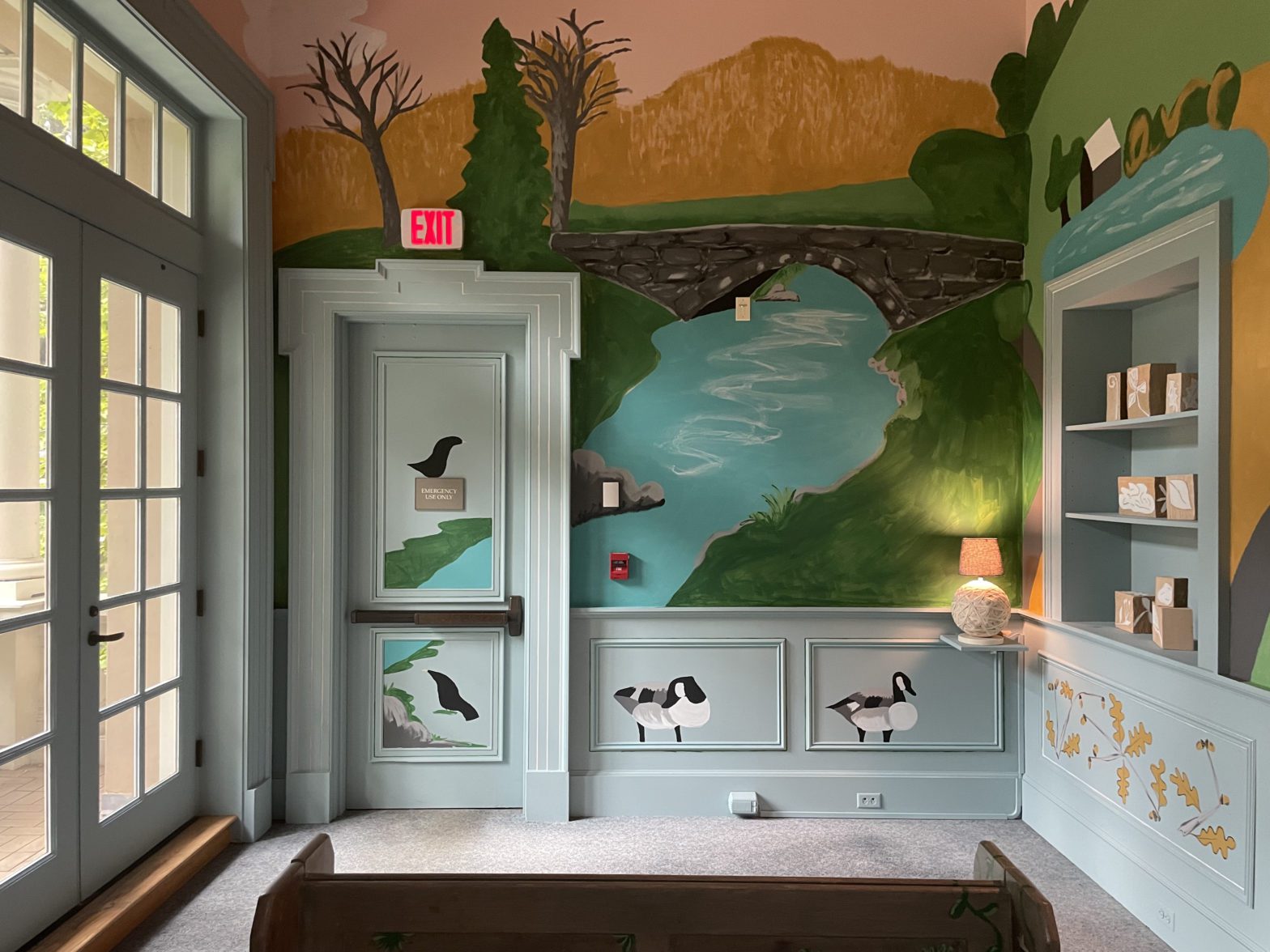
In the lounge, usually furnished in a modern style, Hall painted a folk art mural of the Winterthur landscape with depictions of Canada geese, blossoming tree limbs, leaves, twigs, and other objects that found their way into their sketchbooks and photo library while they wandered the grounds. Hardison decorated the shelves with woodblocks carved with similar natural imagery to acknowledge their work as printmakers.
“It almost seemed too obvious that we would do wallpaper in there,” Hardison says. “What are the other options? And because we were so inspired by the grounds and some of the other things in the collection and given the theme of the exhibition, we thought it would be a perfect opportunity to build a mural with a similar kind of aesthetic.”
The effect is as pleasing as that in any Winterthur room where wallpaper—some patterned, some mural-like—plays a key role in the design.
Among what the couple learned at Winterthur, “I was impressed that, for some, wallpaper was very much a prized possession,” Hardison says. “I was very surprised to find out how wallpaper was transported, as opposed to the removable and disposable stuff nowadays. These were prized works of art that people would have pulled back down, carefully packaged, shipped across the Atlantic, and then reinstalled. That was really interesting.”
A close look at the Chinese Parlor at Winterthur, for example, shows how highly regarded the wallpaper was by Winterthur founder Henry Francis du Pont. Made in the early 18th century, du Pont discovered the paper, unused, in a warehouse in Paris. It was so old and so beautiful, he couldn’t bear to cut it to fit the walls of his parlor, so he had the ceilings coved to accommodate its full length.
“One of the things that is so special about the Maker Creator Fellowship is that it makes the collections come alive,” Hall says. “Artists and designers can use the collection to make new things. These objects are meant to be renewed. Learning the history of wallpaper made us feel stronger and more confident in what we were doing. So much of what artists struggle with is that our work is not valued in the way other things are valued. We’re carrying on a tradition that has a history and lineage. It’s culture.”
Nottene’s work, as well as the work of the other Transformations artists, is currently on view. See their lounge design in the gallery of Outside In: Nature-inspired Design at Winterthur.
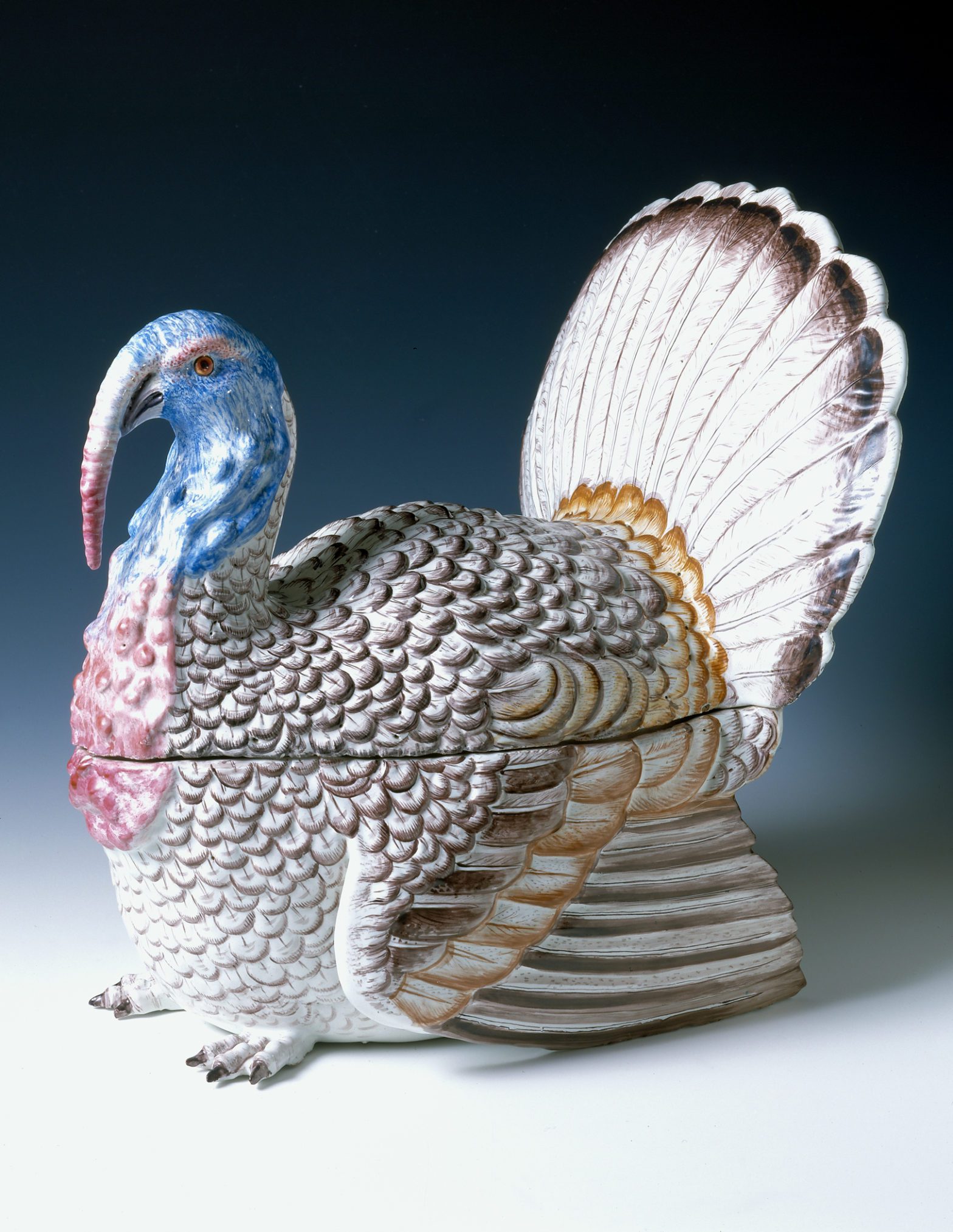
In the 1500s, Spaniards introduced domesticated turkeys from the Americas to the world. In other countries, the bird was valued for its exotic appearance as well as its tasty meat. Here, turkeys would come to represent the American Thanksgiving.
This ceramic tureen in the form of a turkey was created in France in the mid-1700s at the Strasbourg factory. (Others were made in Germany and elsewhere.) Though it is tempting to assume it was intended specifically for serving a stew or soup made from turkey, it probably was used to contain a range of tempting hot foods.
Tureens in naturalistic animal and vegetable shapes were popular elements of fashionable table settings. Such a tureen would have been at home on a table with dishes shaped like cabbages or cauliflowers and dinner plates painted with designs inspired by nature. In some cases, moss, potted plants, or flowers helped to complete the theatrical quality of the dinner display.
Winterthur curator Leslie Grigsby has long embraced the idea of bringing nature to her dinner table. For special meals, she often creates a centerpiece by arranging her favorite ceramic animal figures among greenery and fall leaves gathered from outside her home.
Leslie B. Grigsby, senior curator of ceramics and glass
Ceramic turkey tureen, Strasbourg factory, France, 1750-1760
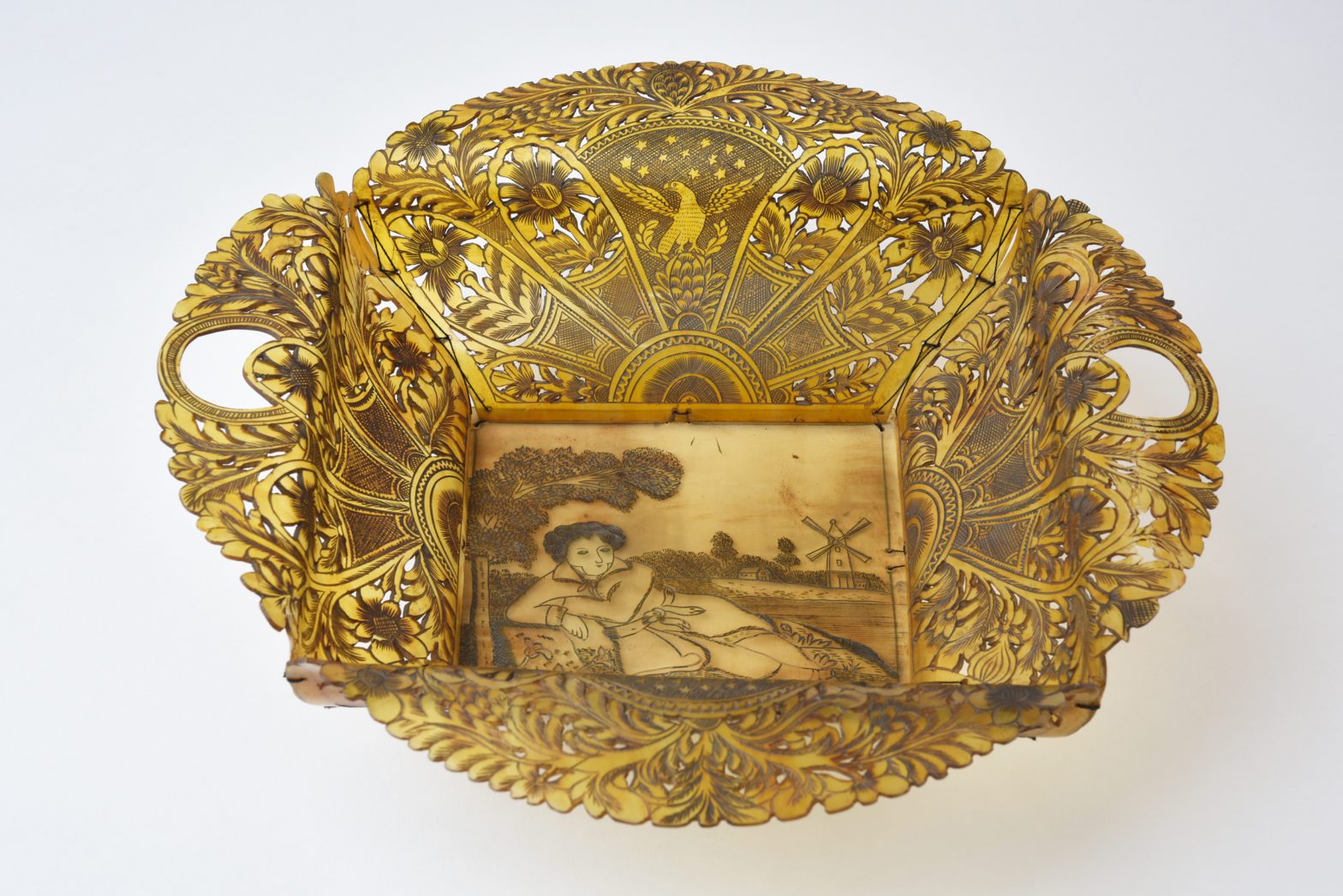
“Autumn and apple-picking are always paired thoughts in my mind, and the squared form of this basket when made by tinsmiths was used for apples, but this one is made from translucent cattle horn. The S-curved sides are engraved and pierced with the American national eagle and stars surrounded by leaves and blooming flowers very much in the manner of lady’s high back combs of the 1830s. I knew the hair comb industry was prolific, but horn baskets are unusual survivors. When I found this one in an antique shop, it was a natural fit for the collection. With a little help from Winterthur’s conservators to make new laces and stabilize the sides, it is now ready for display.”
Ann Wagner, senior curator
Basket, probably made in Rhode Island or Massachusetts, ca. 1830-50
Museum purchase with funds drawn from the Centenary Fund, 2016.0020
A signature installation at Winterthur further explores historic craft, trade, and lifeways
A reinstallation of With Hammer in Hand: A Story of American Craft at Winterthur Museum, Garden & Library refreshes and updates the story of the Dominy family, skilled craftsmen who worked and traded in East Hampton, Long Island, in the 18th and early 19th centuries.
The updated exhibition presents a more detailed, nuanced view of the Dominys as vital members of a vibrant, diverse community, which included English colonists, members of the Shinnecock and Montaukett communities, enslaved people, and free people of color, who earned their living from offshore fishing and farming.
“The Dominys reflected and helped shape the special regional identity of their community through furniture, clocks, and other objects that may appear to our eyes as common, simple, and practical, but they are beautifully designed and executed,” said Josh Lane, the Lois F. and Henry S. McNeil Curator of Furniture at Winterthur. “We want visitors to understand the Dominy craftsmen as members of a multigenerational family living under one roof with their wives and children and apprentices, and as a vital part of their community where everyone turned to them for all sorts of woodworking and small metalsmithing needs.”
Three generations of the family—Nathaniel Dominy IV (1737–1812), Nathaniel Dominy V (1770–1852), and Felix Dominy (1800–1868)—worked in the shops from the mid-18th century through about 1840. In the patchwork of communities that made up eastern Long Island, they built houses, barns, and windmills; supplied furniture, clocks, and coffins; repaired hay rakes, wagon wheels, and spinning wheels; mended watches; and helped maintain civic buildings such as schoolhouses.
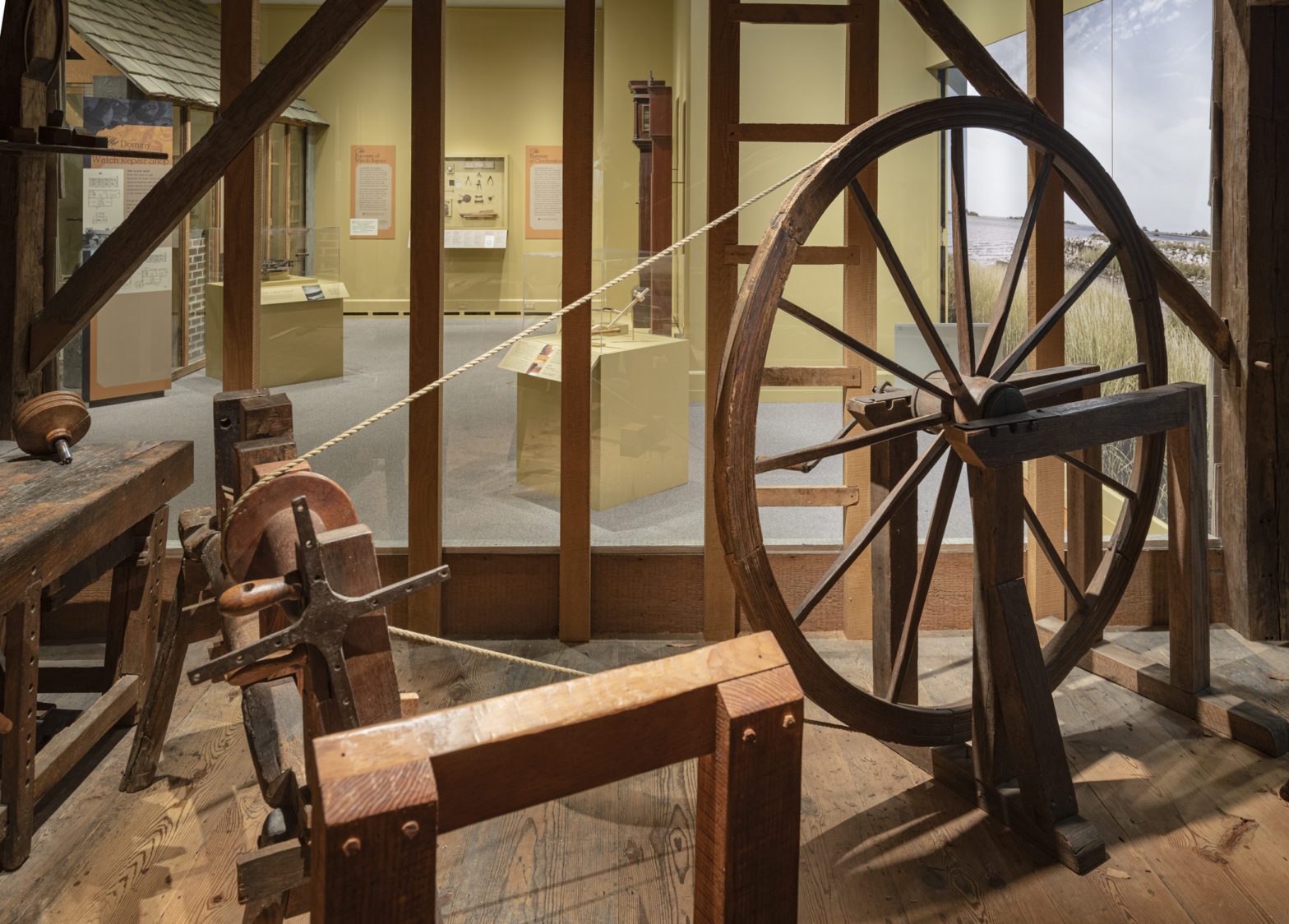
With Hammer in Hand displays nearly all the contents of the Dominys’ woodworking, clock making, and watch repair shops—including lathes, workbenches, and more than 1,000 hand tools. It also contains examples of furniture and tall clocks as well as extensive shop records and family papers.
In addition, it features short video interviews with Charles F. Hummel, curator emeritus at Winterthur and the preeminent scholar of the Dominys, outlining how the collection survived and how it came to Winterthur as well as video excerpts on how the collection continues to intrigue and inspire craftspeople. A new floor-to-ceiling mural of a saltwater marsh situates the Dominys in the seaside community of their time.
Together, the tools, shop products, and written records tell a more complete story about the practices and roles of skilled craftsmen in preindustrial America than any other single grouping of artifacts and documents that have survived from this period.
With Hammer in Hand: A Story of American Craft is a permanent exhibition at Winterthur and is included as part of general admission.
ABOUT WINTERTHUR MUSEUM, GARDEN & LIBRARY
Winterthur—known worldwide for its preeminent collection of American decorative arts, naturalistic garden, and research library for the study of American art and material culture— offers a variety of tours, exhibitions, programs, and activities throughout the year. Admission includes the Winterthur Garden and galleries.
Winterthur, located on Route 52, six miles northwest of Wilmington, Delaware, and five miles south of U.S. Route 1, is closed on Mondays (except during Yuletide) and on Thanksgiving and Christmas Day. Museum hours are 10:00 am–5:00 pm, Tuesday–Sunday. $20 for adults; $18 for students and seniors; $6 for ages 2–11. Memberships are available for free and discounted admission. Winterthur is committed to accessible programming for all. For information, including special services, call 800.448.3883, 302.888.4600, or TTY 302.888.4907, or visit winterthur.org.
For the most updated information about Covid safety protocols, visit winterthur.org/faq.
Masquerading as snowflakes: The tiny white flowers of the garland spiraea (Spiraea x arguta) in the Sundial Garden look like a flurry of snowflakes among their colored leaves.
Another azalea show: Many of the azaleas are displaying lovely colored leaves – yellows, chartreuse, bronzes, purples, and some bright red. In particular, the ‘Firefly’ azalea (Rhododendron ‘Firefly’ Kurume hybrid azalea) along Garden Lane on the edge of Enchanted Woods is a show of brilliant reds.
Pretend it’s spring:
The forsythias are blooming on the field edge of Azalea Woods (Forsythia species) and on Sycamore Hill (Forsythia ‘Winterthur’).
In Enchanted Woods, several azaleas (Rhododendron ‘Alight’) are blooming.
Along the Winterhazel Walk, several Korean rhododendrons (Rhododendron mucronulatum) are blooming.
In Azalea Woods, 2 pink tree rhododendrons (Rhododendron hybrid Winterthur Dexter #55) are blooming.
ENTRANCE DRIVE AND PARKING AREA
pb Abelia x grandiflora (Glossy abelia – rosy-bronze bracts)
ber Catalpa species (Catalpa – long, bean-like green to brown seed pods)
Explore this place of beauty, history, and learning! Winterthur offers special rates for groups of 15 or more people. We are happy to work with you to customize your visit. To book your tour, please call 800.448.3883 or email grouptours@winterthur.org
Admission includes: a self-guided tour of elegantly furnished rooms in which Henry Francis du Pont entertained his family and friends in grand style; a narrated tram tour* through the 60-acre garden and its succession of show-stopping blooms; the Campbell Collection of Soup Tureens; exhibitions; and access to Winterthur’s world-class research library. Please plan to spend about three hours.
Winterthur has on-site dining in the Visitor Center Cafeteria. Boxed lunches are available by pre-order (see below) or your group may go through the line.
Group Rates
A minimum of 15 visitors are required per group to receive the General Admission group rate of $23 ($27 during Yuletide at Winterthur). Receive two complimentary tickets for 15 paid admissions.
*Effective February 28, 2026, the General Admission group rate will be $24 ($28 during Yuletide at Winterthur).
No deposit is required. Payment in full is due one week prior to tour date. Group Tours are available by advance reservation only. We recommend booking your group tour at least four to six weeks prior to your desired tour date.
*March through December, weather permitting. Trams are shared with the general public and are available on a first-come, first-served basis.
Guided Garden Walks
Discover horticultural secrets on guided garden walks. $50 per group, optional add-on.
Boxed Lunches
Select Two
$17.50 per box
Roasted turkey with applewood smoked bacon, tomato, and lettuce with garlic aioli on a brioche
Grilled chicken with romaine lettuce, pecorino cheese, and Caesar dressing in a tortilla wrap
Roast beef with caramelized onions and arugula with blue cheese aioli on a ciabatta
Honey-baked ham with tomato, lettuce, Swiss cheese, and honey Dijon mustard on a brioche
Balsamic-roasted squash with tomato confit, red onion, feta cheese, sundried-tomato pesto, and spinach on a ciabatta
Grilled portobello mushroom with roasted bell pepper, Boursin cheese, arugula, and balsamic vinaigrette in a tortilla wrap
Smashed-chickpea and avocado with feta cheese, tomato, red onion, watercress, and green goddess dressing on seven-grain bread
Mixed-greens salad with citrus segments, shaved fennel, and toasted pine nuts with a citrus vinaigrette
Spinach salad with strawberries, red onion, and candied pecans with strawberry balsamic dressing
$19.00 per box
Genoa salami with spicy soppressata, tomato confit, marinated artichokes, mozzarella, arugula, and lemon-basil pesto on a ciabatta
Cilantro-lime shrimp with romaine lettuce, avocado, and chipotle slaw on a tortilla wrap
Grilled marinated steak with sautéed peppers and onions, provolone cheese, and herbed mayo on a ciabatta
All boxed lunches include a bag of chips, fresh fruit, house-baked cookie, a bottle of water, and eco-friendly cutlery.
Sandwich selections and counts are due 5 business days prior to your visit. Please ask your catering representative about private seating, delivery, or customized options.
Explore recent acquisitions that feature works from different craft practices— painting, metalwork, ceramic, furniture, and literary arts—all engaging with the arts and crafts movement’s goal of harmonizing beauty with functionality. These objects highlight women artists, designs exploring non-Western influences, and items made specifically for children. Plus, enjoy an installation that highlights toxic pigments used in bookbinding and other potentially toxic objects in the collection, and learn how to spot potential hazards in your own collections.
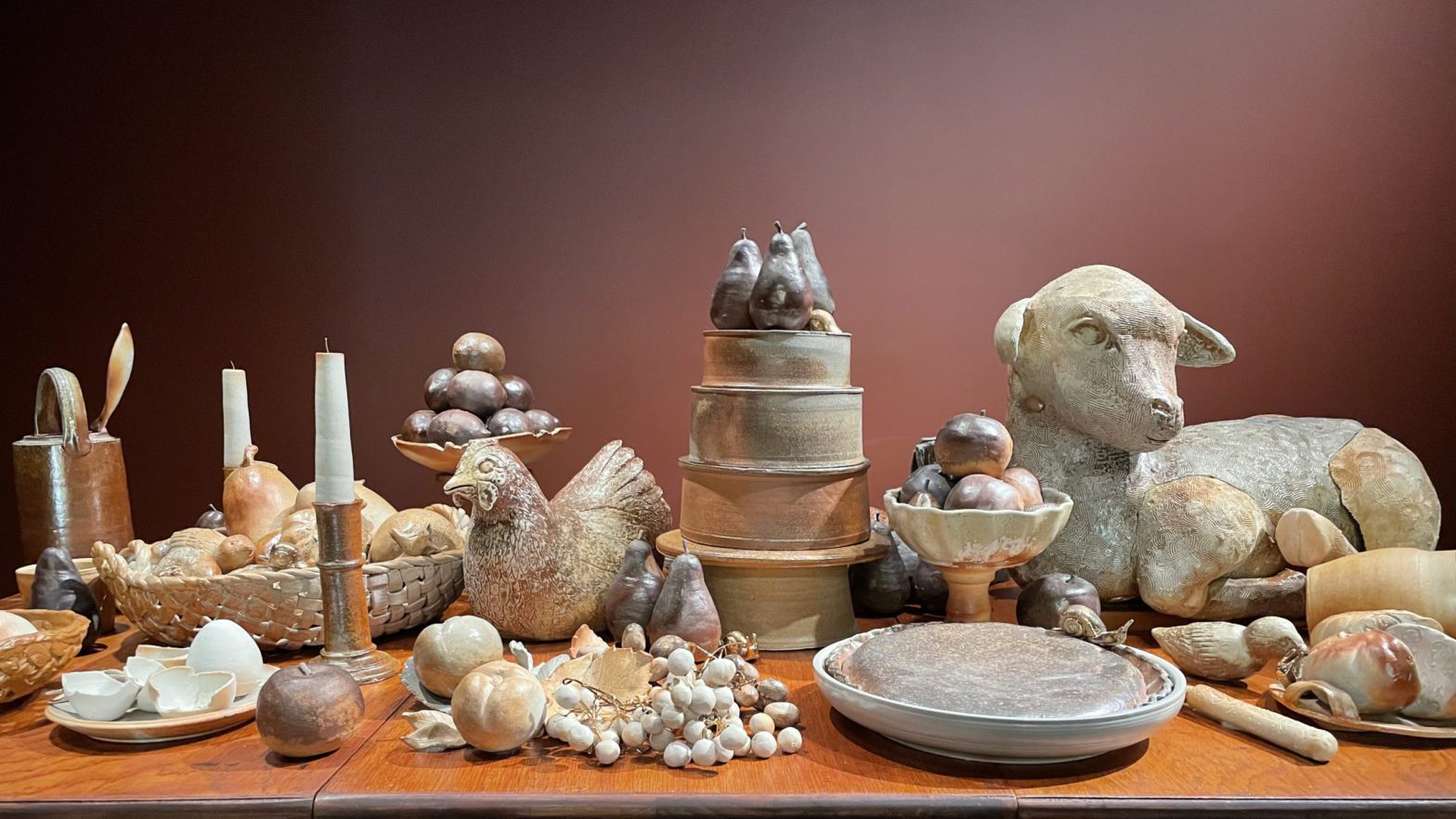
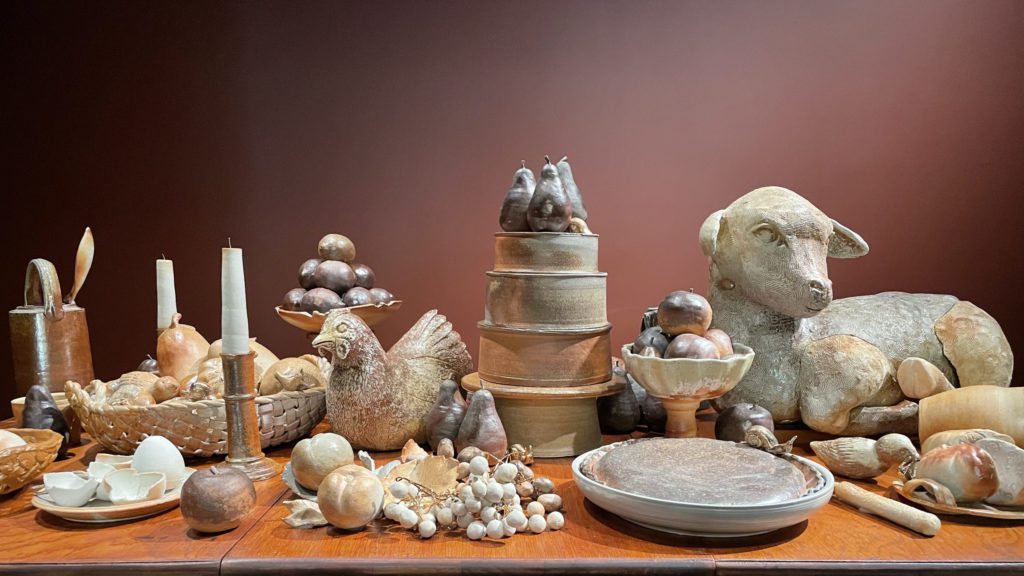
Heather Ossandon’s ceramic still life stays rooted in the everyday while transcending the history it draws from.
Ceramicist Heather Ossandon describes herself as an “Air Force brat.” Born in the Philippines, she spent her childhood in England and the United States, in homes filled with traditional Japanese rice bowls, Korean objects, and British teapots. “We had that in our house because we lived there. I thought that was kind of commonplace but it turns out maybe not,” she laughs.
The unique ceramics traditions of the countries where she has lived and traveled inform both the functional pottery she makes for the commercial market and her sculpture pieces, such as Still Life with Fruit. The work is now on display in the Winterthur galleries as part of Transformations: Contemporary Artists at Winterthur, which showcases current responses to the traditional forms and objects the institution is known for.
“I’m really in love with still lifes and the more I look at them, the more I’m fascinated and just really intrigued by them,” Ossandon says. “Because I teach drawing as well, we use it as a tool, so I think sometimes people believe that they are sort of mundane. But there are actually so many things you can embed in them. And the longer I look, the more I think, ‘Look at this bowl of peaches. There’s so much happening.’ I’ve been really intrigued by that, so it’s just naturally moved into the work.”
Ossandon found ideas for her Still Life with Fruit through Winterthur’s Maker-Creator Research Fellowship, which provides access to all to Winterthur’s collections, grounds, and some staff for research that inspires the work of creative professionals. Among Ossandon’s sources were Mary Jane Peale’s Still Life with Fruit painting, historic glasses, crockery, tableware, cookbooks, and other resources from the Winterthur museum and library collections.
Also incorporated into Ossandon’s assemblage are references to Winterthur’s past as a working farm. Through the specific objects in the still life, some laden with personal significance, Ossandon conveys a sense of place that is specific to one location while being relevant to any location and expressing something that is personally meaningful to everyone.
“I was looking at what people were eating, how people were communicating, how they were recording things all related to food because I feel like that’s really universal,” Ossandon says. “I was also familiar with the Peales and I felt like I wanted to highlight Mary Jane’s work, specifically, being a woman, I wanted to bring those to light.”
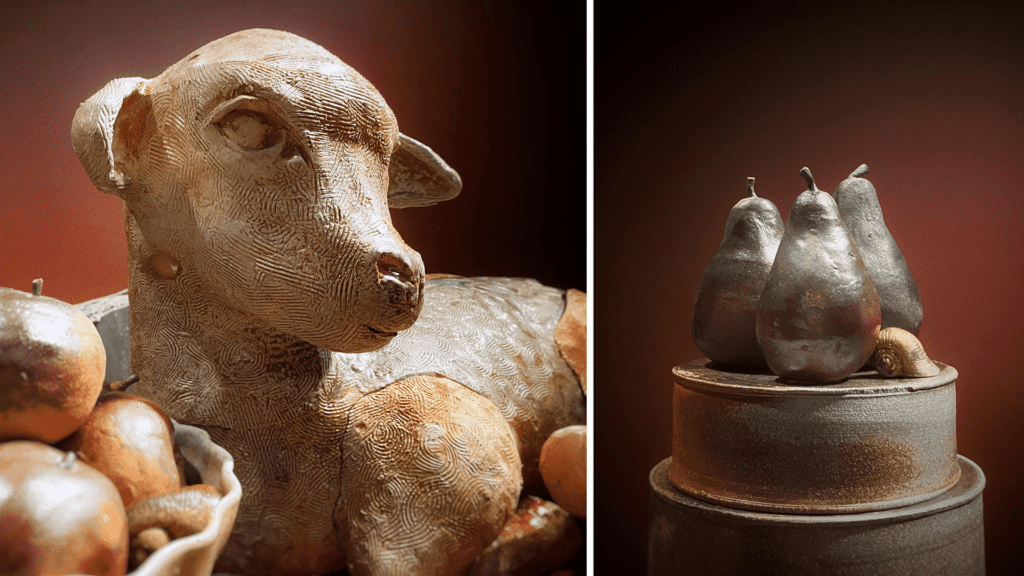
Still Life with Fruit also relates to the current exhibition Outside In: Nature-inspired Design at Winterthur not only through some of its forms—various fruits, a snail on the edge of a pie, farm animals such as a chicken and lamb—but also through the idea of transformations, the process of changing clay to rock and glass with heat. Still Life is the first large work that Ossandon has made entirely by wood firing in the kiln, a laborious, time-consuming effort that results in unique colors and surface textures. The lamb is the largest piece she has wood fired to date. “I’m very excited to see that all come together,” Ossandon says.
The particular inspirations for Still Life with Fruit may be recent, but for Ossandon, inspiration from Winterthur is nothing new. As a high school student in southern New Jersey, she visited Winterthur on a field trip in the mid-1990s to see the newly acquired Campbell Collection of Soup Tureens, which includes outstanding examples of ceramic craft.
“I always remembered going there, but I never remembered where it was,” she says. “So fast forward 20 years or something, I went to graduate school at the University of Delaware, then I became aware of Winterthur, and I realized, that’s the place!”
“I really feel like the fellowship has influenced the work I’ve made ever since, but it was influencing me all along because of that trip I had back in the day. It’s has been a really special place for me. Winterthur doesn’t end. And that’s how I feel about ceramics in general.”
Ossandon’s work, as well as the work of the other Transformations artists, is currently on view in the Galleries area.
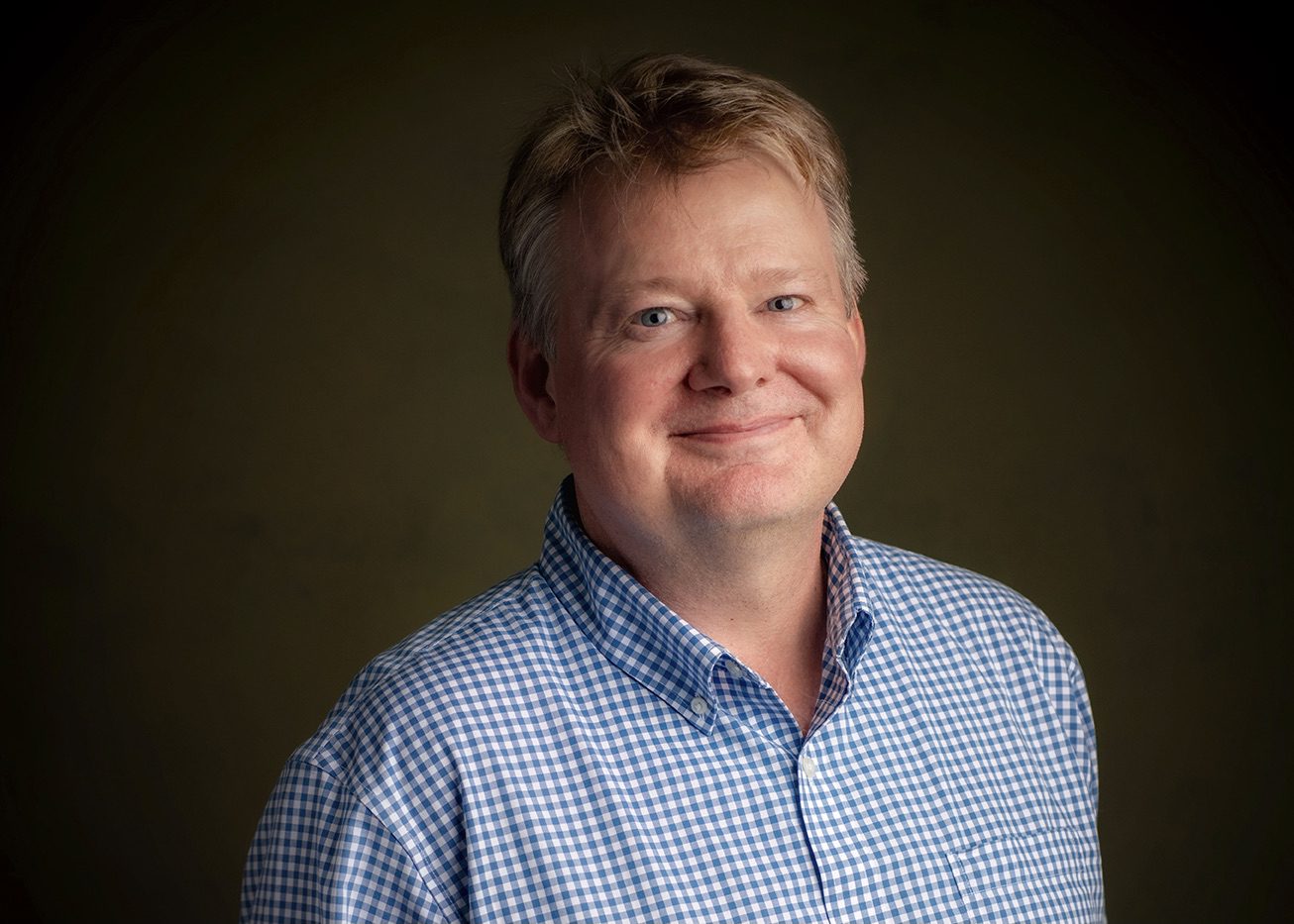
Winterthur, DE, October 12, 2021—Chris Strand, the longtime director of garden and estate at Winterthur Museum, Garden & Library, has been named its Charles F. Montgomery Director and CEO. Strand has served as interim director and CEO at Winterthur since May.
“Chris is so skilled in so many areas—fundraising, morale raising, communication,” said Kathy P. Booth, chair of the Winterthur Board of Trustees. “The Board is thrilled to have someone who knows Winterthur so well.”
As interim director, Strand was responsible for all aspects of museum, library, and garden operations, including management of Winterthur’s academic programs through the University of Delaware, fundraising, Board relations, long-range planning, budget oversight, and daily coordination of the senior management team in service of Winterthur’s mission. He continues that work in his new role.
Strand had served as Brown Harrington Director of Garden and Estate at Winterthur since May 2005, managing the care of Winterthur’s nearly 1,000 acres and its diverse resources through close work with its horticulture, natural lands, facilities, and security teams.
“I am pleased and honored to be stepping into this role at this moment in Winterthur’s history,” Strand said. “I have really enjoyed working with the Board of Trustees and the staff over the past several months. The Trustees, staff, and our Members are a community that is very dedicated to Winterthur’s success. What they want most is to share this wonderful place with our friends and neighbors and that is an exciting and energizing challenge.”
Strand has enjoyed a long career in horticulture outreach, education, and management. Prior to joining Winterthur, he worked as director of Green Spring Gardens in Fairfax County, Virginia, from January 1998 to May 2005, managing its continuing evolution from a private property to a public garden and historic site, and as outreach horticulturist at The Arnold Arboretum of Harvard University from July 1993 to January 1998. Strand earned a bachelor’s degree in Environmental, Population, and Organismic Biology from the University of Colorado in 1989 and a master’s degree in Public Horticulture Administration with a certificate in Museum Studies through the Longwood Graduate Program Fellowship of the University of Delaware in 1992.
“The Covid-19 pandemic, recent storm damage on the estate, shifting tastes, changes in school visits, and new technologies all present challenges and opportunities,” Strand noted. He credits the Winterthur staff for their creativity in meeting challenges and embracing new audiences while remaining good stewards of the property and collection. “I am very proud of them, and because of them, I am incredibly optimistic about our future,” Strand said.
ABOUT WINTERTHUR MUSEUM, GARDEN & LIBRARY
Winterthur is known worldwide for its preeminent collection of American decorative arts, naturalistic garden, and research library for the study of American art and material culture. It offers a variety of tours, exhibitions, programs, and activities throughout the year. Admission includes the Winterthur Garden, galleries, and a museum tour (by reservation).
Winterthur, located on Route 52, six miles northwest of Wilmington, Delaware, and five miles south of U.S. Route 1, is closed on Mondays (except during Yuletide), Thanksgiving, and Christmas Day. Museum hours are 10:00 am–5:00 pm, Tuesday–Sunday. $20 for adults; $18 for students and seniors; $6 for ages 2–11. Memberships are available, which include free and discounted admission. Winterthur is committed to accessible programming for all. For information, including special services, call 800.448.3883 or visit winterthur.org.
Visit winterthur.org for the latest information and safety guidelines.