Self-Paced House Tours are unavailable beginning November 9 as we prepare the house for Yuletide. Guided specialty tours remain available.
The Museum Store will be closed November 16–20 for Yuletide preparations. Explore Tours »
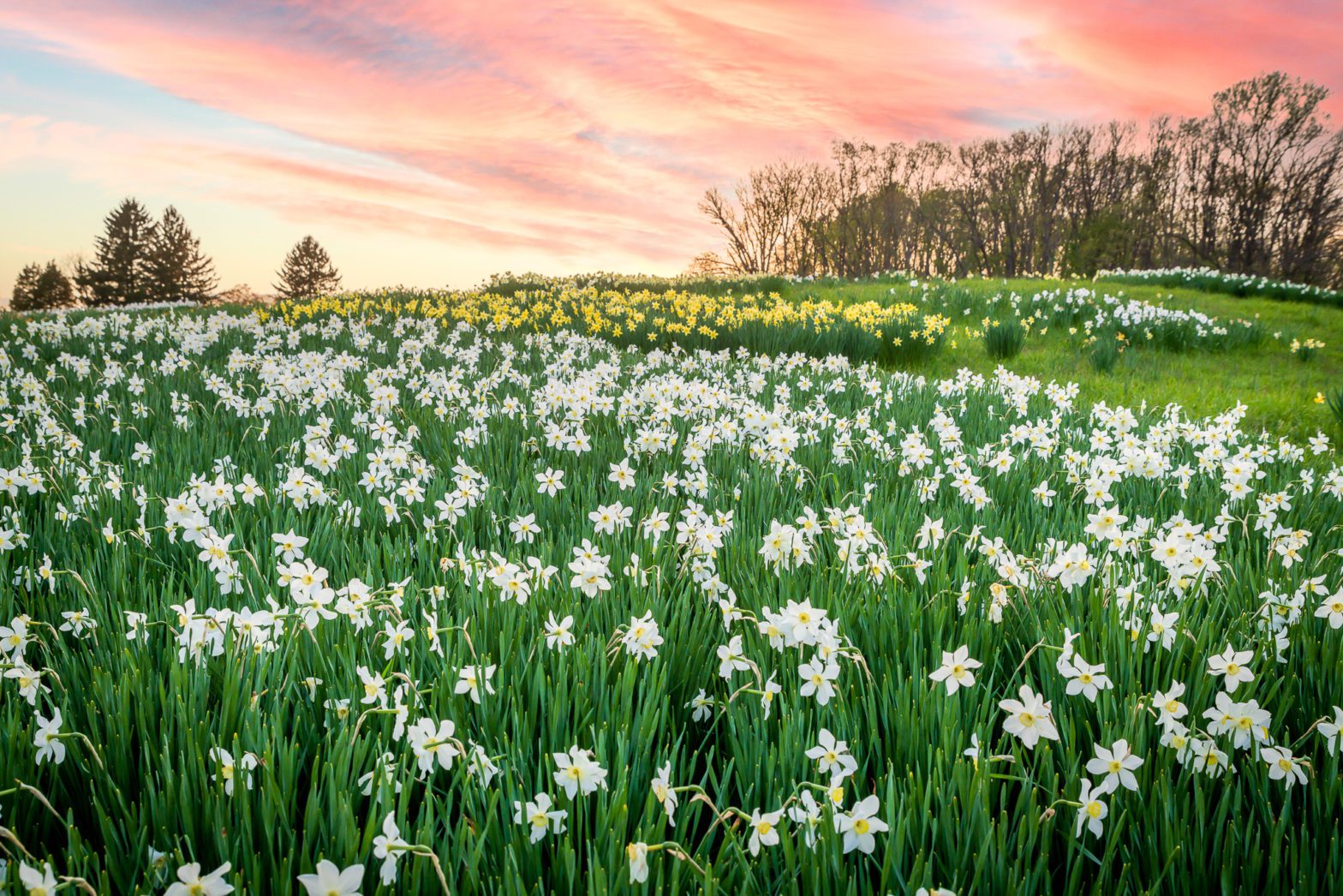
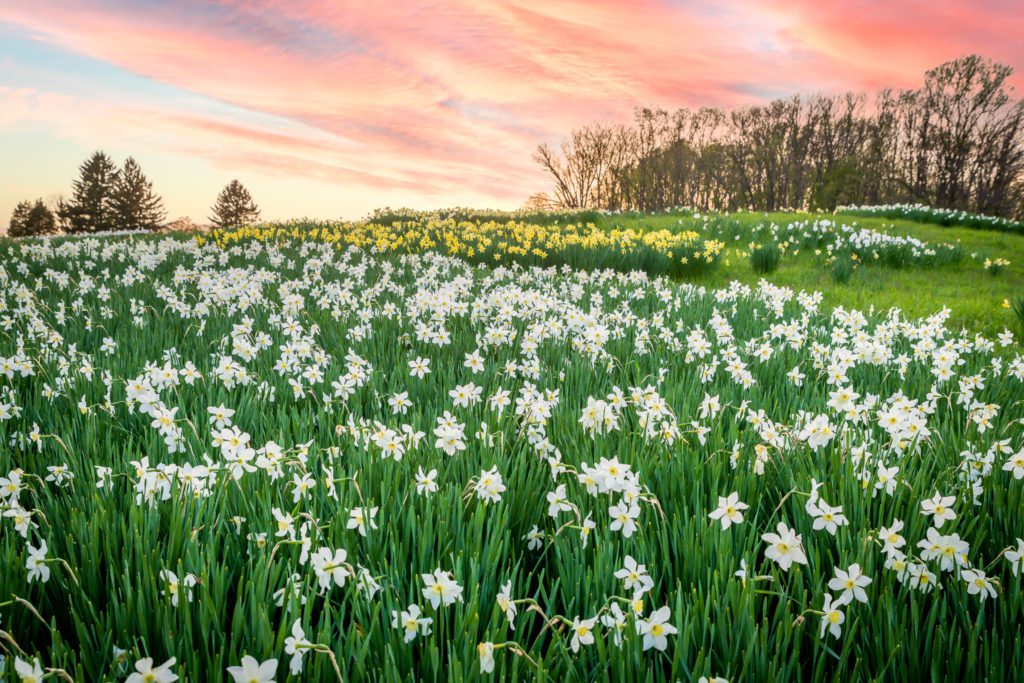
Since 1902, Narcissus have helped define the Winterthur Garden. Since March, they’ve been popping up like crazy.
Behold the daffodil.
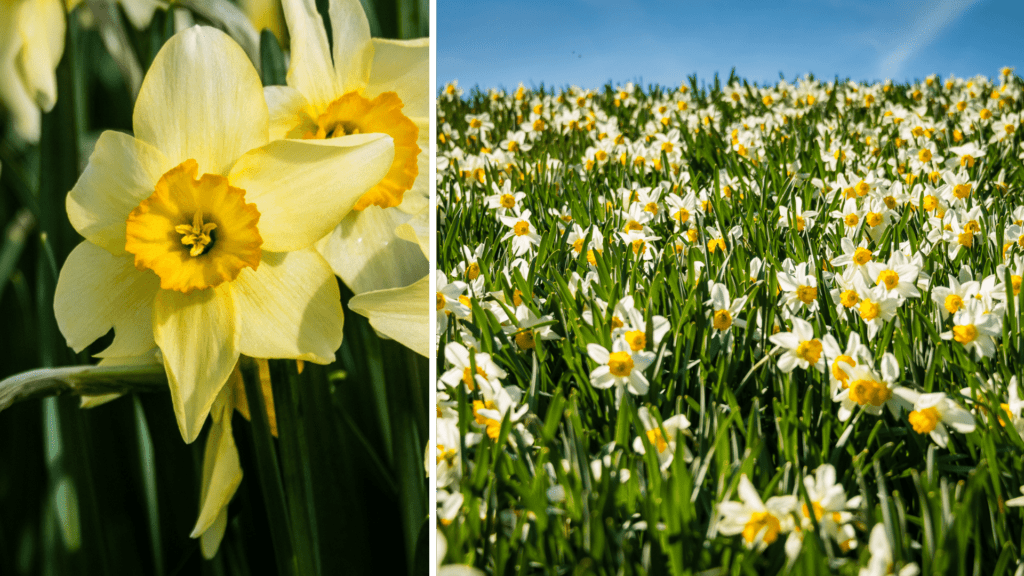
They appear so commonly in gardens that we almost take them for granted; yet, there are 13 divisions, from large cup, small cup, and split cup to Triandrus, Cyclamineus, and Poeticus, to other species, wild variants, and wild hybrids, each with its unique and sometimes maddeningly subtle variations. They fascinated Winterthur founder Henry Francis du Pont throughout his long life, and for good reason.
“This one has a yellow cup with separate white petals making a very star-shaped appearance. There are some where the petals are a little bit wider but they’re still separate. There are still others where the petals overlap. And several cultivars subtly change color when in flower, so you have to watch them over time,” says Linda Eirhart, Alice Cary Brown Director of Garden at Winterthur. “I could see where that attention to detail, looking at that and enjoying seeing the differences, might have fascinated him because it really is fun to look at these and try to figure out, are they the same? Are they different?”
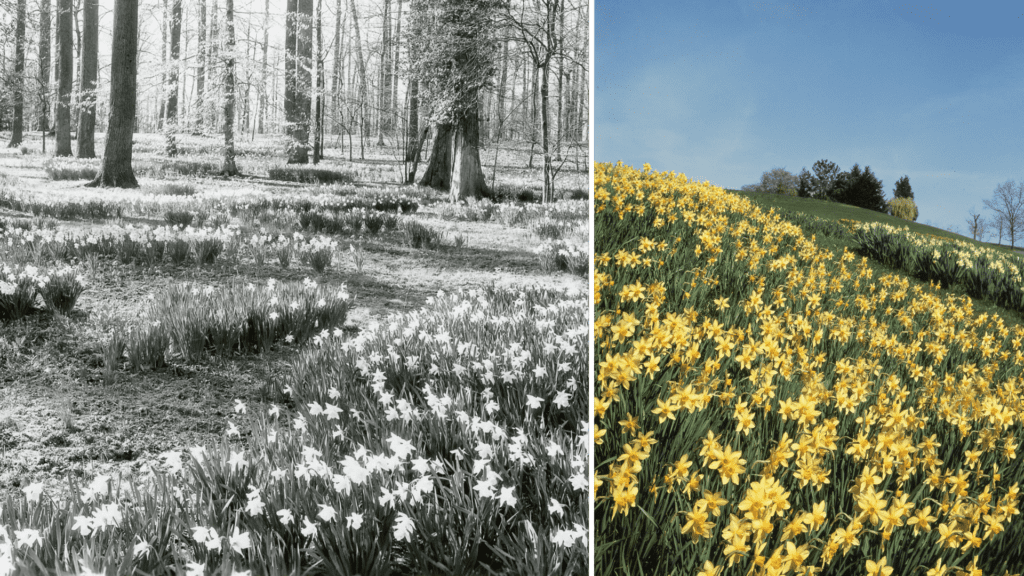
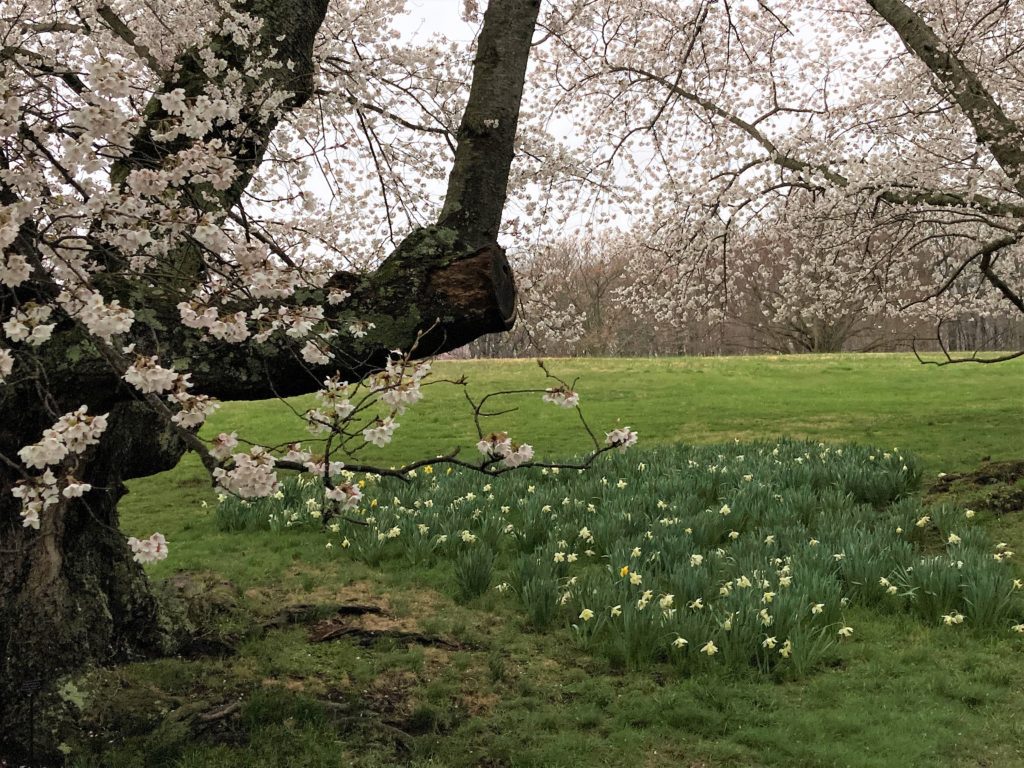
Daffodils so enthralled du Pont that he planted them in large drifts across his estate. Those big drifts still thrive in Browns Wood Meadow along what had been his golf course, at the edge of Azalea Woods, above the Quarry Garden, and on the March Bank, Sycamore Hill, Oak Hill, and along the entrance drive to the Visitor Center. In all, more than 500,000 bulbs blossom across Winterthur from late winter through April.
“The great pleasure in a bulb garden is in its permanency,” du Pont wrote in an article from 1915 about naturalizing Narcissi. In the article he notes that he laid out his first daffodil garden in 1902 on the lawn above what is now the museum. “Of the many gardens one can have, there is none which, once planned and planted, gives more satisfactory results with as little upkeep as that in which narcissi predominate,” he said. He so loved his daffodils that he revised the article in 1937 for The American Daffodil Year Book and again in 1961, when it appeared in the The Daffodil and Tulip Year Book1961.
Many of the daffodils that blossom at Winterthur are historic cultivars from the late 1800s and early 1900s. For the past few years, Eirhart has been working to identify and document them, examining the petals, shapes, sizes, color, and even that subtle color change over the life of the blossom.
The distinctions can be so minute, du Pont did not mention certain cultivars in his articles because identifying them was so difficult. “Everybody has different likes in their flowers,” Eirhart says. “I’ve grown to love these older historic cultivars and the subtle differences between them.” Eirhart notes that they’ve become one of her favorite flowers and they herald a special time of year in the garden.
“When the daffodils are in flower, the cherries, the early azaleas, the magnolias, and the quince will also all be in bloom, so I automatically associate daffodils with all the wonderful trees and shrubs that are in flower too. It’s a beautiful time at Winterthur.”
Winterthur is one of the few places in the country where you can see so many daffodils. Find out for yourself while the daffodils are in bloom through April and join us for Daffodil Day on April 11!
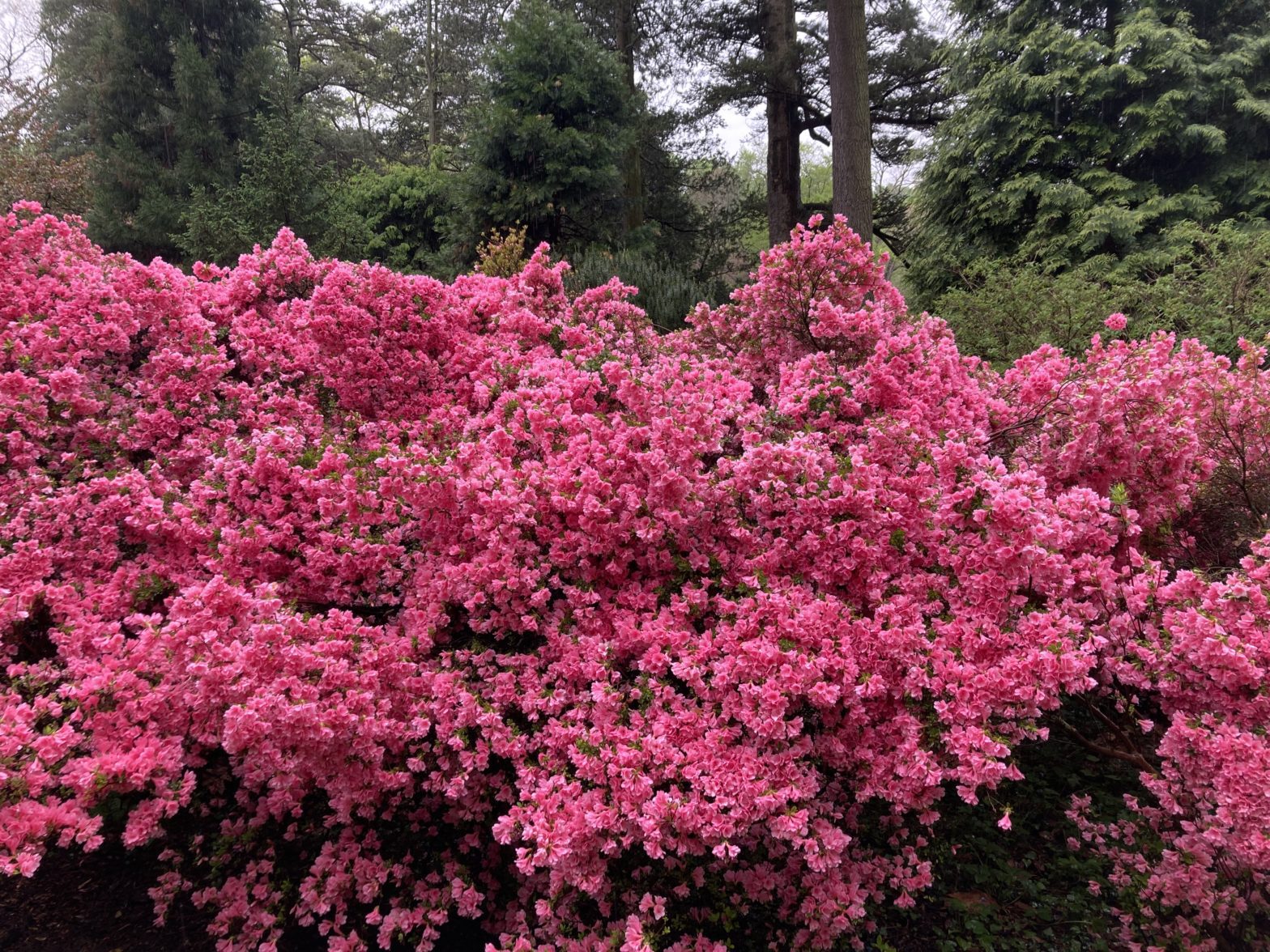
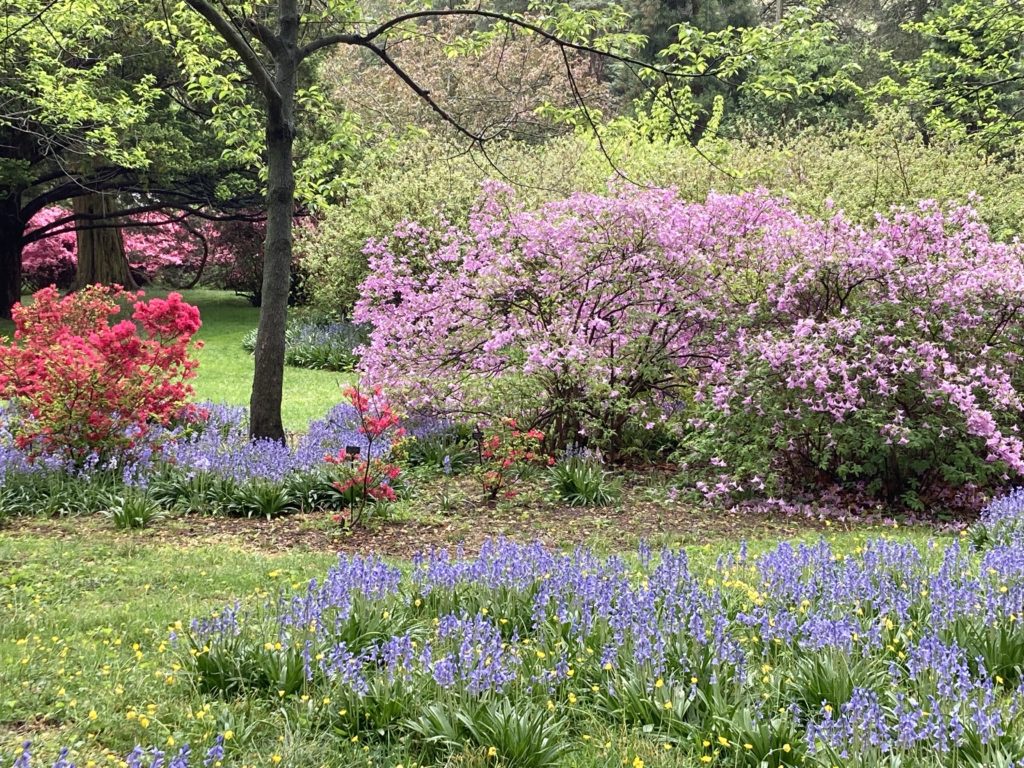
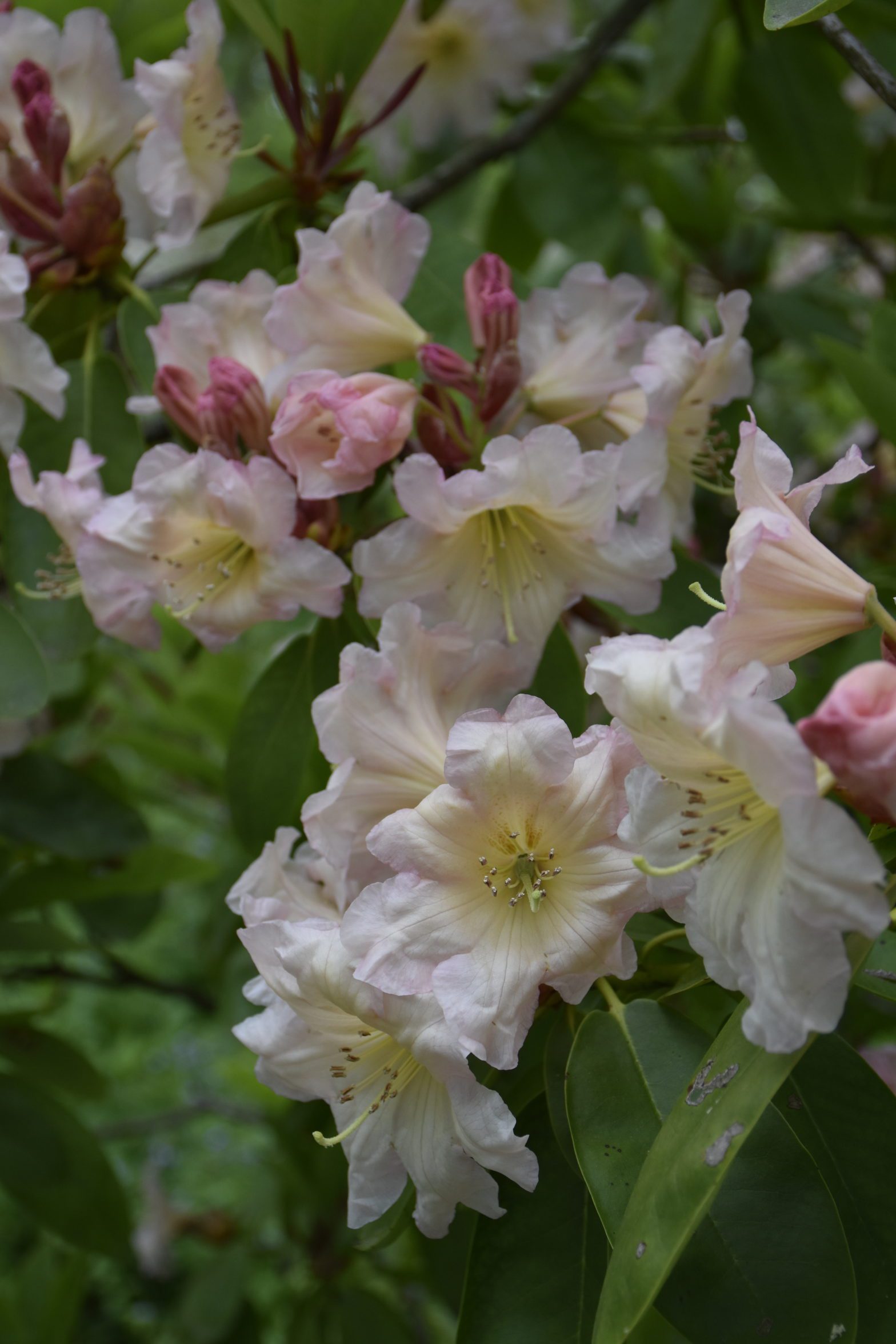
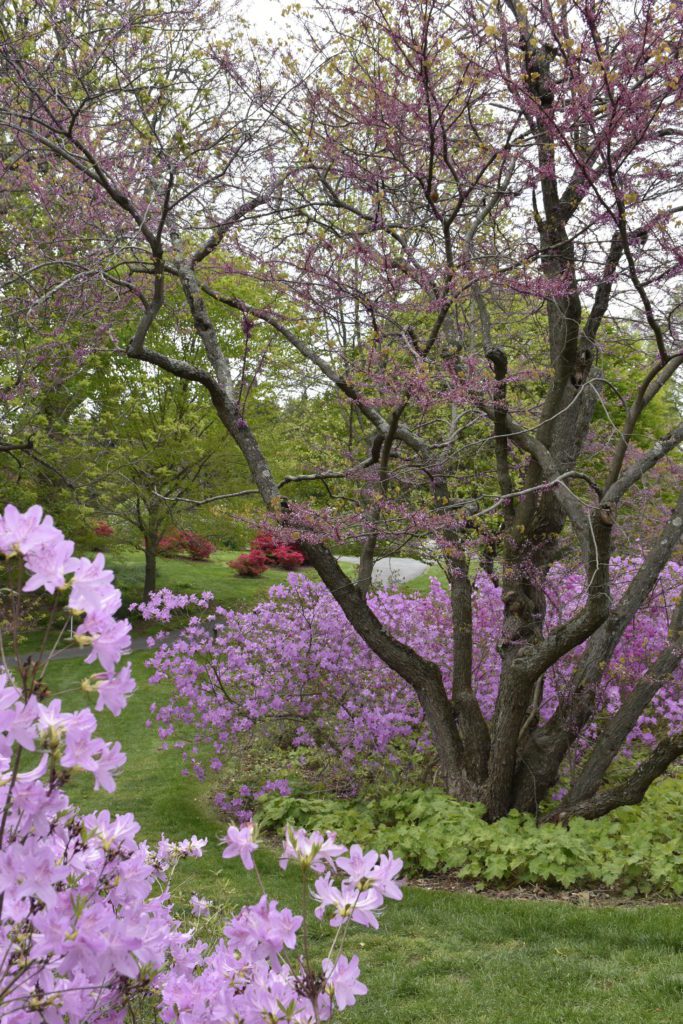
Azaleas and Bluebells are dazzling in Azalea Woods, Upper Peony Garden and sprinkled throughout the Garden.
Check these out:
Dove Tree: Check the corner created by the back of the glass Soup Tureen corridor & the Library to see the fluttering white bracts of the rare Dove Tree, or Handkerchief Tree (Davidia involucrata var. vilmoriana) in bloom.
Primroses: The Quarry Garden is filled with a tapestry of red, pink, and white primroses (Primula species).
Mayapples: The ‘umbrella’ leaves of mayapples (Podophyllum peltatum) appear throughout the gardens and estate. They are listed only here as they are ubiquitous. Look for plants with a ‘double umbrella’ to find the white flowers hidden beneath.
Dogwoods and Doublefiles: White or pink dogwoods (Cornus florida species & varieties) are in bud or in bloom throughout the Estate including the edge of Brown’s Woods. They are mentioned only here. The bright white of doublefile veburnums (Viburnum plicatum forma tomentosum) continue the show of white as listed below and throughout the Estate.
Spring Beauties: The native spring beauties (Claytonia virginica) form a white carpet in the back meadow between Clenny Run and Clenny Run road, on the lawn sloping down to the Museum, along the walkway to Icewell Terrace, and on parts of Oak Hill. Their small, star-shaped white to pale pink flowers can be found throughout the Estate.
Violets: Blue, blue & white, & yellow violets (Viola species) are blooming throughout the gardens and fields. They are mentioned only here.
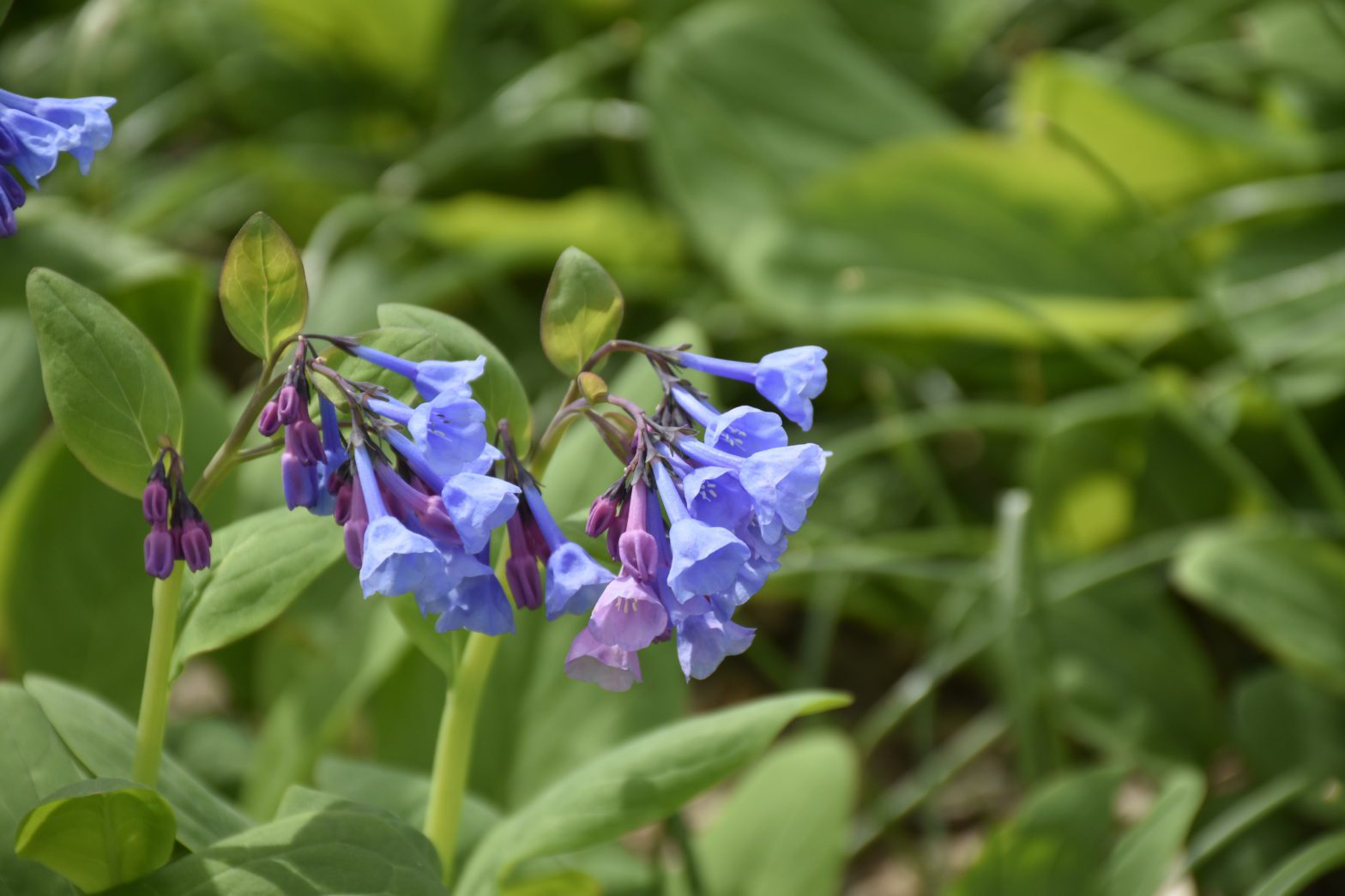
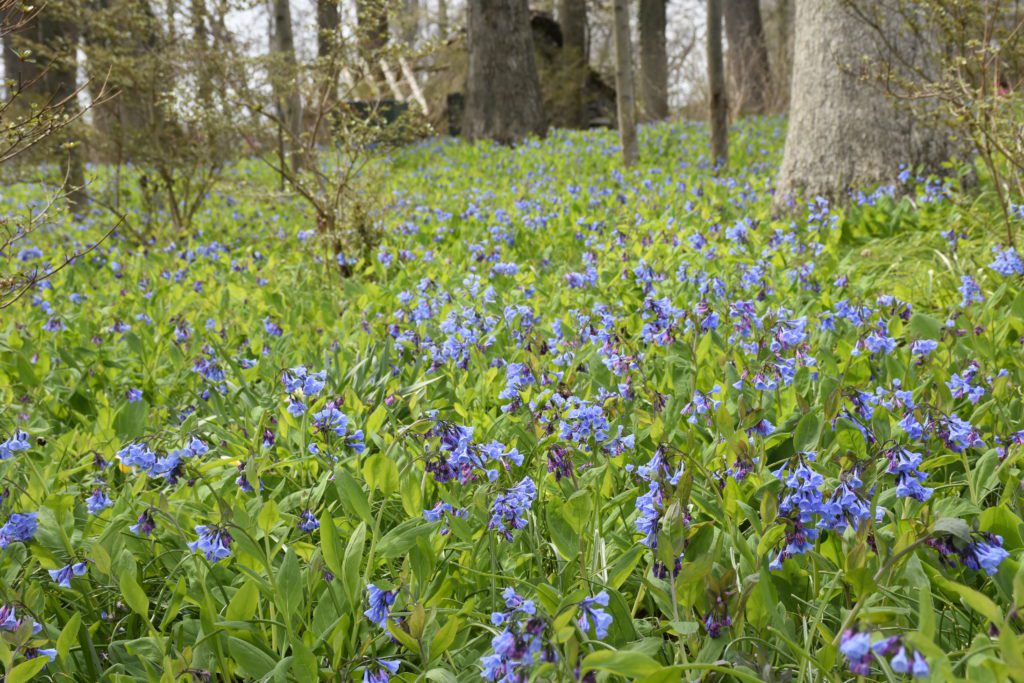
Virginia Bluebells (Mertensia virginica) surrounding Enchanted Woods
Check these out:
Trilliums: Vast expanses of great white trillium (Trillium grandiflorum) can be seen in parts of Azalea Woods, and individuals and colonies of them along with yellow trillium (Trillium luteum) and the dark red toadshade and wake-robin (Trillium sessile & Trillium erectum) can be found throughout the gardens.
Magnificent Entry:The Wilson pearlbush (Exochorda giraldii x wilsonii) is creating a lovely white frame for the Latimeria Gate entrance to the Pinetum.
Sundial Garden and Quince Walk: A flurry of flowers with the flowering quince (Chaenomeles cultivars) showing off in blazing red-orange, orange, red and cooler pale orange & white with a supporting cast of white spiraea (Spiraea x arguta & Spiraea prunifolium cultivars) and a carpet of pale blue starflower (Ipheion uniflorum).
An Ocean of Blue: Virginia bluebells (Mertensia virginica) are blooming throughout the gardens with great waves of them in parts of Azalea Woods, in the area of the koi ponds, in Enchanted Woods, on Oak Hill and the Quarry. Italian windflowers (Anemone apennina) form a blue & white carpet extending throughout Azalea Woods, down the March Bank to the stream, & up the opposite bank into Icewell Terrace. They accent other parts of the garden.
Spring Beauties: The native spring beauties (Claytonia virginica) form a white carpet on the lawn sloping down to the Museum and on parts of Oak Hill. Their small, star-shaped white to pale pink flowers can be found throughout the Estate.
Violets: Blue, blue & white, & yellow violets (Viola species) are blooming throughout the gardens and fields. They are mentioned only here.
Bloom Report #17 April 27, 2022 55 F, Partly Cloudy
Azaleas are getting ready to steal the Garden show! Visit Winterthur May 7th for Azalea and Bluebell Day to get a front row seat to watch the beauty begin to unfold.
Check these out:
Trilliums: Vast expanses of great white trillium (Trillium grandiflorum) can be seen in parts of Azalea Woods, and individuals and colonies of them along with yellow trillium (Trillium luteum) and the dark red toadshade and wake-robin (Trillium sessile & Trillium erectum) can be found throughout the gardens.
Magnificent Entry: The Wilson pearlbush (Exochorda giraldii x wilsonii) is creating a lovely white frame for the Latimeria Gate entrance to the Pinetum.
Dogwoods: White or pink dogwoods (Cornus florida species & varieties) are in bud or in bloom throughout the Estate including the edge of Brown’s Woods. They are mentioned only here.
Spring Beauties: The native spring beauties (Claytonia virginica) form a white carpet on the lawn sloping down to the Museum, along the walkway to Icewell Terrace, and on parts of Oak Hill. Their small, star-shaped white to pale pink flowers can be found throughout the Estate.
Violets: Blue, blue & white, & yellow violets (Viola species) are blooming throughout the gardens and fields. They are mentioned only here.
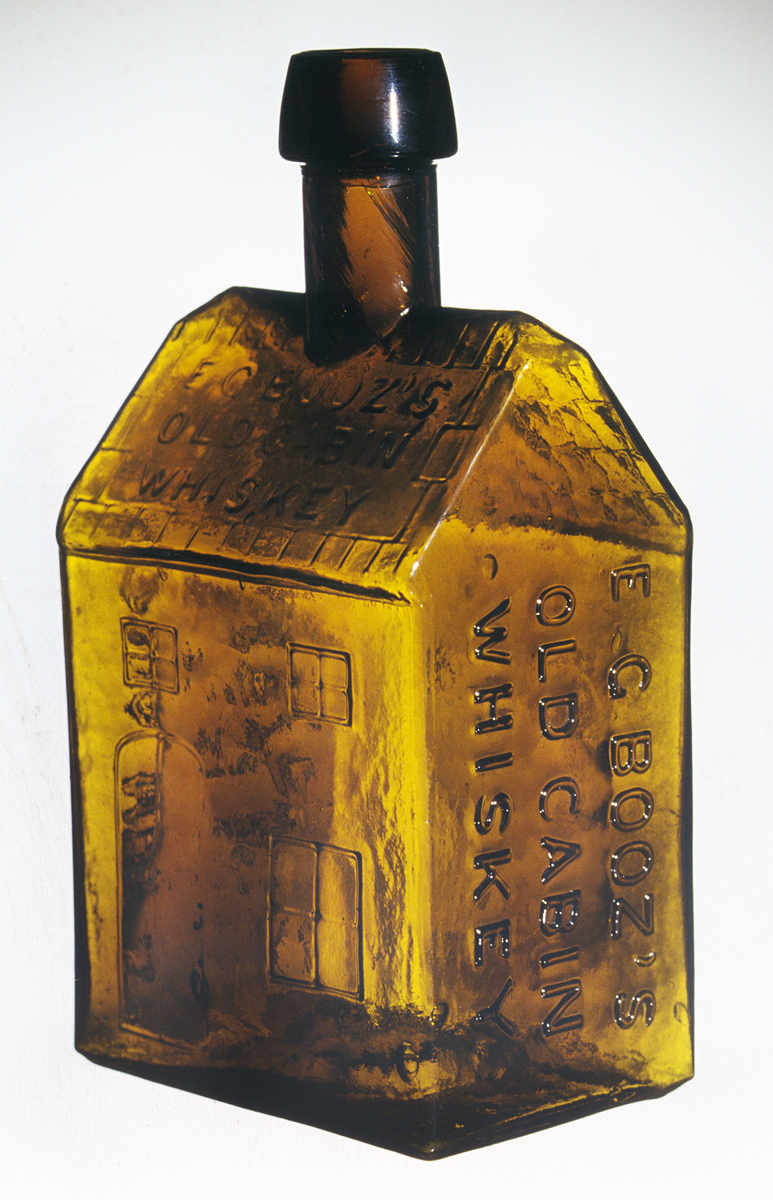
As the morning sun spills through the east-facing windows of the Hall of Statues, you might catch a glimpse of this object casting a warm amber light. This mold-blown, house-shaped flask, made between 1860 and 1870 by the Whitney Glass Works, holds a spot on my Winterthur favorite objects list because it was made in my hometown of Glassboro, New Jersey. Made to house E. G. Booz’s Old Cabin Whiskey, the flask, to me, does not necessarily look like a cabin but instead a house that is remarkably similar to the small two-story glassworker houses that I can remember seeing in my youth. Those houses have mostly disappeared due to redevelopment. Here’s a fun fact. There is a tradition that these flasks helped popularize the word “booze” despite etymological evidence that the term has been in use since the 14th century, with the spelling we know today emerging in the 17th century.
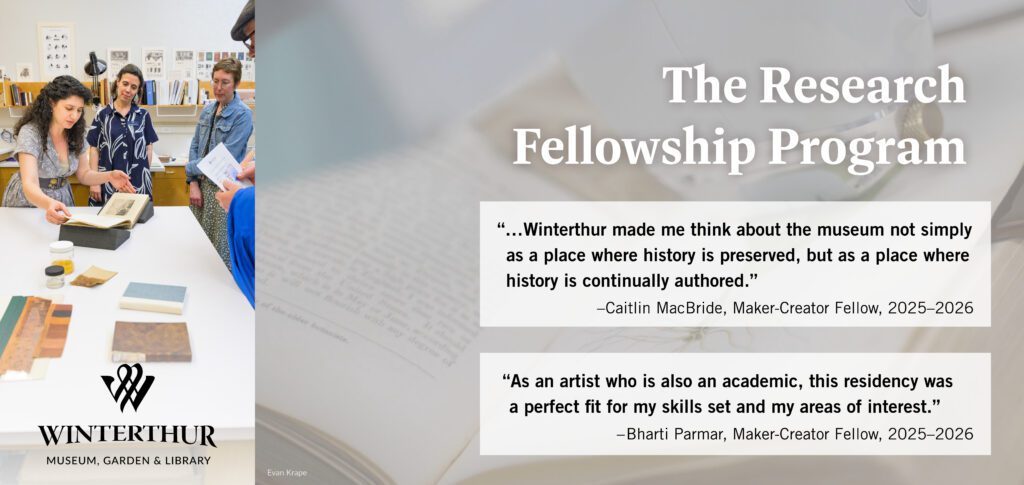
Winterthur supports object-based research through a variety of short- and long-term fellowships that include opportunities for visiting researchers who are self-funded.
Ph.D. or terminal degree holders regardless of nationality (Ph.D. must be completed before the fellowship begins; may still be a candidate when applying)
Winterthur Research Fellowship staff are available to talk with you about potential projects and your application. Please contact Academic Programs staff with any questions.
Fellowship Terms
Required:
Present one Research Fellowship Program lunchtime talk/lecture about your research at Winterthur (length: 20–25 minutes). We prefer that you present during your residency; if that is not possible, we will work to schedule this afterward.
Attend weekly Research Fellowship Program lunchtime talks and take part in discussion, contributing to the collegial atmosphere of our scholarly community.
Share one post about your research on your own social media and tag #researchatwinterthur and @winterthurmuse. Please make this shareable so we can repost it.
Optional:
If you would like to present a public program or engage Winterthur’s visitors, please share your idea with Academic Programs staff before your fellowship begins. Our public programs are scheduled nine to twelve months in advance.
Conditions:
Fellows cannot accept teaching assignments or undertake any other major work or research activities during their fellowship tenure.
Fellows are expected to be on site at least four days a week. Short-term, Postdoctoral, Dissertation, and Maker-Creator fellows may complete part of the fellowship remotely, for the equivalent time. We cannot support fully remote fellowships, but we will work with you on a flexible schedule as needed.
Fellows may use sabbaticals and grants from your own institutions during your fellowship tenure so long as they do not prevent you from meeting Winterthur’s fellowship requirements.
Long-Term Fellowships
National Endowment for the Humanities (NEH) Postdoctoral Fellowship Stipend: $5,000 per month. Fellowship must be completed by February 28, 2028.
This fellowship supports residence at Winterthur Museum, Garden & Library for a duration of four months as a junior or senior scholar whose project holds the potential for wider impact upon the humanities rooted in research using Winterthur’s collections.
NEH fellowships are for scholars who have already completed their formal professional training. Degree candidates and individuals seeking support for work in pursuit of a degree are not eligible. Candidates for advanced degrees must have completed all requirements, except for the actual conferral of the degree, by January 15, 2027. This includes the dissertation defense. Foreign nationals who have been residents in the United States for at least three years immediately preceding the application deadline for the fellowship are eligible.
NEH Fellows are significant contributors to Winterthur’s intellectual community and are expected to be in regular and continuous residence at Winterthur for the entirety of their fellowship. They must devote full time to their study and may not accept teaching assignments or undertake any other major activities during the tenure of their award. Fellows may hold other major fellowships or grants during fellowship tenure, in addition to sabbaticals and supplemental grants from their own institutions. Recipients may not hold any other NEH-funded grants concurrent to the NEH Postdoctoral Fellowship; holding an additional NEH-funded grant before or after the fellowship is permitted.
Winterthur Postdoctoral Fellowship Stipend: $4,500 per month.
This fellowship is a four-month fellowship for advanced research or for revising research for publication and is open to all applicants regardless of nationality. You may apply if you will have completed your Ph.D. before September 1, 2027. You may still be a Ph.D. candidate when you apply (applications are due January 15, 2027). If you are unsure whether your degree timing qualifies, please contact us.
“As a China scholar, I have never thought I would conduct research at Winterthur, which I assumed to be primarily for American history and material culture. From my experience, however, I have learned about their surprising global connections.”
Yuan Yi, Postdoctoral Fellow, 2025–2026
Dissertation Fellowships
Stipend: $2,500 per month.
These fellowships support doctoral candidates who are researching or writing their dissertations; they last four to eight months. If you are completing your Ph.D. independently, without enrollment at a university, you are not eligible for a dissertation fellowship, but you may apply for a short-term fellowship. If you are unsure which fellowship is appropriate, please contact us.
Short-Term Fellowships
Stipend: $3,000 per month.
Open to independent or institutional researchers and scholars of all levels, including graduate students completing Ph.D. and M.A. degrees. Applicants may apply for fellowship periods ranging from four to six weeks. Hybrid completion of this fellowship is possible.
You do not need to apply for a particular named fellowship (e.g., Faith Andrews, William Seale, ESA). We consider every short-term application for the following awards:
Faith Andrews Fellowships for the study of Shaker life and material culture
William Seale Fellowship for research related to architectural, landscape and gardens, and White House/Presidential history.
Ephemera Society of America—Winterthur Fellowship
The American Trust for the British Library (ATBL) Research Fellowship
Ephemera Society of America—Winterthur Fellowship This fellowship is jointly sponsored by the Ephemera Society of America (ESA) and Winterthur Museum, Garden & Library. Open to graduate and undergraduate students, the fellowship supports a visiting researcher at Winterthur for up to four weeks. We welcome projects that reflect a scholarly interest in ephemera and make use of Winterthur’s extensive ephemera holdings, including trade cards, greeting cards and postcards, cigar box labels, die-cuts, scrap, and thousands of other library and museum collections.
To be considered, mention the fellowship in your application essay. This does not affect your consideration for other Winterthur fellowships.
Additional expectation: In addition to the Winterthur Fellowship requirements, the recipient will propose a talk for the next ESA conference following their fellowship and/or submit an article for publication in the Ephemera Society of America Journal.
Conservation Research Fellowship
Open to independent or institutional conservators or conservation scientists interested in pursuing projects that advance their research interest and professional development goals. Any topic is welcome, provided our facilities and resources can support the chosen project.
Before you apply, we encourage you to contact Conservation Department staff to discuss whether your project suits their expertise and lab resources. In your application, please name your area of interest and the staff member(s) you contacted.
Conservation Residency
Funding for the stipend of $3,000 per month plus all travel and lodging is generously supported by alumni of the Winterthur/University of Delaware Program in Art Conservation.
Open to conservation professionals with an established project in alignment with a departmental priority detailed below, the program supports visiting experts for up to four weeks, hosted at Winterthur by a member of the Conservation Department. These residencies are designed to foster meaningful exchange, bring fresh perspectives and specialized expertise that can accelerate research, advance strategic projects, and enrich student learning—while also offering Winterthur staff the rare opportunity to pause, reflect, and reinvest their energy in the work they do best.
For the 2027–2028 term, we welcome projects that support expertise in the following areas:
upholstery conservation
stain reduction of ceramics
quantitative analysis of historical glass
mechanics and structural treatments of paintings
20th-century synthetic textiles
dye analysis
instrumental analysis of leather tanning processes
microscopy of plant materials
conservation of photo albums and scrapbooks
Visiting experts will have access to Winterthur’s full conservation facilities, analytical equipment at both the museum and the University of Delaware, and Winterthur’s museum, garden and library collections. In addition to the Winterthur Fellowship requirements, the Conservation Residency recipient will be expected to engage in sharing with faculty, staff, and students in their identified area of expertise.
To apply, contact us by December and identify a Conservation Department host to sponsor your application. Identify your host in your formal application.
The American Trust for the British Library (ATBL) Research Fellowship
Winterthur is a partner institution with the ATBL.
This ATBL offers a $2,500 stipend that supports research using collections in any department in the British Library.
We are excited to announce René Lommez Gomes, Ph.D., Associate Professor of Museum Studies, Art History and Cultural Heritage, Universidade Federal de Minas Gerais in Brazil, as the recipient of this year’s Jenny and Pierre du Pont ATBL-Winterthur Short-Term Research Fellowship.
How it works: ATBL partners with American collections-based institutions that currently offer established, competitive short-term research fellowships or stipends. Winterthur short-term applicants can elect to be considered for an ATBL fellowship if they receive a Winterthur fellowship (please select this option in the application portal; the Winterthur award is $3,000). ATBL will notify recipients directly on or before May 1, 2027, for next steps in their application process.
Questions? Email fellowships@atbl.usand check the organization’s website for information about this year’s competitive cycle.
“My lunchtime talk gave me the opportunity to pose very specific questions to a very knowledgeable audience… hearing from a group of experts has made me feel more confident about my own understanding and interpretations.”
Cambra Sklarz, Ph.D. Candidate, University of California, Riverside, 2023-2024 Short-Term Research Fellow
Maker-Creator Fellowship
Stipend: $3,000 per month.
HOW WILL WINTERTHUR INSPIRE YOU?
Our four-to-six-week research fellowships are designed for artistic and creative professionals to examine, study, and immerse themselves in Winterthur’s vast collections to inspire their practices. Past fellows have utilized the museum’s landscape, gardens, museum collections, and library for inspiration, precedent, instruction, and material for their creations. See our Current and Past Research Fellows page for a list of all Maker-Creator Fellowship recipients. The Winterthur Fellows’ Projects page has more information on the range of creative projects shaped by experiences at Winterthur.
This fellowship is designed to enhance artists’ practices through time with the institution’s collections. Winterthur has no dedicated studio space and there is no expectation that new work will be produced on site during the fellowship. Occasionally, modest on-site creation may be possible depending on the practice, and program staff are available to talk through your goals prior to applying.
Maker-Creator applicants are encouraged to contact Academic Programs staff with any questions about project feasibility or the application process and will review drafts of application narratives received before December 1.
Directions to apply can be found here. Maker-Creator Fellowship applicants will also need to submit work samples (images, video, or writing). See “Apply for Research Fellowships” for details.
“The duet of primary source research and object-driven house tours grounded my time and provided me with a solid, sturdy footing for the next step of translating research into artworks. Without Winterthur’s Maker-Creator Fellowship and all that it encompassed, I know my project might not be a reality.”
Brece Honeycutt, artist and 2023-2024 Maker-Creator Fellow
Affiliated Researchers
We reserve a limited number of spaces for Affiliated Researchers who can provide their own financial support to be in residence. We welcome affiliated researchers at any stage of their career or artistic practice. Affiliated Researchers receive the same benefits as funded fellows, with access adjusted to the scope and needs of the project.
There is no application form. An email of interest should be sent to Academic Programs staff with the following information:
details of your current project or research subject
dates of intended time in residence at Winterthur
a copy of your current résumé or curriculum vitae
and a letter of reference that addresses your project, record of accomplishment, and ability to work with a collegial group. If you are working closely with Winterthur staff as part of your project, the letter of reference should come from that staff member.
Requests are reviewed by staff on a rolling basis. Please allow at least two months for processing a status request before the intended start date of your research here.
The Research Fellowship Program has been made possible in part by a major grant from the National Endowment for the Humanities. Any views, findings, conclusions, or recommendations expressed here do not necessarily represent those of the National Endowment for the Humanities.
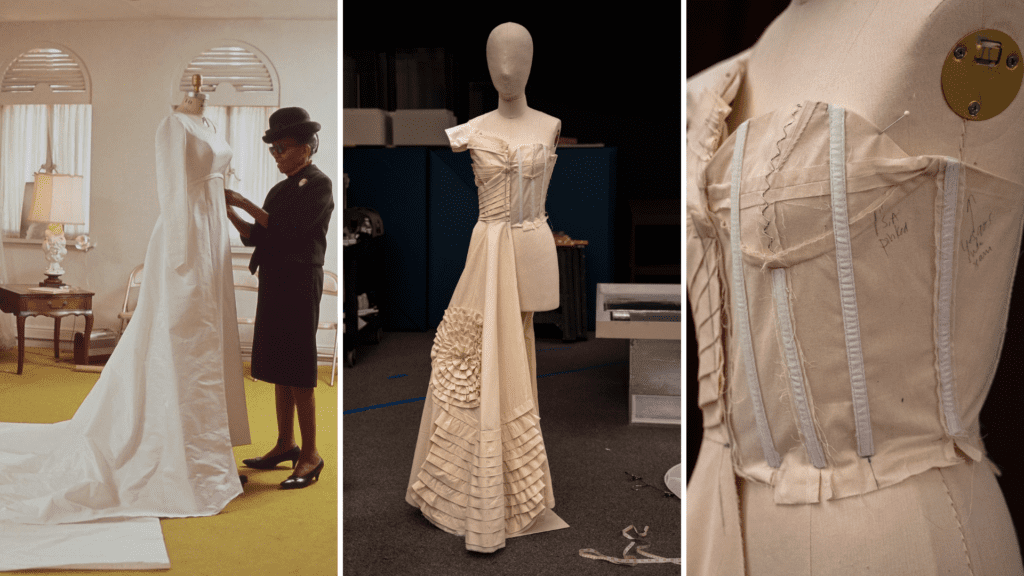
Image (left): Johnson Publishing Company Archive. Courtesy Ford Foundation, J. Paul Getty Trust, John D. and Catherine T. MacArthur Foundation, Andrew W. Mellon Foundation and Smithsonian Institution.
In 1953, American couturier Ann Lowe designed the wedding dress for future First Lady Jacqueline Bouvier’s marriage to John F. Kennedy, a dress that became one of the most recognizable and beloved wedding dresses in America. As a Black designer, Lowe didn’t receive proper credit for her work at the time.
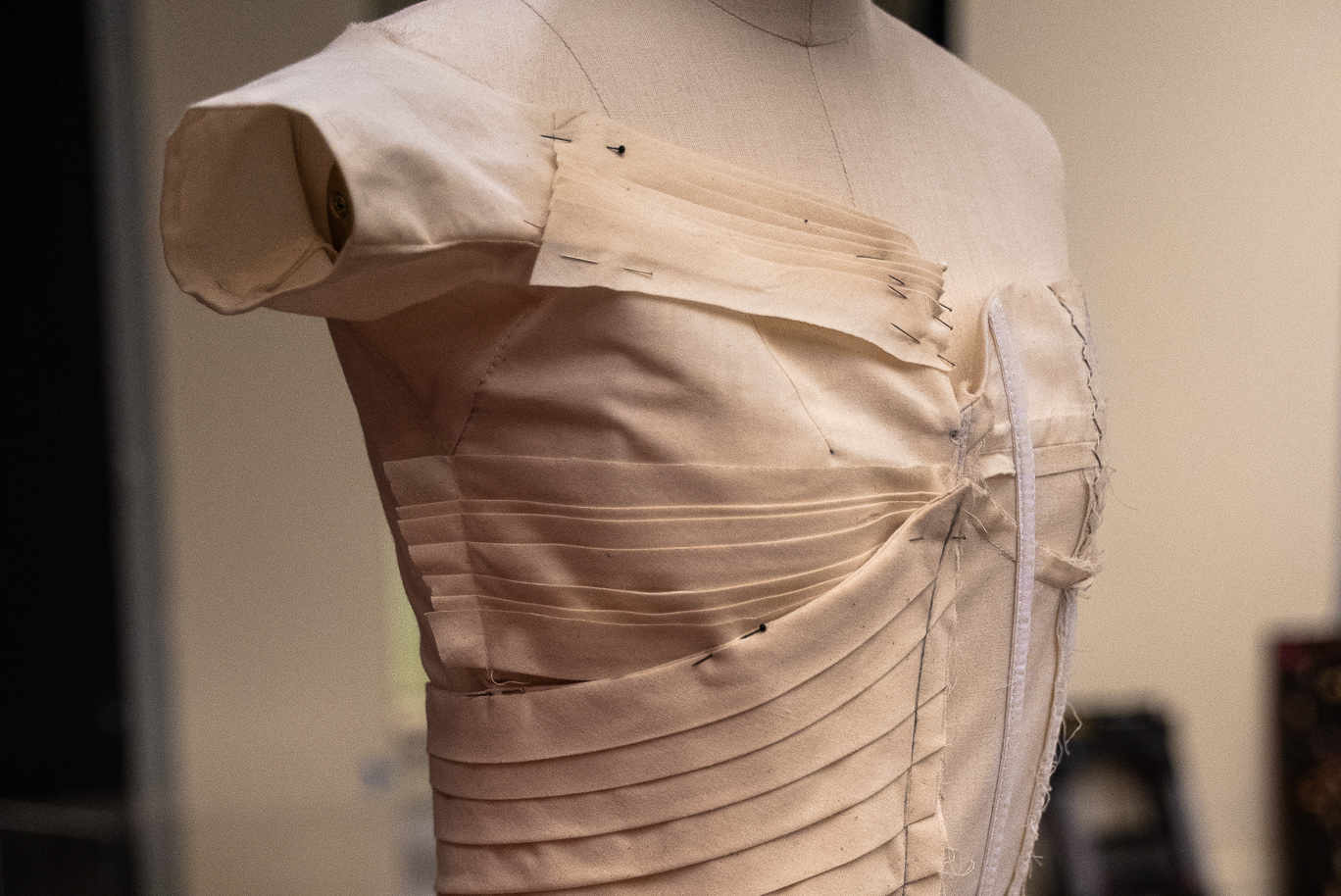
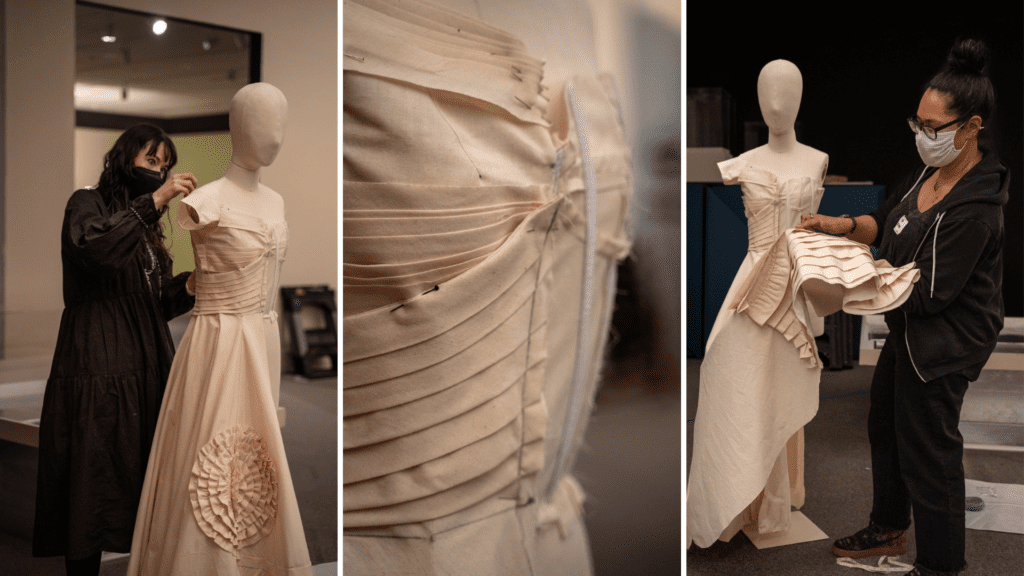
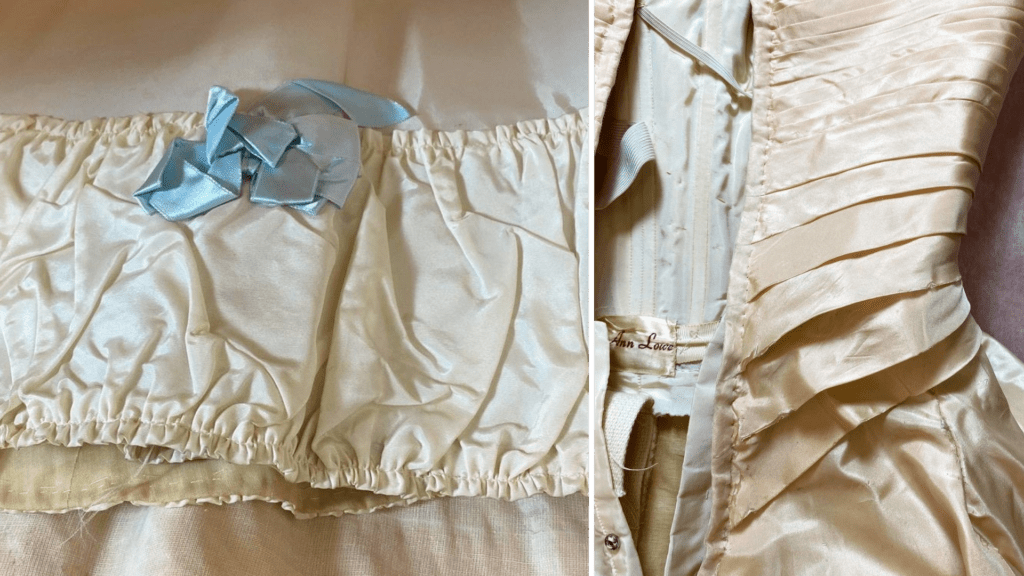
Textile conservator Kate Sahmel accompanied University of Delaware Fashion and Apparel Studies professor Katya Roelse for a recent visit to the John F. Kennedy Presidential Library and Museum in Boston to examine and document the construction of the original dress, which is too fragile to display on a form. Working with University students, Roelse will use the information gathered from this visit to create a reproduction of the dress for the Winterthur exhibition Ann Lowe: American Couturier, opening September 2023.
Katya Roelse (left) University of Delaware Instructor of Fashion and Apparel Studies, with the muslin prototype of the wedding gown she created, and Elizabeth Way (right) Associate Curator, The Museum of FIT, and guest curator of the 2023 exhibition, Ann Lowe: American Couturier, examining the muslin prototype.
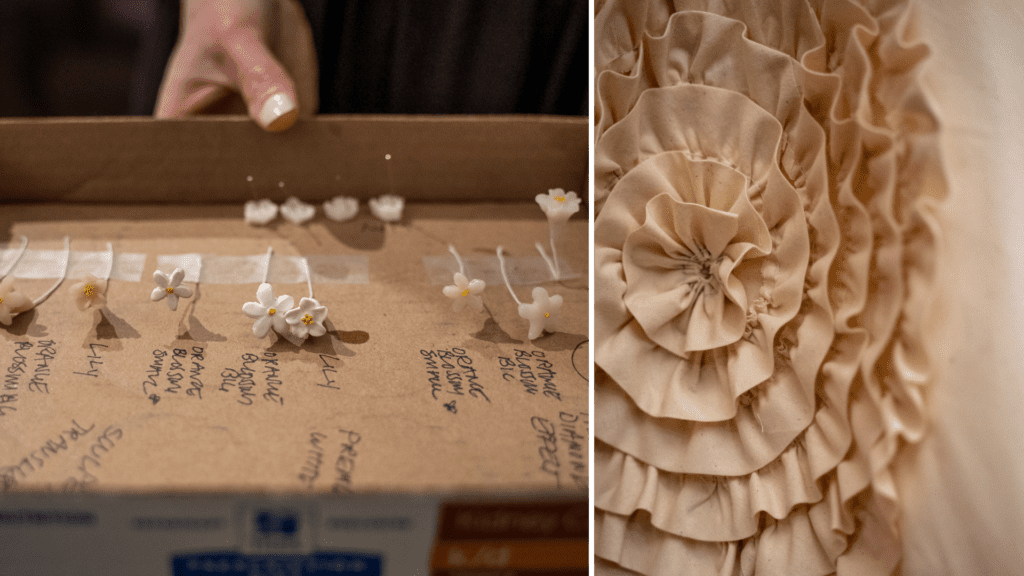
The dress features several details characteristic of Lowe’s work, such as the ornate rosettes that embellish the skirt, each with a small spray of wax flowers at the center. A blue ribbon hidden under the skirt at the hem was a delightful surprise and completed the dress with a hopeful charm for her new marriage.
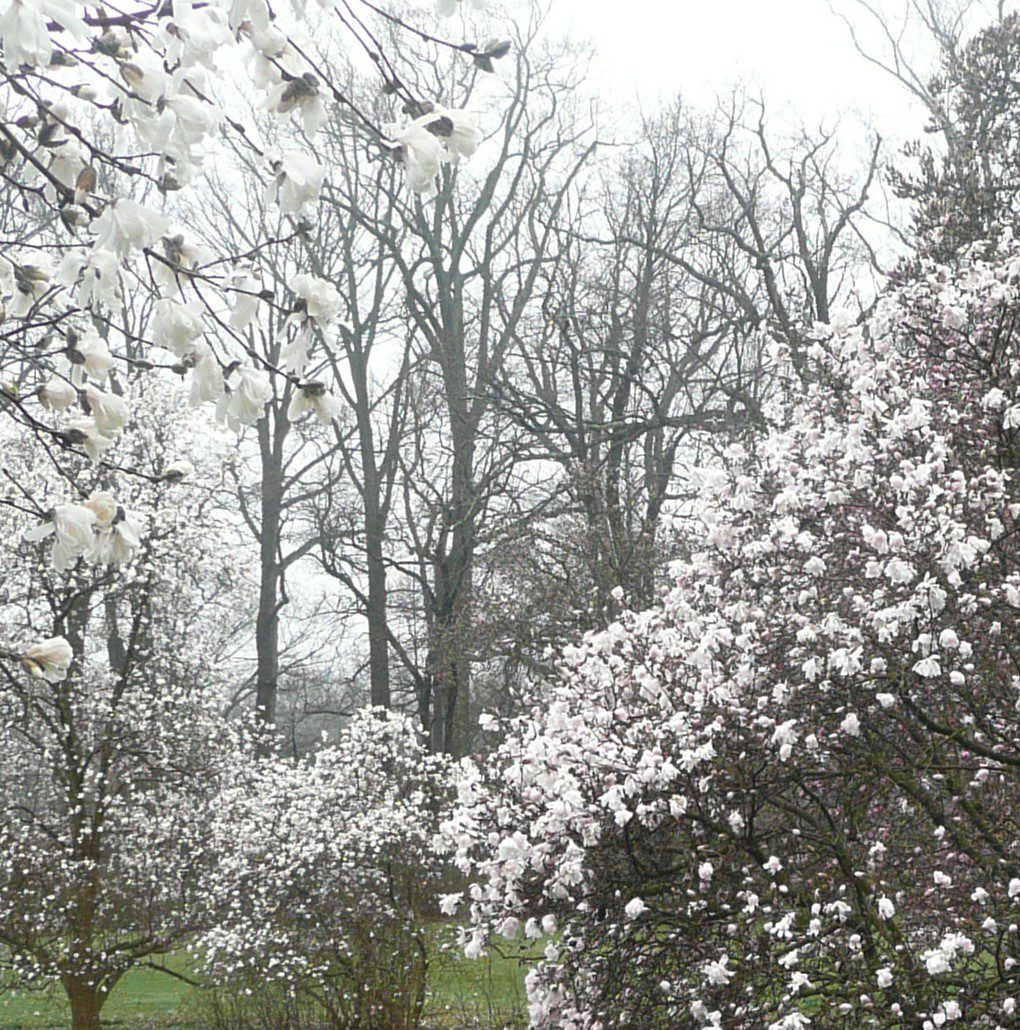
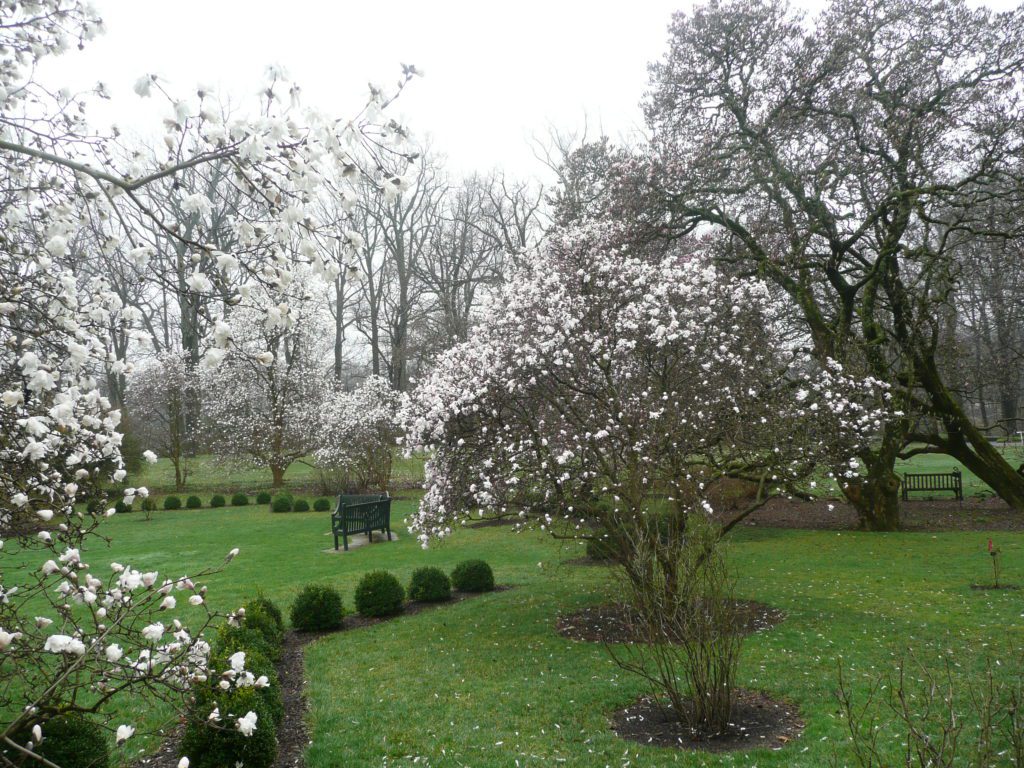
Magnolias in Pinetum. The sight and smell is intoxicating!
Check these out:
Blue carpet: A lavender-blue expanse of glory-of-the-snow (Chionodoxa forbesii) extendsthrough Azalea Woods, down the hill towards the Museum and down the March Bank, across the stream and up the hill through Icewell Terrace. In many places, he blue carpet includes royal blue Siberian squill (Scilla siberica).
Dazzling show: This week areas of the garden are aglow in the golden radiance of forsythias (Forsythia x intermedia, Forsythia ovata, Forsythia suspensa, Forsythia viridissima, Forsythia ‘Winterthur’). They start at the upper edge of the visitor parking lot, with masses along the drive behind the carriage houses, along the lower side of Chandler Farm Road below the Fire House, along the Museum lawn edge of the Peony Garden, along the field edge of Azalea Woods, along the Pinetum overlook wall, and on the Quarry edge of Sycamore Hill. The soft yellow glow of winter hazel (Corylopsis ‘Winterthur’, Corylopsis platypetala, Corylopsis spicata, Corylopsis pauciflora) starts with masses of blooms at the upper edge of the visitor parking lot and along the Winterhazel Walk, with accents in the woods from the Visitor Center to the Underpass, at the East Upper Terrace of the Museum, and along the Quarry walkway.
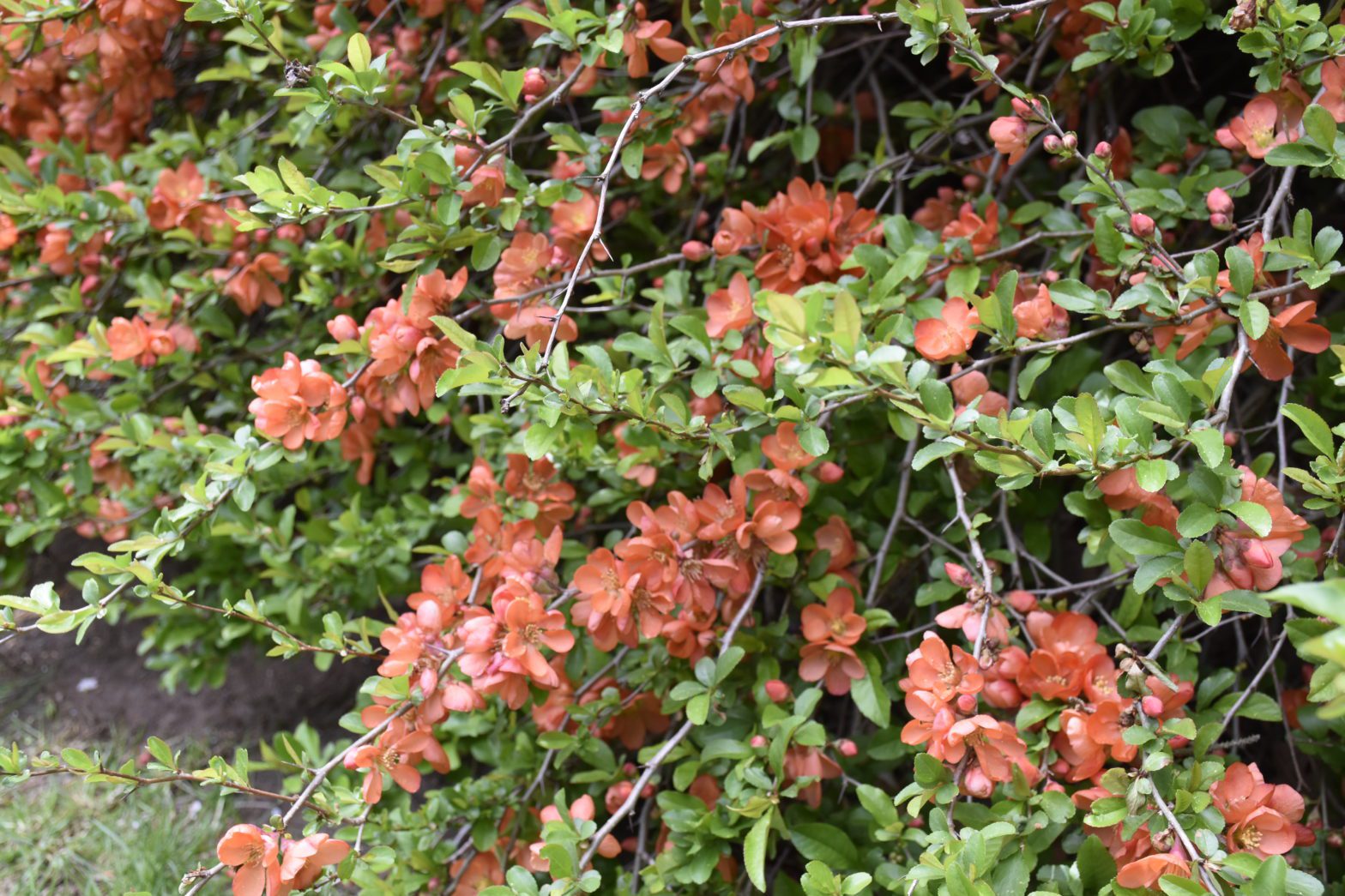
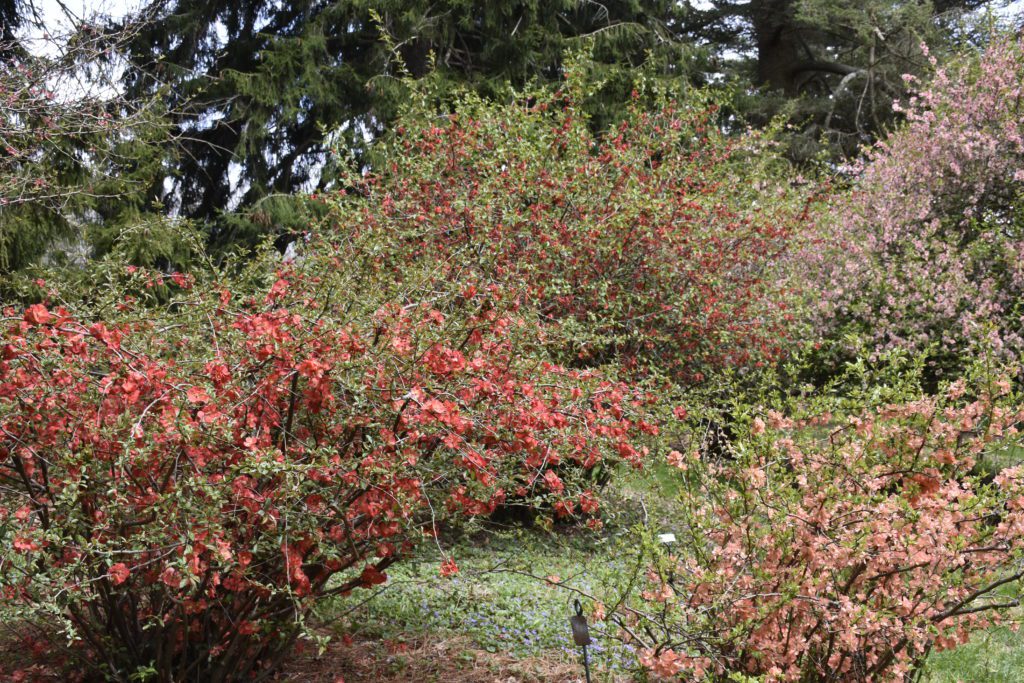
The Flowering Quince in the Pinetum. The wide variety of colors are stunning!
Check these out:
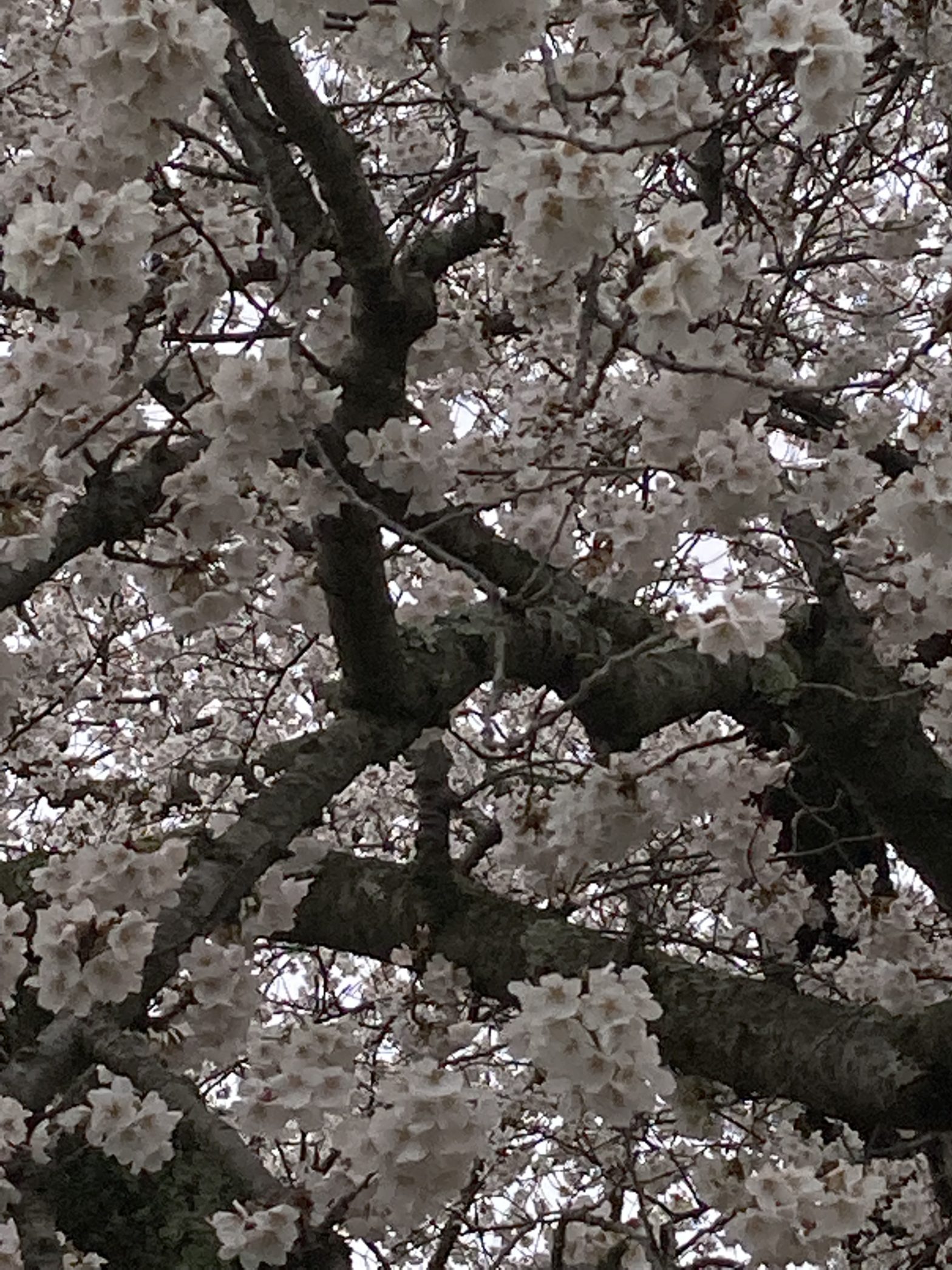
Cherries!: This week the cherry trees are at peak bloom. The white expanse of Yoshino weeping cherry (Prunus yedoensis ‘Shidari Yoshino’) is a cloud of delicate blossoms at the upper edge of the visitor’s parking lot. Along Garden Lane, the performance includes the white large Sargent cherry trees (Prunus sargentii) and the delicate white-to-pink of the Accolade (Prunus ‘Accolade’) and autumn rosebud (Prunus subhirtella ‘Autumnalis’) cherries.
Sundial Garden and Quince Walk: A flurry of flowers with the flowering quince (Chaenomeles cultivars) showing off in blazing red-orange, orange, red and cooler pale orange & white with a supporting cast of white spiraea (Spiraea x arguta & Spiraea prunifolium cultivars) and a carpet of pale blue starflower (Ipheion uniflorum).
Funny names: This year there is an abundance of bright white bloodroot (Sanguinaria canadensis) and golden yellow trout lily (Erythronium species). There is a dense group of bloodroot flowers in the lawn at the sidewalk edge of the visitors parking lot midway between the Picnic House and the walkway to the Visitor Center. There is a golden carpet of trout lily flowers on the slope across the stream opposite the Magnolia Bend entrance to the March Walk.
Amazing anemones: Italian windflowers – (Anemone apennina) form a blue & white carpet extending throughout Azalea Woods, down the March Bank to the stream, & up the opposite bank into Icewell Terrace. They accent other parts of the garden.
Spring beauties: The native spring beauties (Claytonia virginica) form a white carpet on the lawn sloping down to the Museum and on parts of Oak Hill. Their small, star-shaped white to pale pink flowers can be found throughout the Estate.
Violets: Blue, blue & white, & yellow violets (Viola species) are blooming throughout the gardens and fields. They are mentioned only here.
Sargent Cherry Tree (Prunus sargentii) on Garden Lane
Check these out:
Cherries!: This week the cherry trees are at peak bloom. The white expanse of Yoshino weeping cherry (Prunus yedoensis ‘Shidari Yoshino’) is a cloud of delicate blossoms at the upper edge of the visitor’s parking lot. Along Garden Lane, the performance includes the white large Sargent cherry trees (Prunus sargentii) and the delicate white-to-pink of the Accolade (Prunus ‘Accolade’) and autumn rosebud (Prunus subhirtella ‘Autumnalis’) cherries.
Sundial Garden and Quince Walk: A flurry of flowers with the flowering quince (Chaenomeles cultivars) showing off in blazing red-orange, orange, red and cooler pale orange & white with a supporting cast of white spiraea (Spiraea x arguta & Spiraea prunifolium cultivars) and a carpet of pale blue starflower (Ipheion uniflorum).
Blue carpet: A lavender-blue expanse of glory-of-the-snow (Chionodoxa forbesii) extends through Azalea Woods, down the hill towards the Museum and down the March Bank, across the stream and up the hill through Icewell Terrace. In many places, the blue carpet includes royal blue Siberian squill (Scilla siberica) and the blue and white flowers of Italian windflower (Anemone apennina).
Dazzling show: This week areas of the garden are aglow in the golden radiance of forsythias (Forsythia x intermedia, Forsythia suspensa, Forsythia viridissima, Forsythia ‘Winterthur’). They start at the upper edge of the visitor parking lot, with masses along the drive behind the carriage houses, along the lower side of Chandler Farm Road below the Fire House, along the Museum lawn edge of the Peony Garden, along the field edge of Azalea Woods, and on the Quarry edge of Sycamore Hill.