Search Site

A Yuletide Floral Tradition

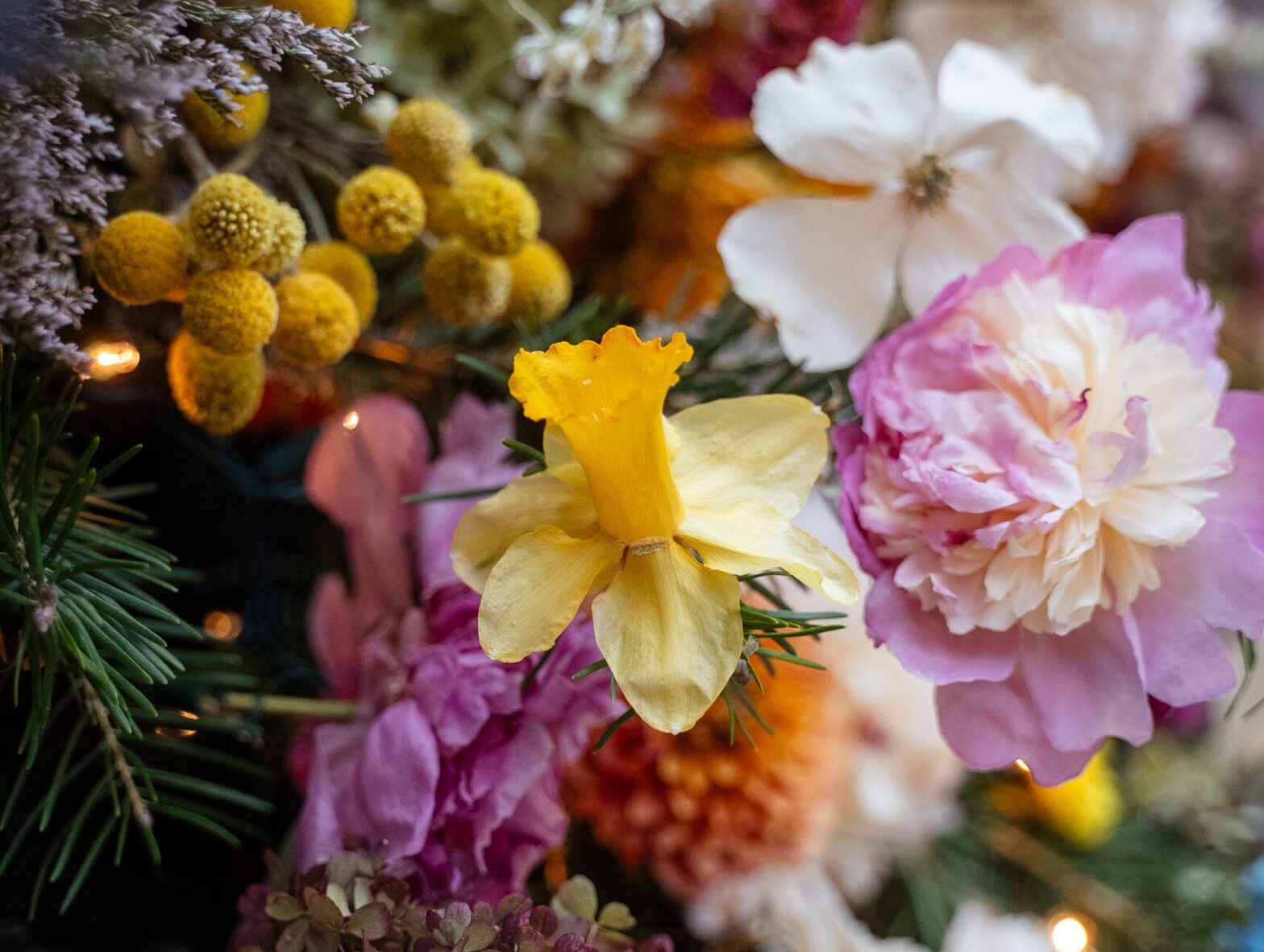
Colorful flowers have always been a vital part of Winterthur, both inside and out. Throughout the year, flowers are collected from across the estate to be artfully arranged and displayed in the interiors of Henry Francis du Pont’s former home. Before the flowers wilt, members of the Floral Design team collect them and prepare them to be dried. Once preserved, the still-vibrant blooms are destined to decorate the Dried-Flower Tree, a holiday tradition at Winterthur since 1985.
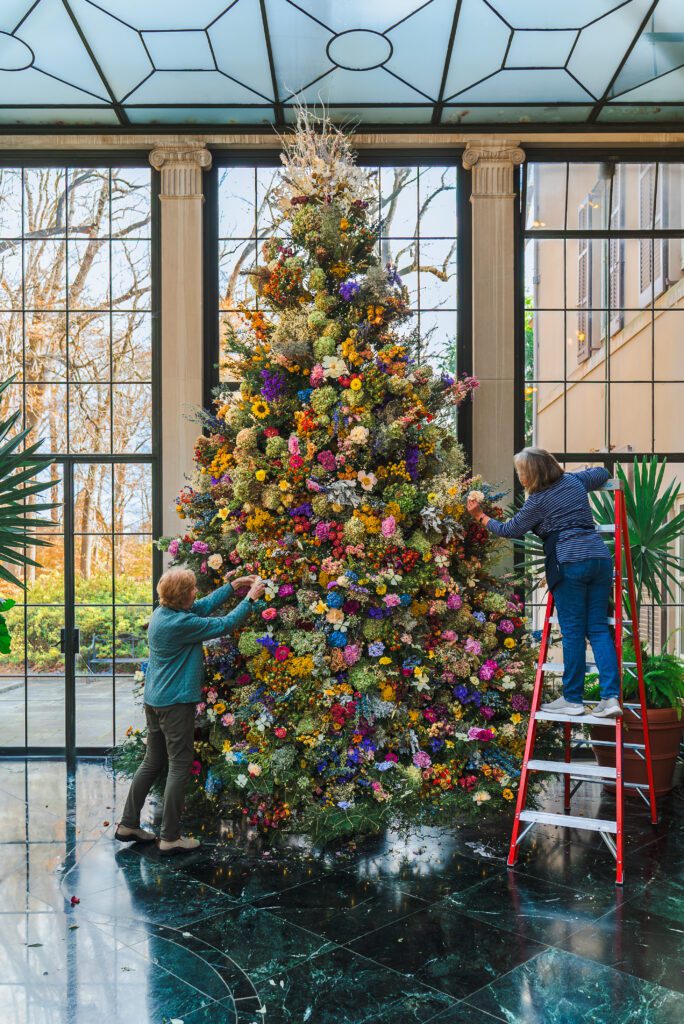
The tree looks different every year, depending on which flowers are used in arrangements. In 2019, for instance, when Winterthur presented the exhibition Costuming THE CROWN, the tree was filled with roses, the flower spotlighted in the show as well as in arrangements in the house.
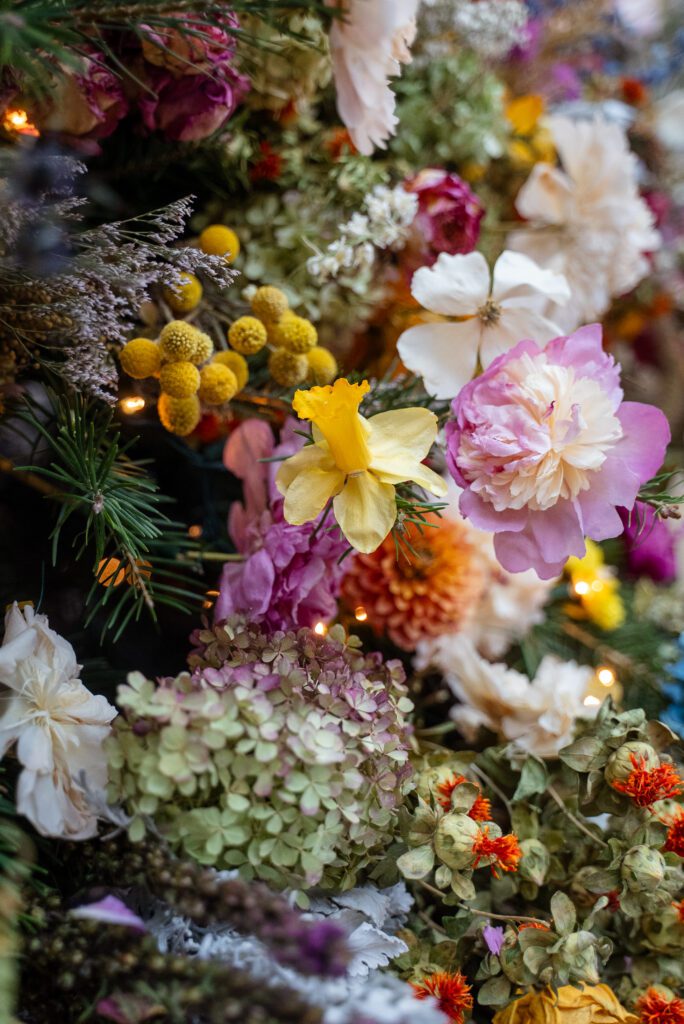
Most of the flowers are air-dried in a basement of a building on the estate, though some of the more delicate specimens are dried using silica gel. It takes the designers about 70 hours to decorate the tree, which boasts hundreds of daffodils and dogwood flowers, Queen Anne’s lace and lace-cap hydrangeas, peonies, zinnias, silver-dollar seed pods, and so many more.
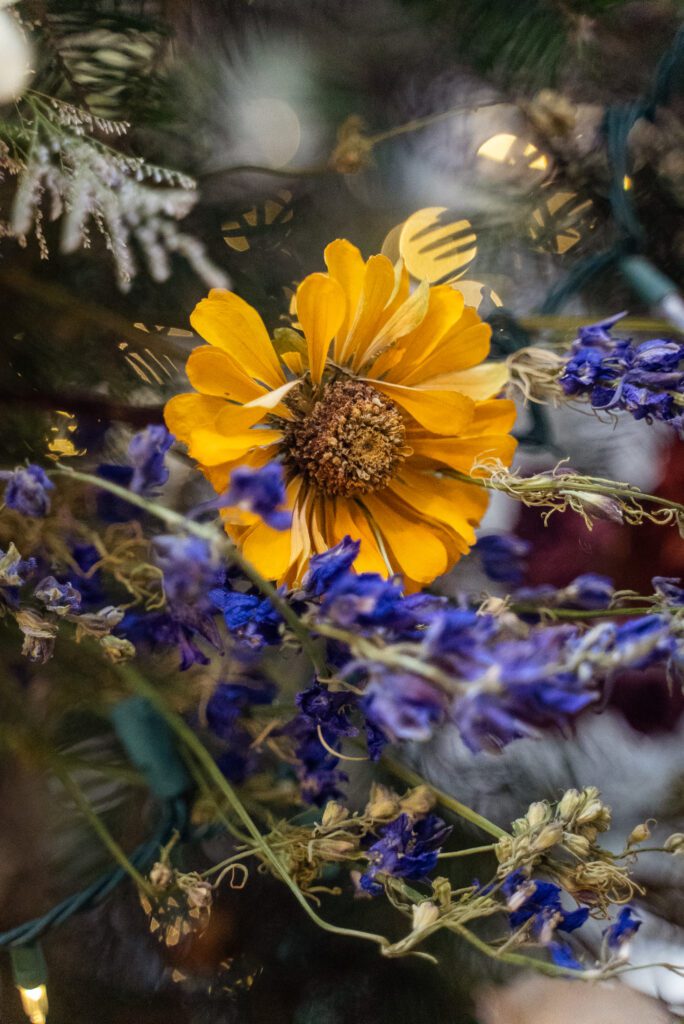
An article about the tree that appeared in Victoria magazine declared: “Undoubtedly, the biggest draw is the Dried Flower Tree, which holds sway in the capacious Conservatory. This focal point is a design masterpiece, to be sure, but it is also an ingenious way to give dual duty to the floral arrangements that adorn key rooms of the residence throughout the year. As a passionate gardener, the late Mr. du Pont once replenished these displays daily, but staff now allow each bouquet to shine for a week before retiring the stems to the cellar to dry. . . . These perfectly preserved flowers of spring and summer reprise their roles as natural beauties to the delight of Winterthur’s spellbound visitors.”
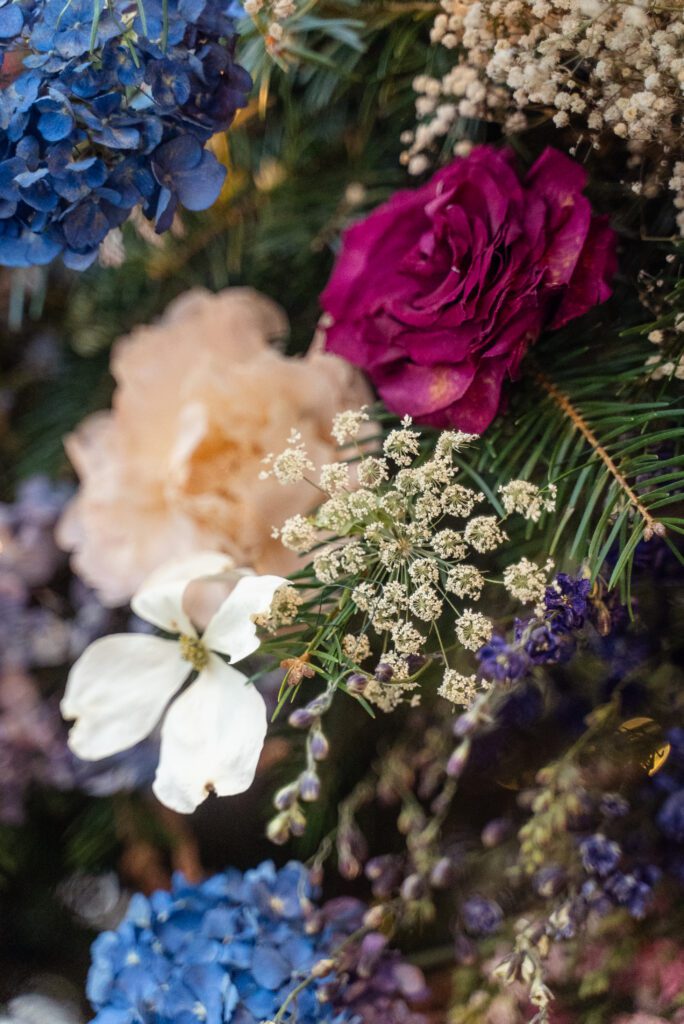
We hope you’ll visit soon to experience the special beauty of the Dried-Flower Tree this holiday season.
Tips for New Collectors

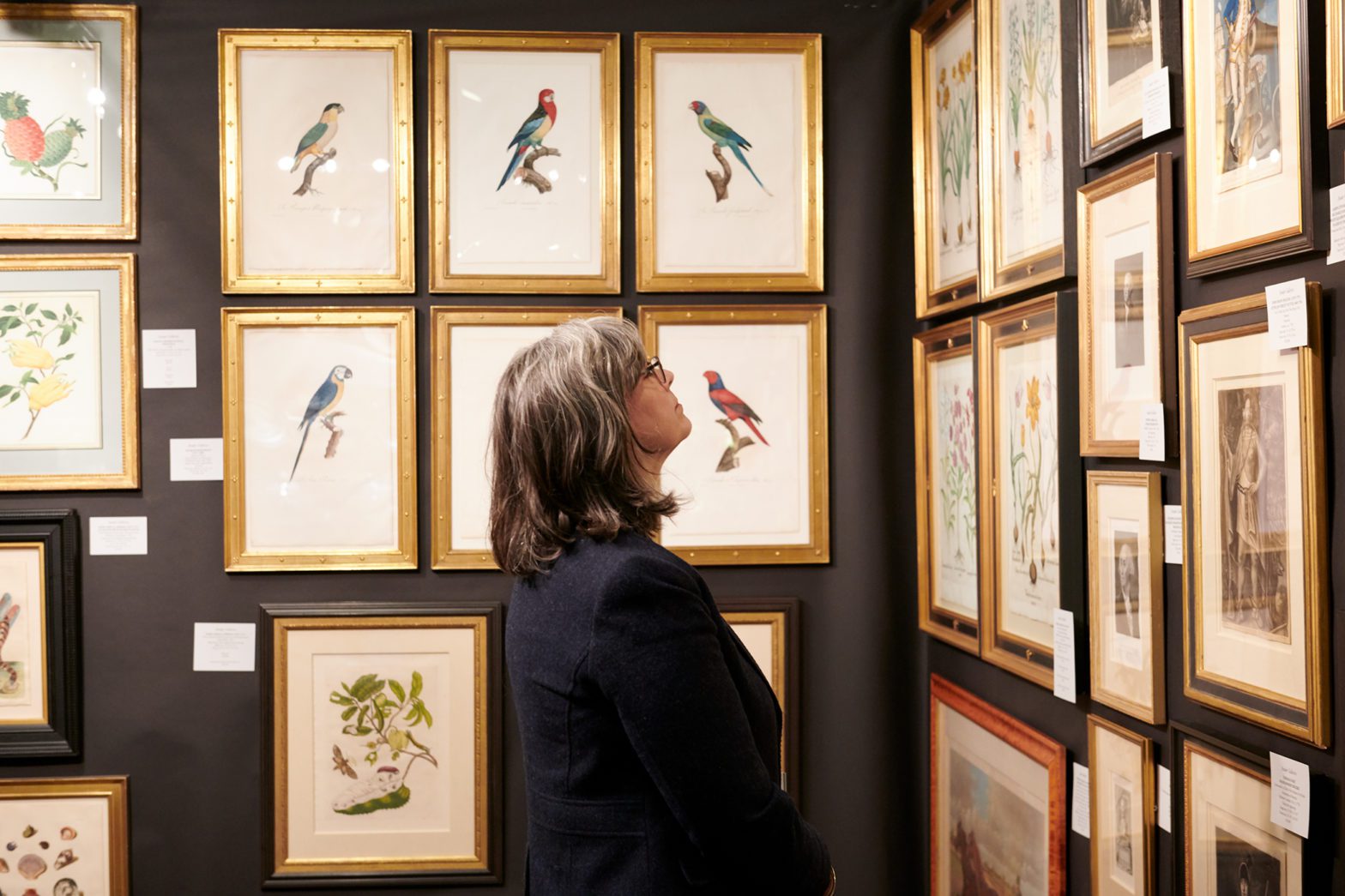
What’s the difference between a collector and a pack rat? Focus, knowledge, enthusiasm, and discipline. The chase is also half the fun. Are you a collector?

1. Collect what you enjoy.

You’ll know you’re a successful collector when you rearrange your home to make room for the things you’ve found.

2. Do your homework.

Learn about what you like, find people who know your area
of collecting, and ask questions.

3. Buy the best you can afford.

Quality counts, and good quality costs more. As you become comfortable with your expertise, consider buying better pieces.

4. Don’t buy an “investment.”

Buy because you enjoy a particular piece, not because you think it’s an alternative to the stock market.

5. Ask questions.

Dealers know the market, and part of why you buy from them is their knowledge and expertise. Other collectors are also a good source of information.

6. Protect your collection.

Light, water, dust, sunlight, and accidents can damage antiques. There are many resources that can help. Perhaps start with Caring for Your Cherished Objects (Winterthur 2021). If you amass valuable material, insure it with insurance companies that specialize in collections. If your object or artwork needs professional conservation, the American Institute for Conservation has lists of certified conservators in just about every field.

7. Have fun!

Attend shows, go to auction previews, visit Winterthur, and have a good time!

These tips were created by Forbes Maner, a trustee of Winterthur Museum, Garden & Library and supporter of the Delaware Antiques Show.

Deirdre Murphy

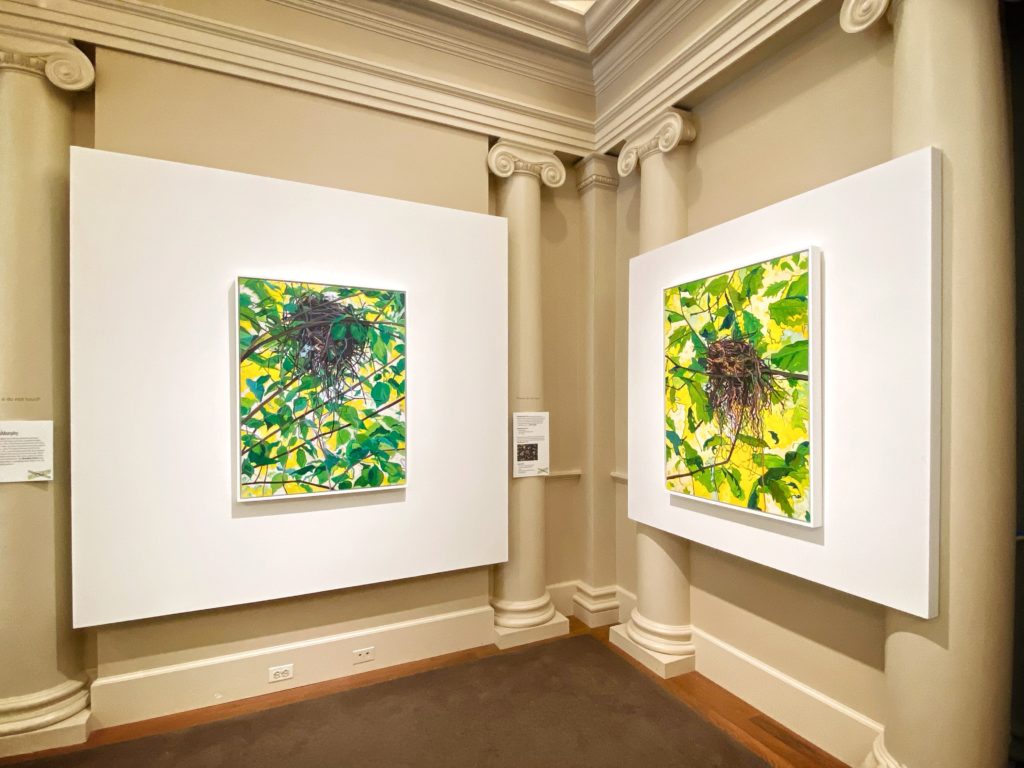
Since childhood, Deirdre Murphy has been fascinated by nature, citing it as consistent inspiration in her art. Beginning her process with observational paintings made en plein air, Murphy translates the intersection of nature, science, and manmade decorative arts in her works.

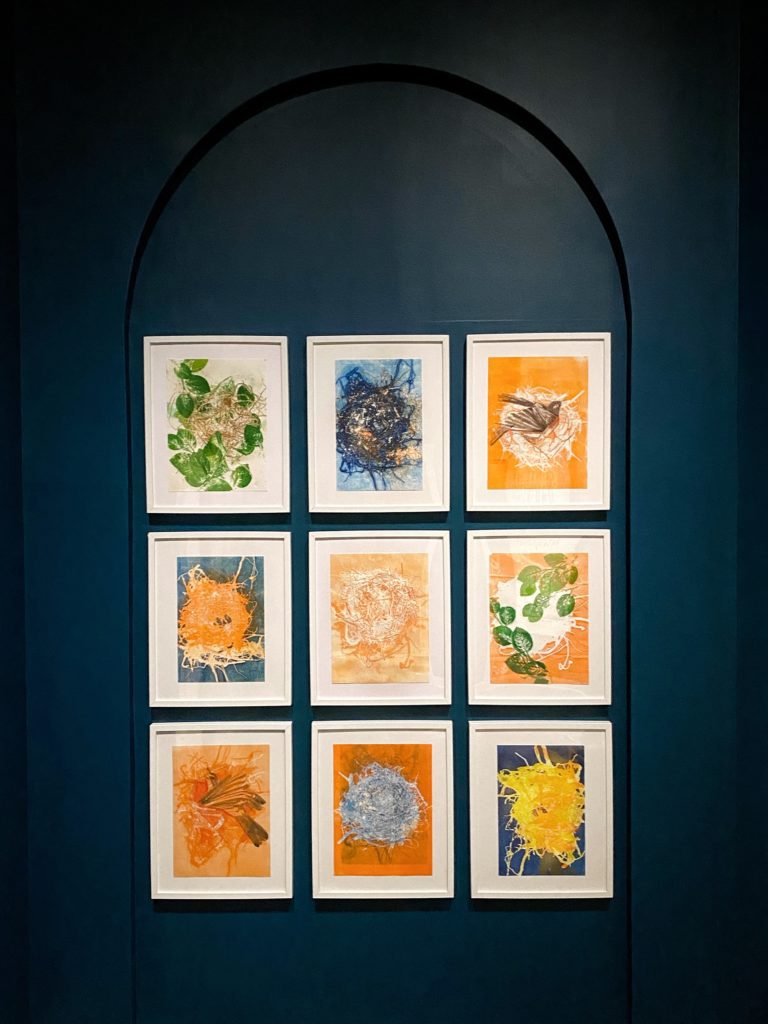
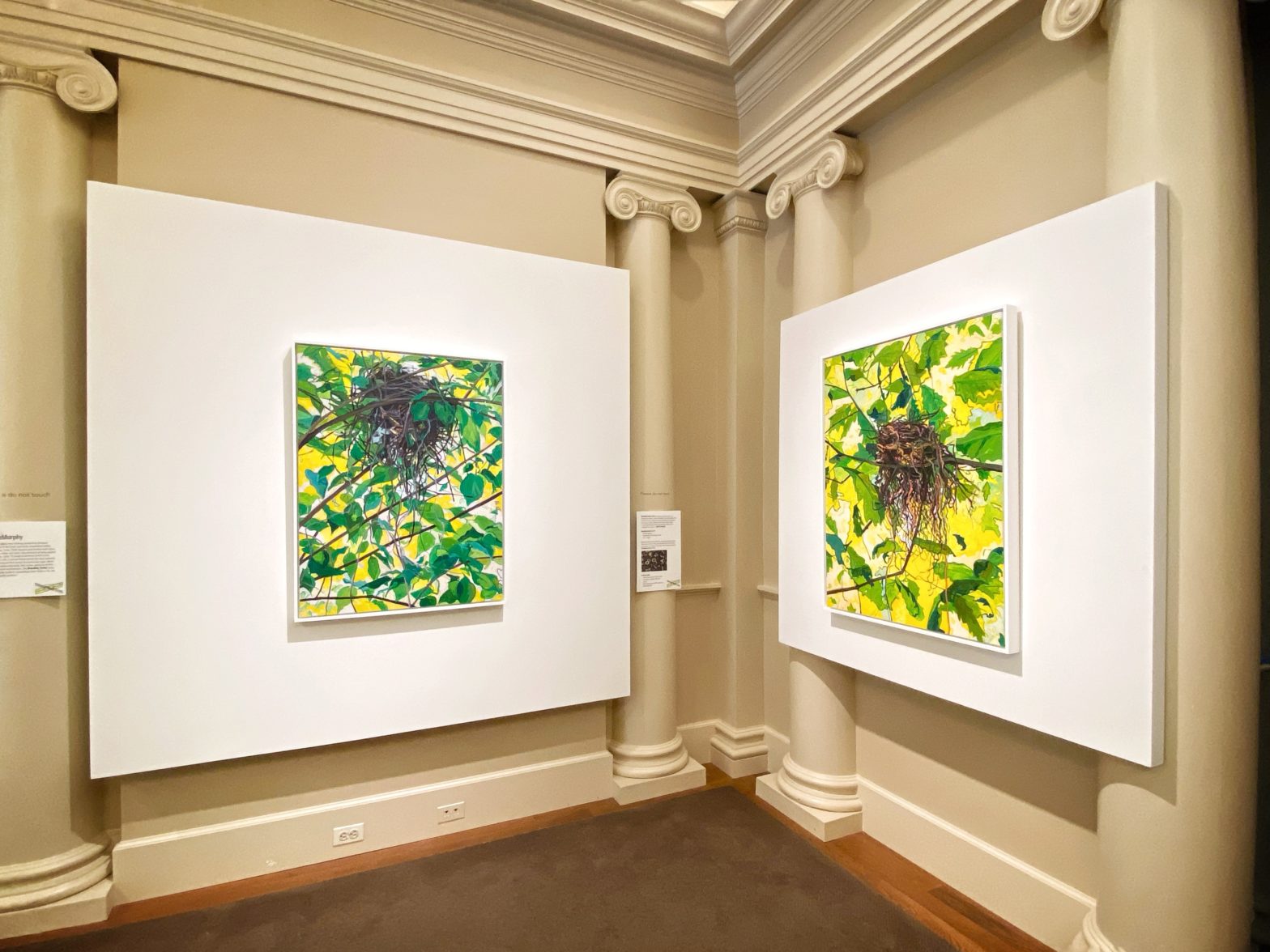
As a Winterthur Maker-Creator Fellow, Murphy was drawn to the John James Audubon prints in the Winterthur collection, which are considered some of the finest natural history prints ever made, most notably his illustrations of birds. American decorative arts and patterns also served as muse for Murphy’s Nest Neuron and Brooding Season series currently displayed at Winterthur. From looking at Winterthur’s collection, Murphy draws the parallel between the layering of leaves to create a world of new color to the layers of patterns in wallpaper and thread in embroidery to create new colors.

During the pandemic, Murphy became fascinated by the architecture of birds’ nests, studying their structures and prompting her to explore the dichotomy of safety and vulnerability in one’s dwelling through the depiction of birds’ nests. Murphy says, “Birds only nest when they’re going to have their young, when they’re breeding. Otherwise, the nest is a place of vulnerability for birds because they’re stationary and they are then prey for the predators. Similar to the feeling during Covid of being incredibly vulnerable, but also the home being this sanctuary.” 

In conjunction with a passion for nature, Murphy also uses science as an inspiration for her work. Her father was a hematologist, and he showed her images of different blood cells, pointing out recurring patterns. The phenomenon of naturally recurring patterns became a driving inspiration, especially when co-teaching a class on the neuroanatomy of the brain at Lehigh University. The clumps of neurons in the brain heavily mirrored the tangles of birds’ nests, prompting Murphy to create the Nest Neuron series, drawing out the interconnectedness of man and nature.  

The effects of climate change on surrounding nature also greatly inspires Murphy in her artistic production, she is especially interested in the changes in bird migration. Murphy firmly believes that one cannot discuss and draw inspiration from nature without also considering the effects of climate change, which can be felt throughout her entire oeuvre. 

Deirdre Murphy’s works are now on display in Winterthur’s Galleries. 

Apply for Research Fellowships

Key dates
Application portal opensNovember 1, 2026
Optional draft review deadlineDecember 1, 2026
Applications dueJanuary 15, 2027
Decisions announcedBy April 1, 2027
Fellowship dates for completionSeptember 1, 2027–August 31, 2028

Academic Programs staff are available to review draft application narratives received from applicants before December 1. Feedback will be sent in reply by mid-December. Please email Academic Programs to inquire about a review request. 

When I originally applied, [library staff] gave me a few additional library items to study that helped me round out my research plan. The feedback on my proposal offered by [Program staff] also helped me to develop those plans… (T)his… pre-application consultation prepared me well for the fellowship.

Brigitte Bailey, Short-Term Fellow, 2020-21

Components

Application form and category

If you apply for a Postdoctoral or Dissertation Fellowship that is not awarded, we will also automatically consider your application for a Short-Term Fellowship, unless you opt out of that consideration.

Essay

Upload an application essay of no more than 1,500 words (PDF only) that provides a concise overview of your project. Address the following questions:

  • What ideas, questions, or problems guide your project?
  • What is distinctive about your project? How does it complement, expand, or challenge prior study in the field? Please be specific about prior scholarship that informs your work.
  • What will you do at Winterthur, and why is a fellowship at Winterthur necessary for successful completion of your project? How do you intend to study, question, and examine the Winterthur collections in service of your project? Please outline any specific needs or requests (ex. drawing, measuring, photography). 

Bibliography of Winterthur Sources (PDF; 2 pages maximum)

List the sources you plan to use at Winterthur during your fellowship. We are particularly interested in any library special collections or museum objects you might use. If you are selected, we will work with you to create a plan of work to access these collections.

  • Library sources: Use WinterCat to search the collections and include the title, date, and any call number.
  • Museum objects: Search the Museum Collection Digital Database and list no more than 20 museum objects as examples of what you would most likely wish to consult (if selected for a fellowship we will consult with you again to create a plan of work). You may group objects by type, e.g., English transferware jugs made between 1750-1775, rather than naming 20 individual objects. Otherwise, please list a call number/object number for each object (ex. glass pitcher, 1959.0059) or library source.
  • Garden collections: see Plant Finder database. 

Vita

Upload your current résumé or CV (PDF only; 5 pages max).

References

Request two recent letters of reference. Letters should address your scholarly record, your current project, and your ability to work collegially with others. Recommenders will receive a link once you have started your application and entered their email address into the application.

Dissertation applicants: one letter must come from your dissertation advisor.

Maker-Creator applicants: letters should address your ability to work productively in a cohort and your record of completed projects.

Work Samples (Maker-Creator Applicants Only)

Provide the following digital work samples:

  • Portfolio of 5-10 high-res images or videos of your work (JPG, JPEG, or PDF for visual files; MP3 or MP4 for video files; YouTube or Vimeo for hosted video – please include time stamps where review should occur) OR 
  • For writers, a writing sample of current or previous work (ex. play and video scripts; prose and poetry; works of non-fiction, etc.), not to exceed 10 pages in length (PDF only).
  • You are strongly encouraged to include any relevant reviews of your work by professional critics (PDF or web address) and web addresses for samples that can be viewed online.
  • Mailed work samples will not be accepted.
  • Letters of reference for artists should address the ability to work productively in a cohort environment and a track record of completed projects.

Application checklist

ItemRequired forFormat and limitNotes
Application formEveryoneOnlineChoose your fellowship category; Postdoctoral and Dissertation applicants may also be considered for Short-Term.
EssayEveryonePDF, up to 1,500 wordsConservation residency applicants: include the staff sponsor here.
Bibliography of Winterthur SourcesEveryonePDF, two pages; up to 20 museum objectsGroup objects if you like; cite call numbers and object numbers.
CV / résuméEveryonePDF, up to five pages 
Two letters of referenceEveryoneSubmitted by your recommenders (emailed to academicprograms@winterthur.org)One must be from your dissertation advisor if you apply for a Dissertation Fellowship.
Work samplesMaker-Creator applicants only5–10 images or videos, or up to 10 pages of writingReviews of your work are welcome. Mailed samples are not accepted.

Questions? Please email us.

The Needles I: Stitching Identity Online Exhibition

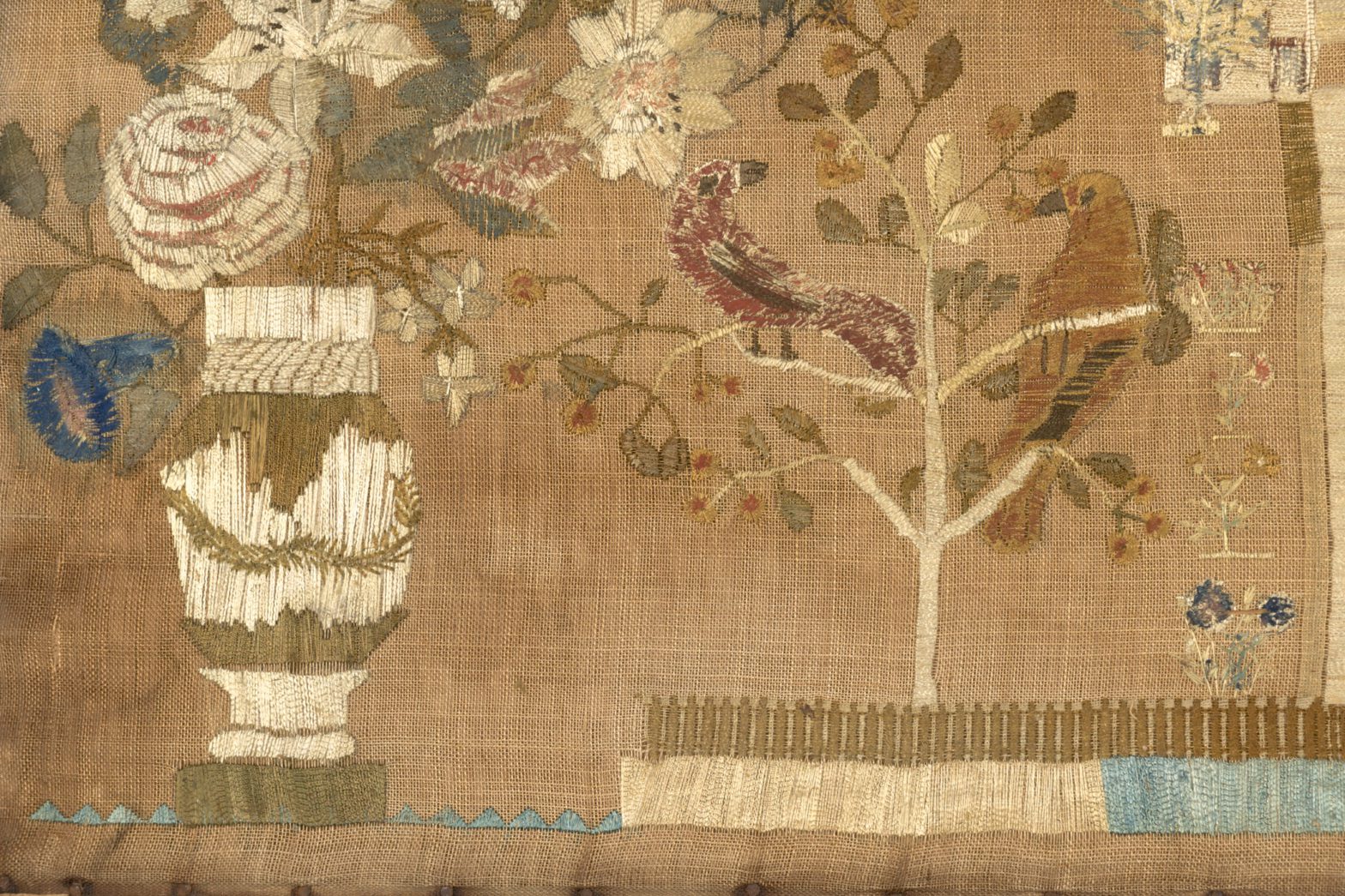
The Needle’s I: Stitching Identity examines how we work with needles and thread to create a sense of self. From historic samplers and clothing to contemporary pieces, the exhibition presents stitchers and stitchery from the 18th century to the present day and explores these makers, their marks, and their stories through themes of family, memory, and craft tradition. The exhibit is inspired by The Needle’s Eye: Women and Work in the Age of Revolution, Marla Miller’s important examination of 18th and early 19th-century identity, gender, and craft and moves it to the present day.

See the exhibition.

Common Destinations: Maps in the American Experience

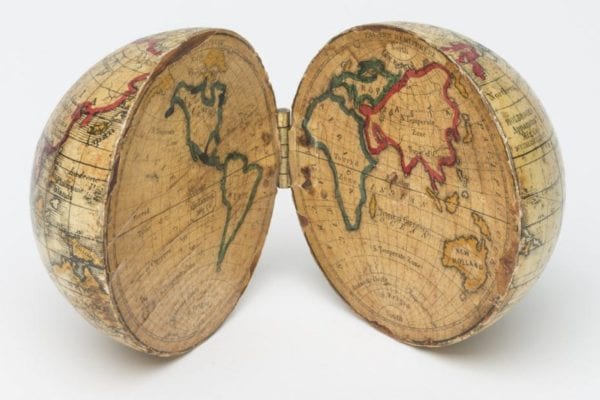
This path-breaking exhibition charts objects and imagery related to America’s historical fascination with maps. Created by Martin Brückner, Professor in English and American Literature at the University of Delaware, Common Destinations was displayed in the Winterthur Galleries from April 2013 to January 2014. It features more than 100 Winterthur library and museum objects as well as loans from other collections.

See the exhibition.

Ann Lowe: American Couturier

Exhibition to tell story of the designer and her decades-long career

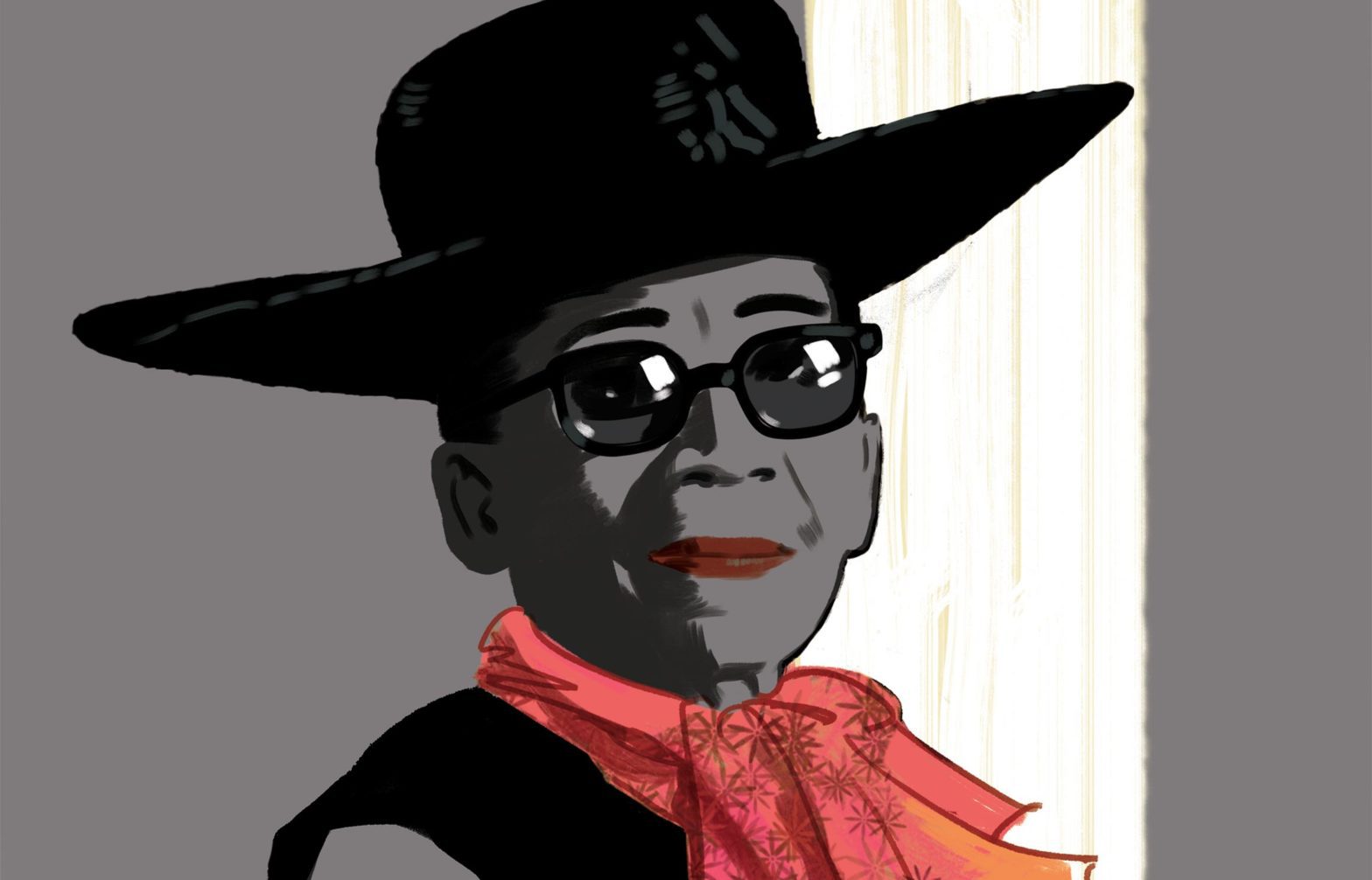
WINTERTHUR, DE (September 12, 2022) – An exhibit entitled Ann Lowe: American Couturier will present the life and work of the remarkable and influential American designer who designed couture gowns for debutantes, heiresses, actresses, and society brides, including Jacqueline Kennedy, Olivia de Havilland, and Marjorie Merriweather Post. The exhibit will be open at Winterthur Museum, Garden, & Library from September 9, 2023, to January 7, 2024.

In 1964, The Saturday Evening Post referred to fashion designer Ann Lowe as “Society’s Best-Kept Secret.” Lowe made gowns that influenced international style—intricately constructed, beautifully designed, and custom-made for each client. For decades, she remained virtually unknown to the wider public. Since then, too little recognition has been given to her influence on American fashion. The exhibition will reveal her evolution as a designer from the 1920s to the 1960s, illuminating her ongoing engagement with fashion trends and shifting cultural moments. 

This is the largest exhibition of Lowe’s work to date, featuring 40 gowns, many never before on public view. Ann Lowe’s recently emerging visibility as a designer stands in contrast to much of her career and the countless unrecognized Black dressmakers and designers who have contributed to American fashion for generations, including her own grandmother and mother. She blazed a path for others to follow and her legacy is still felt in fashion culture.

The exhibition will also feature the work of contemporary couturiers and fashion designers whose current design practices, perspectives, and career paths reflect the trajectory of American fashion emanating from Lowe’s foundation. These include B Michael, Tracy Reese, Amsale Aberra, and Bishme Cromartie. Elizabeth Way, associate curator at The Museum at the Fashion Institute of Technology, is guest curator of the exhibition. 

For information, call 800.448.3883 or visit Winterthur.org/AnnLowe.

This exhibition is made possible through support from the Terra Foundation for American Art, the Coby Foundation, Ltd., and the National Endowment for the Humanities.

Important Tips for School Programs

On-Site Programs

  • Arrive on time. Programs start and end at scheduled times. If you arrive late, we are unable to extend the program.
  • Review museum manners before your visit.
    Students should walk, use quiet voices, and only touch objects when instructed. The gardens are also part of the museum collection, so students should not climb trees, throw stones, or pick flowers.
  • Adults should model positive behavior.
    Staff and chaperones are most helpful when they remain with their assigned groups, manage student behavior, allow students to answer questions, and encourage good museum manners.
  • Name tags are required for all students.
  • No cell phones or headphones should be used by students, chaperones, or school staff during the visit.
  • Food and personal items.
    Food, drinks, gum, pens, and coats are not allowed in the Museum or Galleries. Water is permitted—and encouraged—for outdoor programs.

Chaperone Policy

  • You may bring as many school staff for free as you feel necessary.
  • You may bring one parent/guardian chaperone for every five students.

Group assignments.
You will receive an email one to two weeks before your visit with instructions on how to divide students into groups. Group sizes are determined by museum policy and staffing.

Bag Policy

  • No bag restrictions for Wonder & Wander in Enchanted Woods, Garden Explorers, Hike, and Careers at the Museum programs.
  • Bags may be carried only by school staff on Adopt an Object, Bugs in the Museum, House Tour, Gallery Tour, and Highlights Tour programs. Bags must be carried on the front of the person.
  • No bags allowed on Maker & Marketplace, Discover the Science of Museum Collections, and Making a Museum programs. Hats and lanyards are also not permitted. If school staff attending one of these programs need to carry medication in a bag, it must be placed in a pocket, carried by hand, or transferred to a plastic bag provided by Winterthur.

In-Class Programs 

  • Make sure students are wearing name tags. 
  • Encourage students to practice good classroom manners. 
  • Encourage respectful handling of demonstration items.
  • Model active listening and participation.

Virtual Programs 

  • Log on a few minutes before your program begins.
  • Ensure all names appear accurately. 
  • When applicable, use the chat function appropriately. 
  • Be respectful of your guide and peers.

If you have any questions, please contact school@winterthur.org 

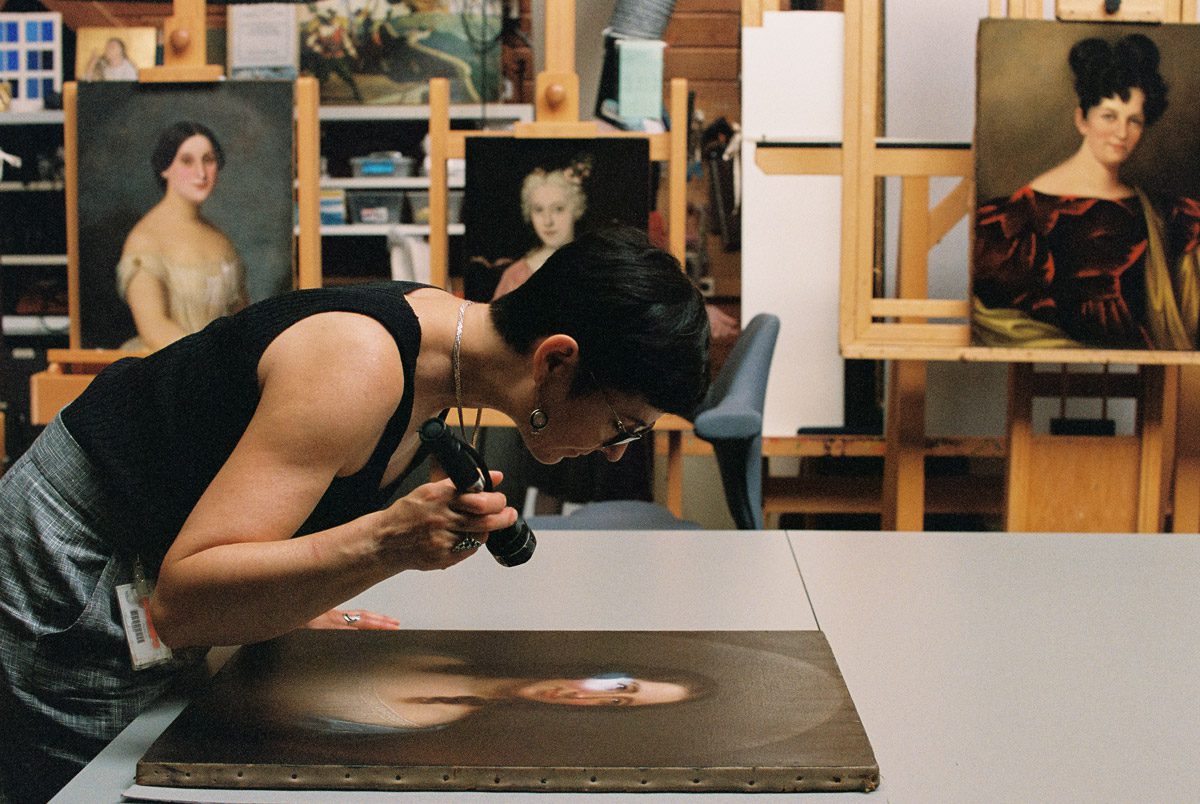
Conservation Focus Lab Tour

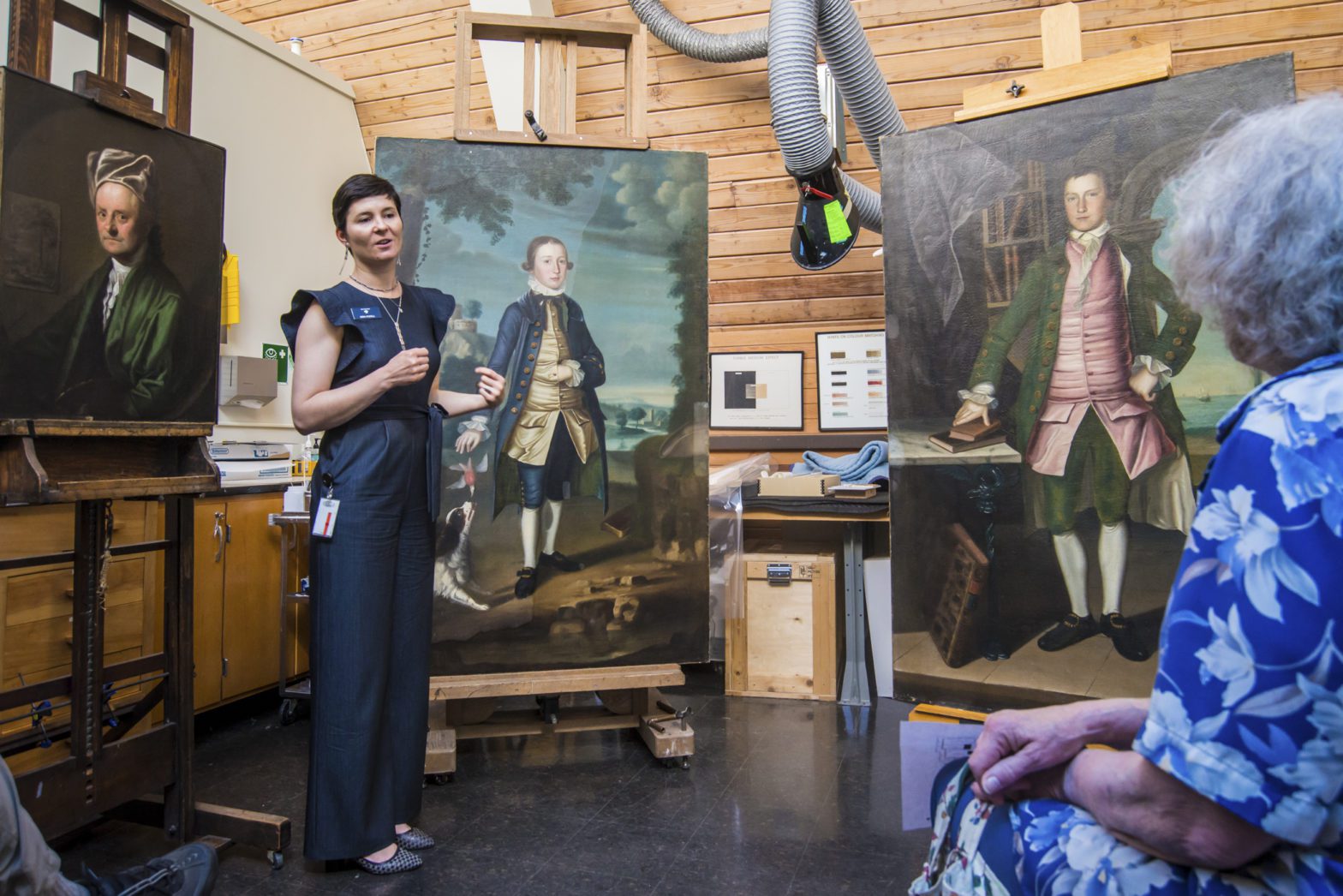
Learn about behind-the-scenes work happening in Winterthur’s conservation laboratories, where works of art and cultural heritage are examined, studied, and cared for by your tour hosts, our conservators, scientists, and graduate students. Registration required; capacity limited. For ages 8 and up. $10 with admission; $5 for Members.

Select Wednesdays | 1:00–2:30 pm

  • October 14: Paintings, Textiles, and Objects Labs
  • November 4: Preventive, Research & Analysis, and Paper Labs
  • December 2: Library, Paintings, and Furniture | Sold out.