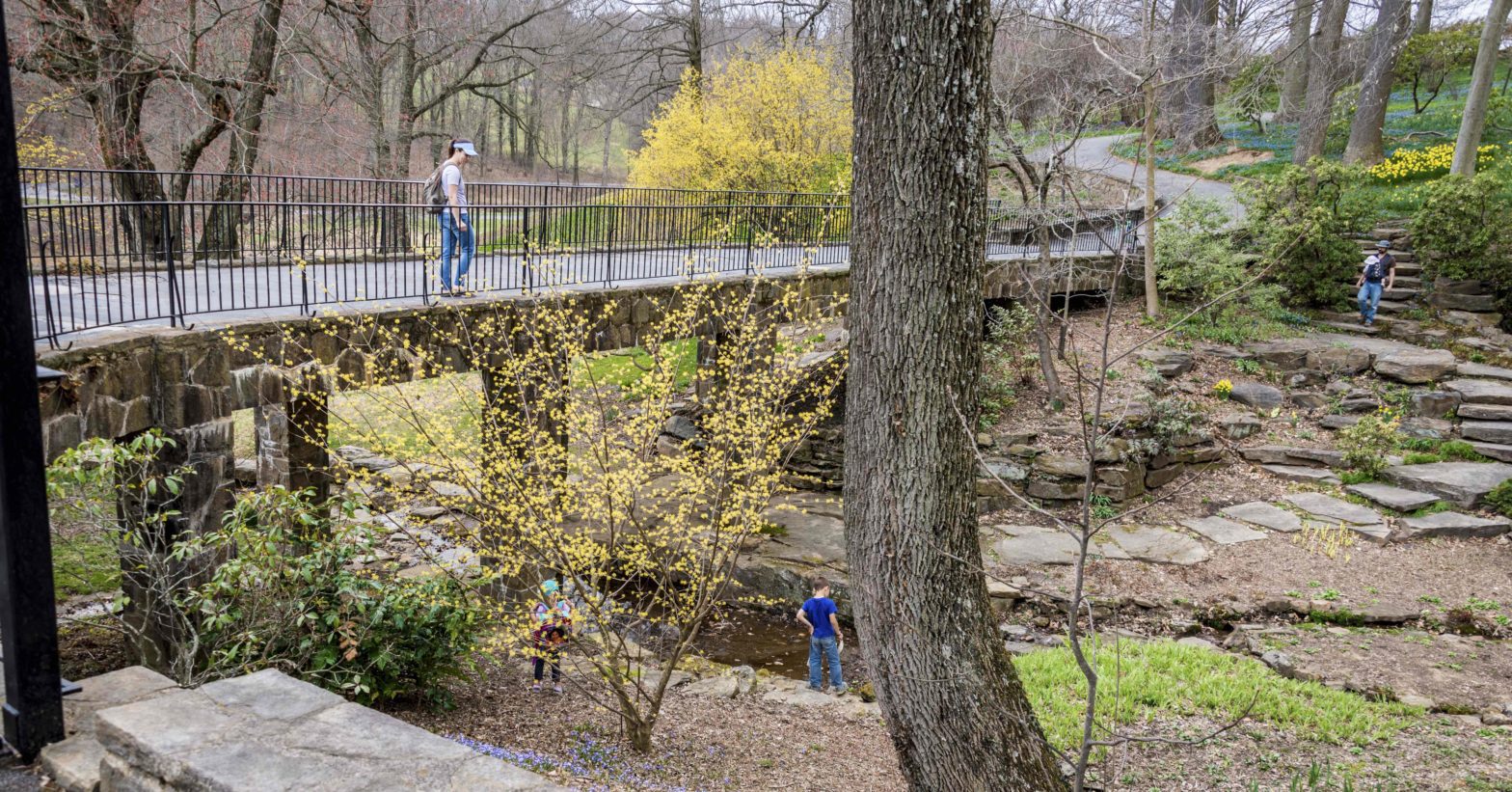
The Quarry Garden bridge offers several perspectives on a beautiful space.
A walk across the Quarry Garden bridge offers one of the most interesting and beautiful perspectives at Winterthur, an overhead view of a charming, unique area.
“We don’t have too many garden areas at Winterthur where you have a bird’s eye view into it and then you can also walk within it and then see it from down below,” says garden curator Carol Long. “When you’re within the bog, the bridge also serves as a focal point, framing the views to the distant field and woodland. It’s substantial yet you can see through it.”
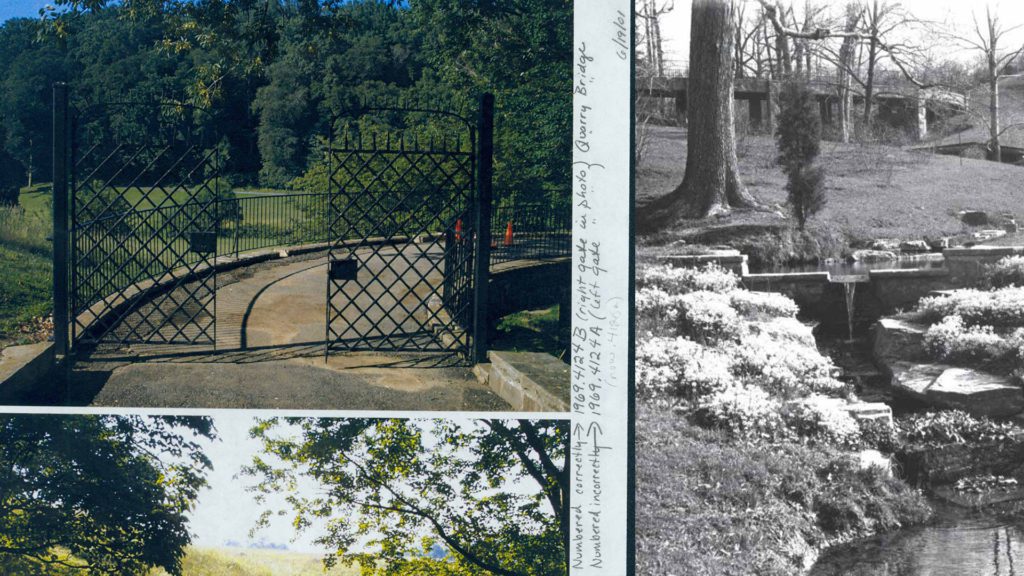
The garden was one of the last areas H.F. du Pont designed for his magnificent estate. Beginning in 1961, he trucked in large rocks from a quarry in nearby Avondale, Pennsylvania, installed them as steps, benches, and terraced walkways in his own abandoned quarry at the base of Oak and Sycamore Hills, then planted primroses galore.
The various primroses seemed ideal for the boggy bottom of the bowl-like space. Fed by three springs, the area stayed moist throughout the year. The springs converged in a small rill that tumbles downhill over a series of weirs before spilling into a large pond.
Over the garden, du Pont installed a footbridge, a curving 100-foot span above the wetland that offers a range of views. From the deck, one can see open vistas. From below, one can see intimate views of the garden. Facing outward at the top of the bridge, one can see views of the pond and landscape beyond.
Things change, of course. Tree loss over time admitted more light, which changed conditions for the plantings. Some varieties of primrose, now perennialized, remain. The garden today is known for summer color from a theater of iris, foamflower, cardinal flower, lobelia, and more. Things seem to bloom from every nook and cranny.
“But it also has an amazing early spring component,” Long notes. “When we think about bulb displays at Winterthur, the March Bank comes to mind, but the Quarry Garden also has an impressive blue phase of glory of the snow with pockets of daffodils. Later in spring, you can see the combination of the primula in the bog and redbud flowers in bloom up on the surrounding Sycamore Hill. So it has that spring component in addition to all that summer color.”
All of that beauty is on an intimate scale that most people can relate to. “Many of Winterthur’s garden areas span several acres and cannot be seen from one vantage point,” Long notes. “Not many of us can relate to gardens of that scale. But we can relate to something the size of the Quarry Garden, especially when viewing the bog from the bridge. We see the garden in its totality. Aesthetically, it’s very, very pretty and can be seen from many different angles.”
The bridge, however, “is in pretty bad shape,” Long says. “It gets a lot of use, especially from our Members and our daily walkers.” The surface is deteriorating, so it needs to be redone, and other repairs will soon become necessary. The bridge remains a unique feature of the Winterthur landscape, which we’d like to maintain for future generations.
Would you like to contribute to the restoration of the Quarry Bridge? Your support will help ensure that the Quarry Bridge remains as H.F. du Pont imagined for the thousands of visitors who enjoy the Quarry Garden each year.
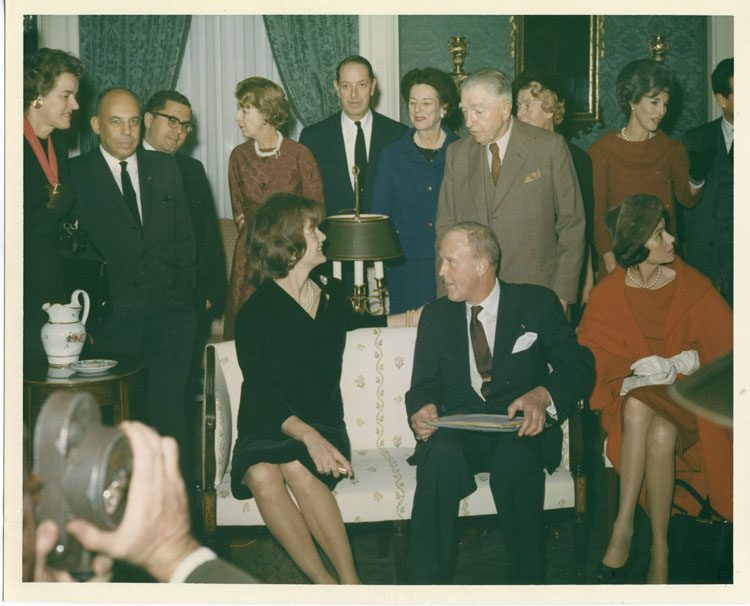
In 1961, Jacqueline Kennedy tapped Winterthur founder Henry Francis du Pont to lead her Fine Arts Committee, which she tasked with finding historic American furniture and art for her famous restoration of the White House interiors. The story of their partnership will be told in Jacqueline Kennedy and H. F. du Pont: From Winterthur to the White House, which opens May 7. Here are a handful of fun facts about the First Lady.
1. Kennedy first visited the White House when she was 11 years old.
And she was not impressed. Raised among wealth and privilege, she was already accustomed to fine homes. She “shuffled through” the White House, recalling later that “Mount Vernon and the National Gallery of Art made a far greater impression.” Upon becoming First Lady, she borrowed every book she could from the Library of Congress to learn more about the executive residence with an eye toward its restoration as a place of grandeur and historic significance.
2. Her mother knew “Harry” du Pont.
Their families traveled in the same elite social circles—“Of course I knew her mother,” du Pont later said of Janet Auchincloss—but Kennedy and du Pont had never met until he accepted her invitation to chair the Fine Arts Committee. Their 50-year age difference may have been a factor. After the committee’s work got underway, du Pont hosted Kennedy for lunch at his winter home in Boca Grande. It was their first meeting.
3. Kennedy’s personal tastes tended toward the continental.
Her family’s heritage was French, she had spent a year studying at the Sorbonne, and she was well schooled in European style by her friends Jayne and Charles Wrightsman, who were major collectors of 18th-century French decorative arts; however, Kennedy intuitively knew the People’s House should be distinctively American. Knowing du Pont to be the most knowledgeable collector of American decorative arts, Jayne Wrightsman suggested Kennedy ask him to chair the Fine Arts Committee. Of course, he knew Wrightsman, too.
4. Kennedy had to ease du Pont’s concerns about using French furniture.
Differing proposals for redecoration of the Red Room suggested furnishing with Empire pieces, using work by American maker Duncan Phyfe, or highlighting objects by French maker Charles-Honore Lannuier, who lived and worked in New York. Du Pont, of course, favored the American Phyfe. When he expressed concern about the committee’s accepting an imported mirror with an eagle in its design, Kennedy responded, “As long as it has the eagle, it doesn’t matter if it’s French.” In the end, Empire—French and American—won the day.
5. After visiting Winterthur, Kennedy forgot her handbag.
Whoops. After spending the day with du Pont at Winterthur, Kennedy and her entourage jumped up from the dinner table in a hurry to reach a flight back to Washington. They were well on their way when du Pont spotted the forgotten purse. He sent Assistant Curator Charlie Hummel and his wife, Marlene, on a speedy chase of the Secret Service down Route 52 in Delaware. Hummell’s wife, Marlene, made the handoff from the car. Mission accomplished.
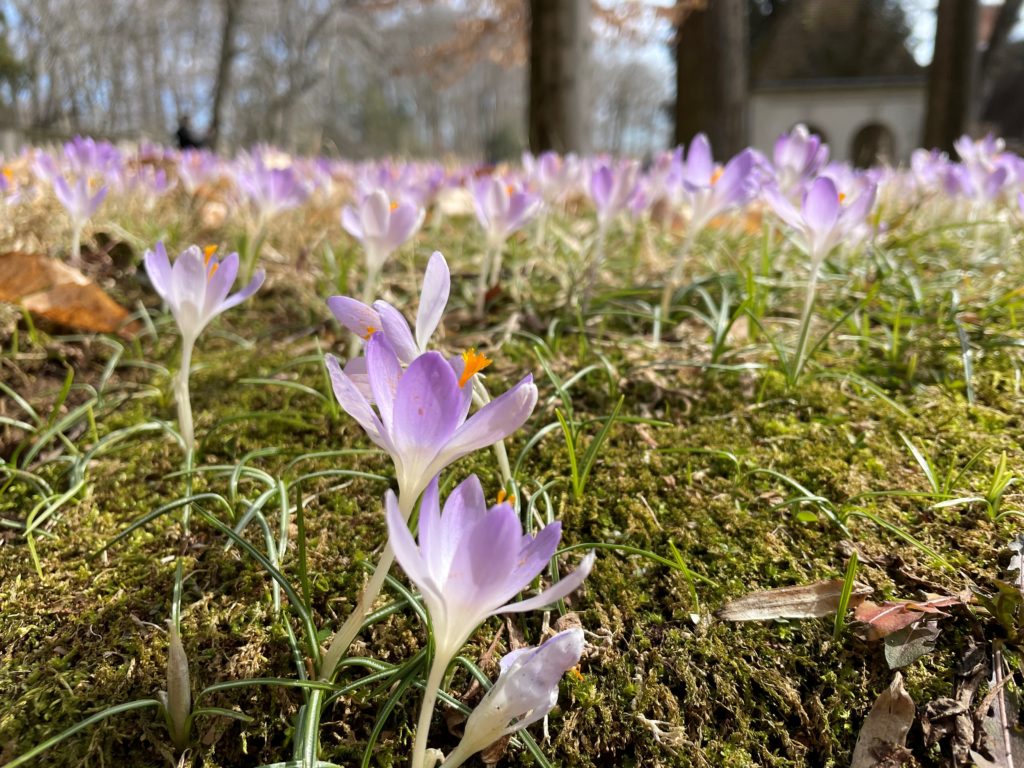
Crocus tommasinianus photograph taken by Collin Hadsell
Check these out:
Tommies: The ‘Tommies’ (Crocus tommasinianus) are starting their display in the lawn of the East Upper Terrace of the Museum.
Snowdrops: Snowdrops (Galanthus species and varieties) are in bud or in bloom throughout the gardens. Blooms can be seen along the March Walk, in the Boxwood Garden on the East Upper Terrace of the Museum, and in the raised bed in the Museum east courtyard.
Winter color: The willow-leaf cotoneaster (Cotoneaster salicifolia) has brilliant red berries and dark purple leaves for a great show of color in winter.
Furry ‘winter coats’: The buds of the magnolias at Magnolia Bend and in the Sundial Garden are covered by fuzzy bud scales. The hairs that create the furry look are called trichomes.
ENTRANCE DRIVE AND PARKING AREA
ber Catalpa species (Catalpa – long, bean-like brown seed pods)
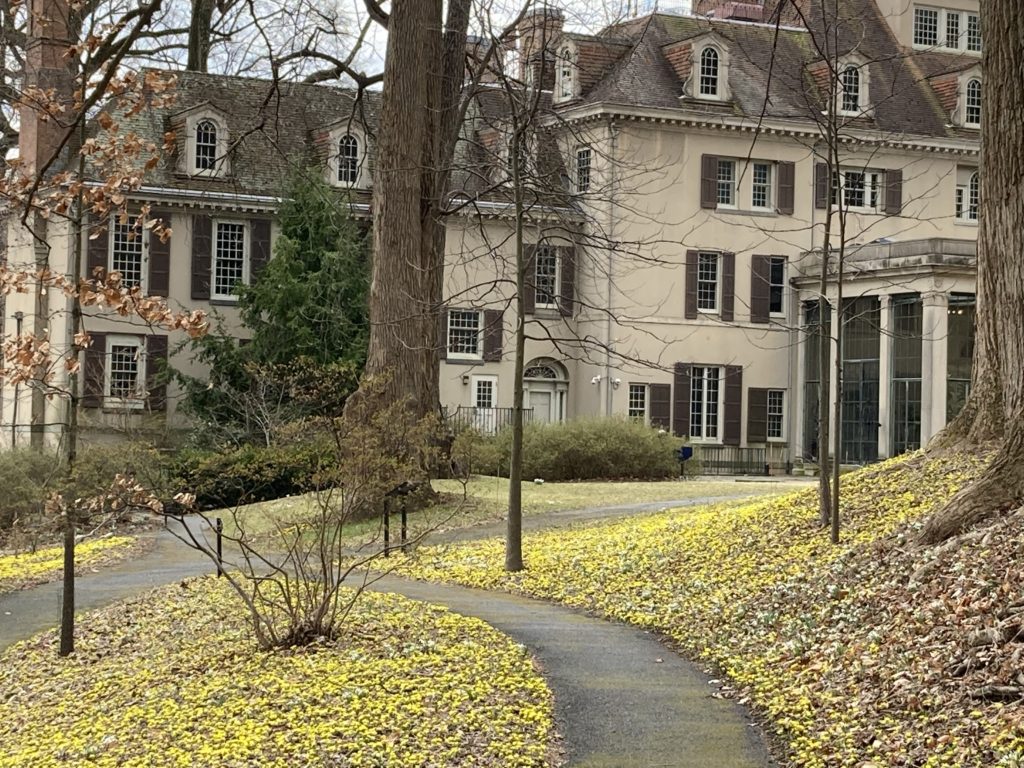
View of the duPont House from March Walk Winter aconites (Eranthis hyemalis)
Check these out:
Terrific Tapestries of color:
The early crocus, ‘Tommies’ (Crocus tommasianus) are blooming throughout the gardens and are carpeting the East Upper Terrace of the Museum lawn in lavender and silver.
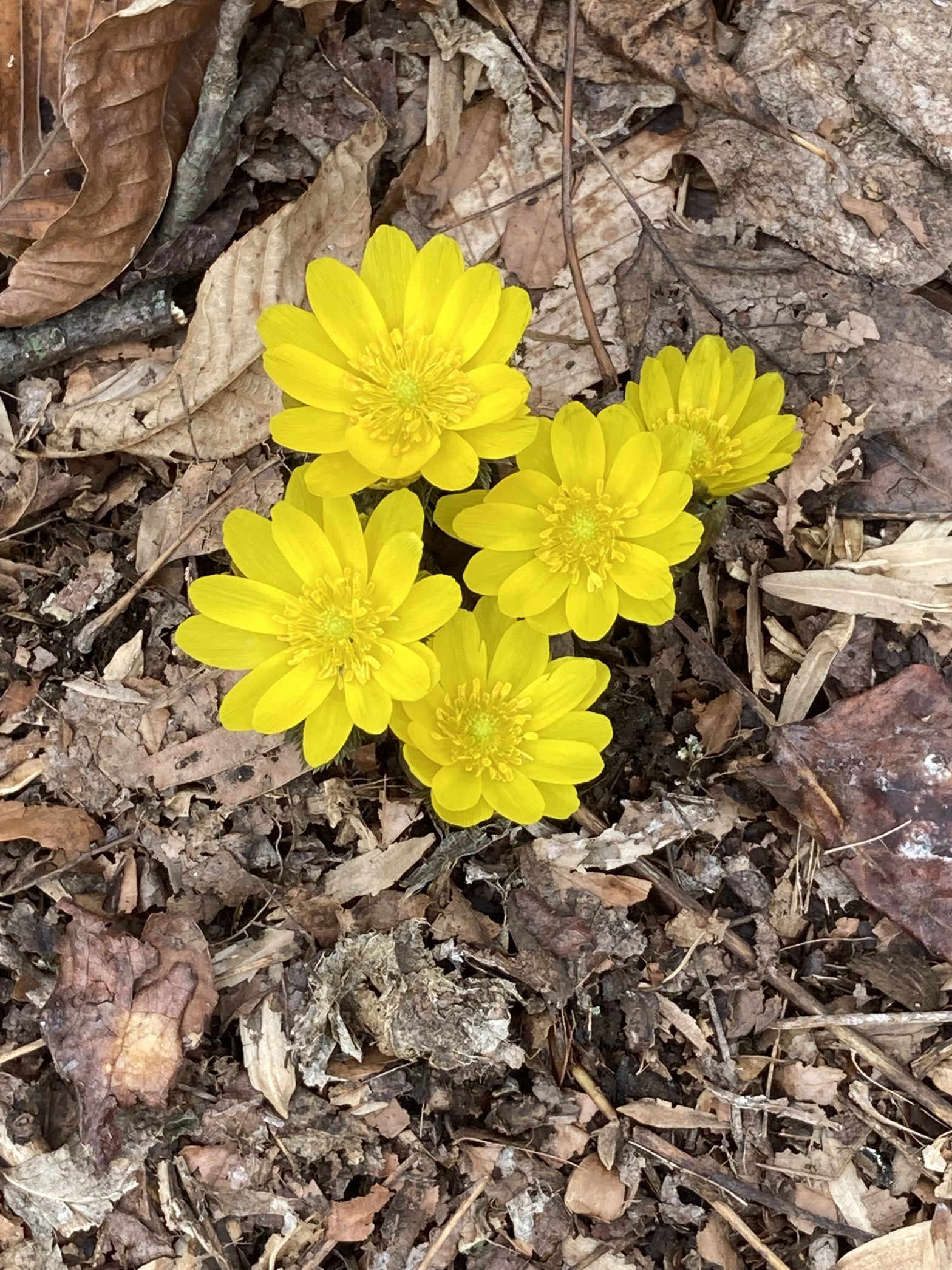
The winter aconites (Eranthis hyemalis) are creating a carpet of gold from Garden Lane across the lawn down to the East Upper Terrace of the Museum and also along the March Bank, in Azalea Woods, and along the walk to the Glade and koi ponds, in Enchanted Woods and in many other places in the gardens.
The yellow winter aconites and golden yellow Amur adonis (Adonis amurensis) merge into the white carpet of snowdrops (Galanthus elwesii & Galanthus nivalis) along the March Bank.
Snowdrops:
Snowdrops (Galanthus elwesii & Galanthus nivalis) are blooming throughout the estate, from the great drifts along the March Bank to small clumps and even individual flowers.
Many varieties of snowdrops (Galanthus varieties) in the collection in the raised beds along the East Museum terrace are in full bloom.
Witch hazel (Hamamelis species & varieties) are in full bloom in the Visitor Center lawn, in the Gallery lawn along Clenny Run, and on the Clenny Run side of the Museum Store, waving their blossoms that look like clusters of tiny ribbons. They look and smell magnificent!
LAGOONS
ber Celastrus scandens (American bittersweet – yellow husks, orange berries)
PARKING AREA TO VISITOR CENTER
fb Crocus tommasinianus (‘Tommies’ – lavender and silver)
Snowdrops: Snowdrops (Galanthus species and varieties) are in bud or in bloom throughout the gardens. Some blooms can be seen in the Peony Garden along the walkway at the end of the Brown Center, in the Boxwood Garden on the Museum upper terrace, along the March Walk, and in the raised bed in the Museum east courtyard.
Winter color: The willow-leaf cotoneaster (Cotoneaster salicifolia) has brilliant red berries and dark purple leaves for a great show of color in winter.
Furry ‘winter coats’: The buds of the magnolias at Magnolia Bend and in the Sundial Garden are covered by fuzzy bud scales. The hairs that create the furry look are called trichomes.
.
ENTRANCE DRIVE AND PARKING AREA
ber Catalpa species (Catalpa – long, bean-like brown seed pods)
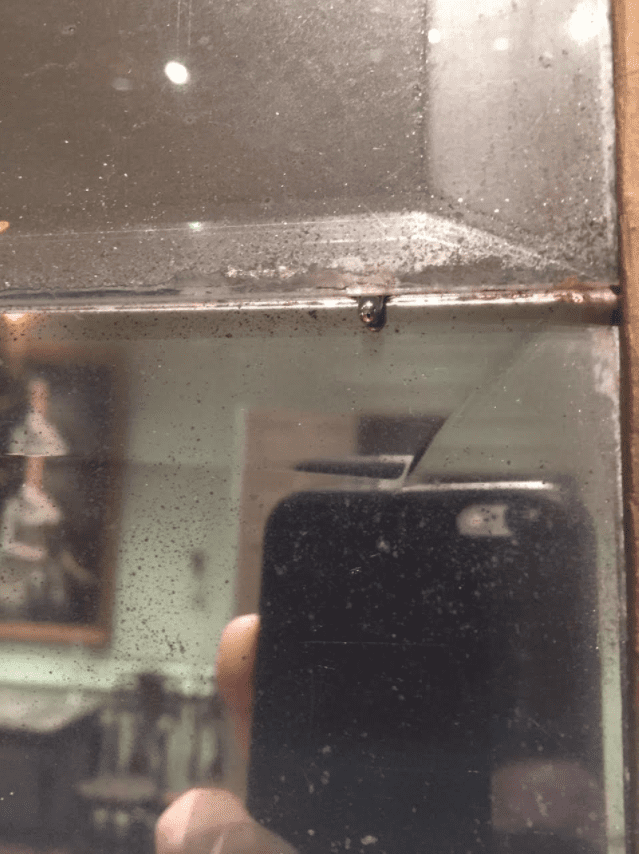
From the end of the 15th to the mid-19th century, tin-mercury amalgams were most often used to create the reflective surfaces on mirrors. Scientists at Winterthur have found that at least two-thirds of the mirrors in the collection contain these amalgams. Unfortunately, they are inherently unstable. Over time, the amalgam deteriorates, producing dark spots and a less reflective surface due to corrosion of the tin and reversion of the mercury to its natural liquid form.
As the mercury drips from the mirrors, it scatters on surfaces below and evaporates. Due to the toxicity of the mercury, that process is a health and safety concern.
For many years, dripping mercury mirrors in storage have been placed inside plastic bags to contain mercury droplets. Recent projects by conservation students revealed that mercury vapor levels are elevated to unsafe ranges inside storage bags. The mirrors are now stored on wire racks with an acid-free corrugated tray below. The open storage provides airflow around the mirror, preventing buildup of mercury vapors, while the tray captures mercury droplets so they don’t fall onto the floor below.
If you have these mirrors in your collection, be sure to handle them with nitrile gloves and keep them in the display orientation. After handling, dispose of the gloves and thoroughly wash your hands.
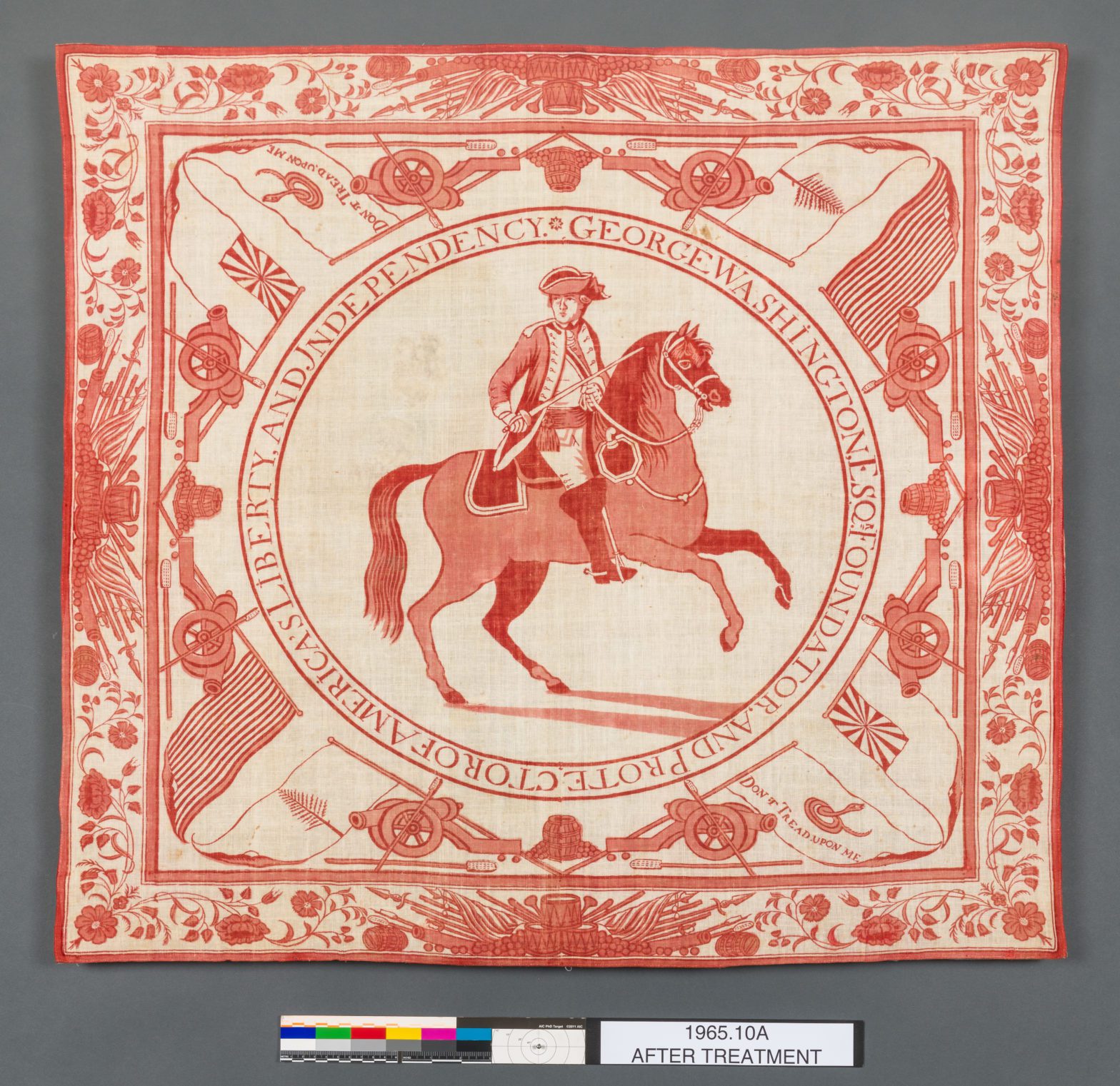
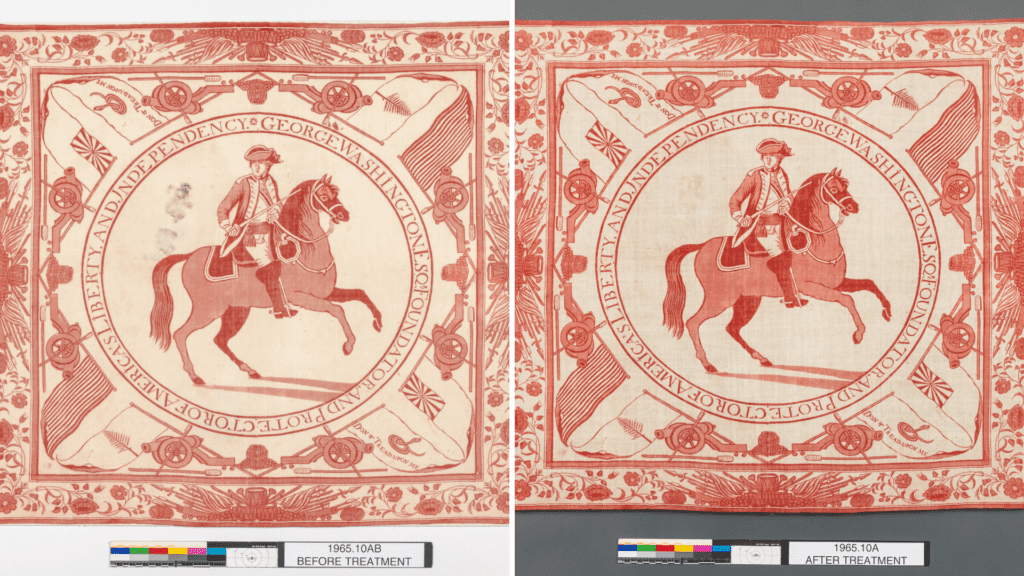
This rare, red-on-white printed handkerchief from the late 18th century shows General George Washington on horseback—and a large gray stain we wanted to reduce before it was exhibited in Hamilton & Burr: Who Wrote Their Stories? in 2019.
Past attempts to reduce the discoloration were minimally successful, so an unsightly muslin patch had been stitched over it. To improve its appearance, conservators need an exacting treatment to match the exacting block printing on both sides of the handkerchief.
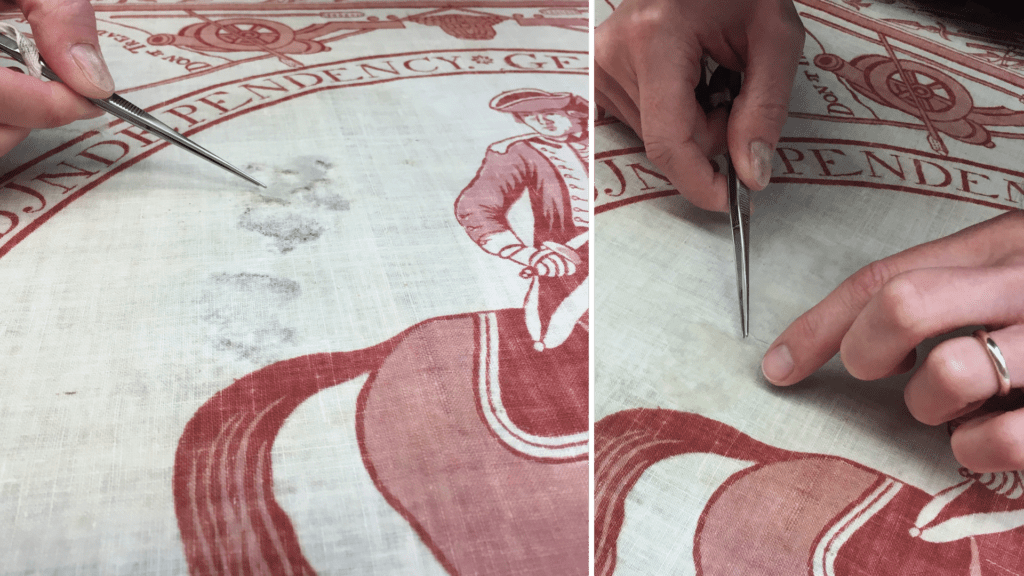
Conservators first applied a series of poultices of cleaning solutions, chelators, and enzymes to the stain. The poultices reduced the gray coloration only minimally, so masking the stain remained the best treatment option.
Conservators created the mask by tinting a sheer Japanese tissue and super-fine silk crepeline with fabric paints and dyes to match the color of the handkerchief. They shaped the tissue with a small, damp brush, then pulled the wet tissue apart to feather the edges. The shaped tissue was fixed over the darkest areas with a water-soluble paste of methyl cellulose and wheat starch, then a patch of crepeline was pasted over the entire stain.
The treatment successfully reduced the appearance of the discoloration while allowing the weave of the fabric to show through. A layer of gray fabric between the handkerchief and its support mount further reduces the appearance of staining. The water-based paste can be reactivated, which makes the treatment reversible.
After its display in Hamilton & Burr, the handkerchief—inconclusively attributed to textile printer John Hewson, of Philadelphia—was returned to its original location in the house in Bertrand Hall.
After discovering arsenic in some vintage books, a conservator spreads the word on safety.
Some people believe the ideas in books are dangerous, but sometimes it’s not the words but the books themselves that are toxic.
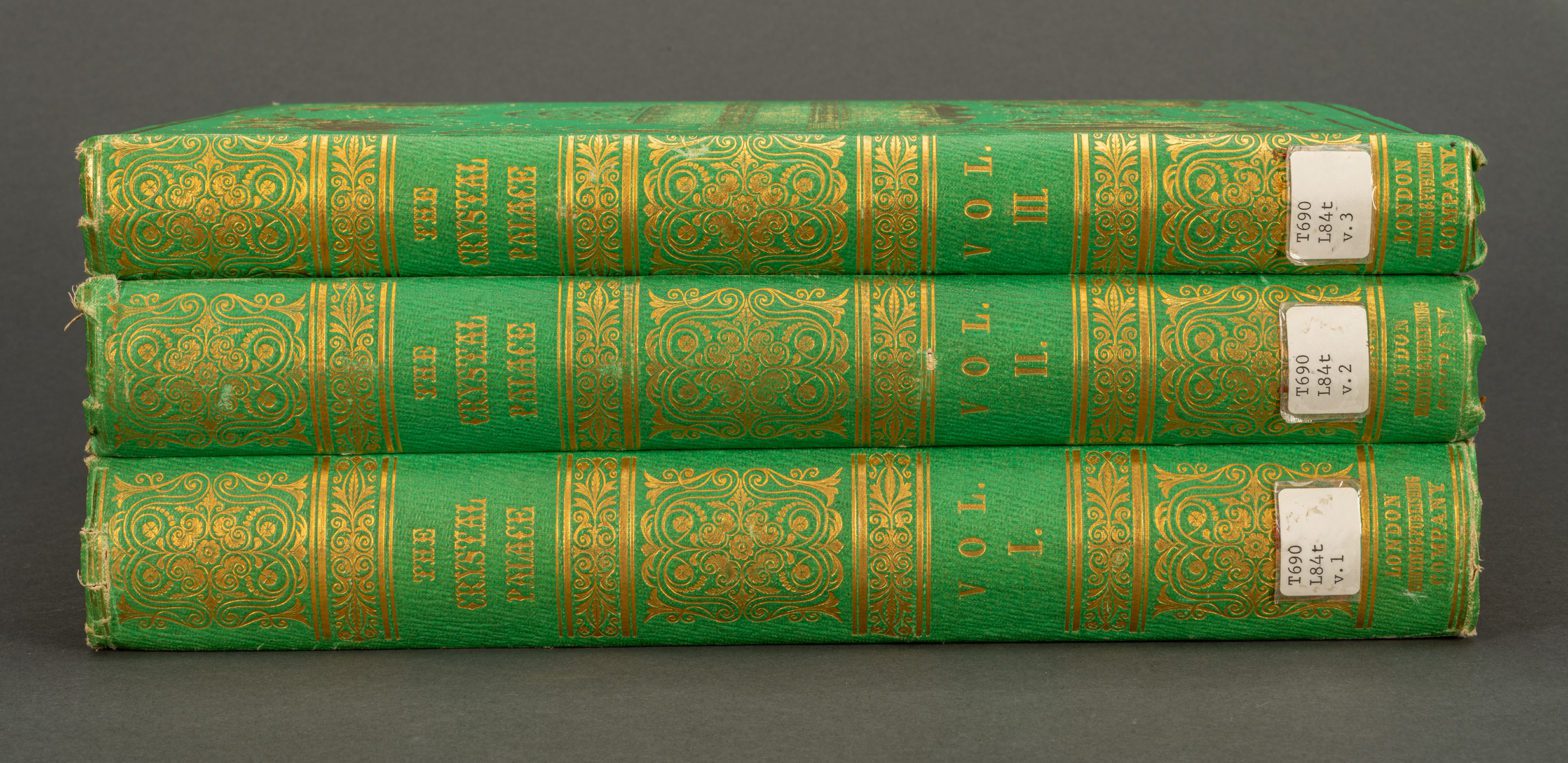
Dr. Melissa Tedone, head of the book and library materials conservation lab, was examining the green cloth on a second edition of Rustic Adornments for Homes of Taste from the Winterthur Library when she noticed the starched coating wasn’t behaving like other dyed cover cloths. She knew about widespread use of a pigment called emerald green in wallpapers of the 19th century, and she was familiar with recent literature about its toxicity. She wondered if the book cloth contained the same poisonous compound.
X-ray fluorescence of Rustic Adornments, conducted by Dr. Rosie Grayburn, head of the Scientific Research and Analysis Laboratory at Winterthur, revealed dangerous copper acetoarsenite, which gives emerald green pigment its peculiar hue. Emerald green was widely used in the 19th century by wallpaper manufacturers and textile makers and caused widespread health problems and even deaths in Europe. Subsequent testing of Tedone’s initial sample revealed toxic levels of arsenic. “It was a lot more than we expected,” Tedone says.
Testing of other green books in Winterthur’s circulating collection turned up four volumes with the toxic pigment, while another five volumes in the Rare Book Collection tested positive. All were of similar vintage (1840s–1860s) and of American or English imprint. Further tests revealed that the pigment is highly friable, meaning it offsets easily when handled.
A later visit to The Library Company of Philadelphia to scan green books of similar vintage revealed 28 arsenical books in its collection, which confirmed the trend. The height of popularity for emerald green pigment in book cloth was in the 1850s in England and the United States. “These bindings are very common in libraries and private collections,” Tedone says.
Owing to the color’s popularity at the time, an untold number of books could contain the compound, and those volumes are highly desired for their beautiful color and gold-decorated covers. Collectors and others need to know the health risks, as do library professionals and other users.
Tedone presented her initial findings and then further research at the Smithsonian Safety and Culture Heritage Summit in October 2019, the American Institute of Conservation Annual Meeting in May 2020, The Grolier Club in May 2021, and the Friends of the University of Delaware Library in November 2021. She is currently working with staff at the University of Delaware Library and the British Library to analyze their collections while working with health and safety experts to develop safe strategies for storing and using these books.
To help librarians, collectors, and booksellers identify arsenical books in their own collections, Winterthur has printed emerald-green color swatch bookmarks with information on identifying and handling these books.