Search Site

Ella Wesner: “An Excellent Man upon the Stage”

By Allie Alvis, Curator of Special Collections

Imagine that you, a young Victorian lady, are spending a night out with friends at the theater. As the playhouse dims, a spotlight illuminates the figure of Champagne Charlie, the picture of swaggering, stylish masculinity. Charlie captivates the audience with amusing tales of chivalry and his ability to please women, accompanied by a parade of chorus girls in “bright but somewhat abbreviated habiliments.”1 You swoon; if only you could find a man like that! But that would be difficult—for, you see, Champagne Charlie is a woman by the name of Ella Wesner.

Advertisement images for Ella Wesner, in Specimens of Theatrical Cuts, by Ledger Job Printing Office (Philadelphia: Ledger Job Printing Office, 1872). 

The drag show is not a modern phenomenon. In fact, the term “drag” likely dates to the stages of Elizabethan England, referring to male actors playing women’s roles in plays including those of Shakespeare.2 And almost as soon as women were legally allowed to be professional actors on the English stage in the mid-17th century, there emerged the “breeches role”—a male part written for or cast as a woman, who would don a masculine costume.

At various points, laws and edicts banned the practice of performing roles outside one’s gender, but the intrepid players persisted, and some even used this restriction as a marketing tool. The roving variety entertainers of the 19th century refined their response into the male impersonator act.

Advertisement images for Ella Wesner, in Specimens of Theatrical Cuts, by Ledger Job Printing Office (Philadelphia: Ledger Job Printing Office, 1872). 

Ella Wesner (she/her) was one such performer at the peak of her fame in the 1870s and ‘80s. Born in Philadelphia in 1841 to a family of actors and dancers, Wesner began her career in ballet and performed “Bel Demonio” in 1864 alongside Felicita Vestvali, who acted in a breeches role in the show.3 Wesner watched Vestvali and learned and later earned a place as a dresser for Annie Hindle, the first male impersonator to make it big in America.

Wesner made it big herself in 1870, sauntering across stages as male characters, including the debonaire Champagne Charlie, the cigarette-smoking Sweet Caporal, Jinks the Jovial Showman, and the amusingly drunk Teetotal. Reviews proclaimed her “a Beau Brummell par excellence” 4 and “an excellent man upon the stage,”5 and she became one of the highest-paid variety performers of the period.6 An 1870 review of her act celebrated her “almost faultless form, a face quite masculine and jet black curling hair, which she wears cut short.”7  Her success was the result of not just hard work, but of advertising. This is where the Winterthur Library comes in.

Advertisement images for Ella Wesner, in Specimens of Theatrical Cuts, by Ledger Job Printing Office (Philadelphia: Ledger Job Printing Office, 1872). 

The library special collections holds a copy of an 1872 trade catalog titled Specimens of Theatrical Cuts, which is a compendium of thousands of illustrations produced by the Philadelphia-based Ledger Job Printing Office. These illustrations were created to be used by newspapers, theaters, and various other agents to advertise the acts and shows coming through town. Many were quite formulaic and could be used for any play or performance that even vaguely touched upon the dramatic or comedic scenes depicted. Among these stock images are illustrations of particularly well-known performers of the day, including four different depictions of Ella Wesner.

Advertisement images for Ella Wesner, in Specimens of Theatrical Cuts, by Ledger Job Printing Office (Philadelphia: Ledger Job Printing Office, 1872). 

Her inclusion in this volume speaks not just to how prolific Wesner was as a performer, but to her dominance of the genre in the 1870s. Her illustrations are all captioned with her name, making it impossible to reuse them to advertise other male impersonators. Although her career had several ups and downs—at one point, she ran off to Paris with the mistress of a robber baron—her act was deeply influential for later generations of male impersonators, including Vesta Tilley and Ella Shields.

Wesner didn’t just dress as a man onstage; she “preferred men’s apparel” throughout her life and was buried in a suit per her request.8  This physical evidence of Wesner’s fame is one of many LGBTQIA+ stories found in the library collections.

Sources:

1. “Yesterday’s Concerts.”  Clipping.  1885.  Digital Transgender Archivehttps://www.digitaltransgenderarchive.net/files/6q182k40p

2. David A Gerstner. Routledge International Encyclopedia of Queer Culture. London: Routledge, 2006, page 191.

3. Gillian M. Rodger. Just One of the Boys: Female-to-Male Cross-Dressing on the American Variety Stage. Champaign: University of Illinois Press, 2018, pages 35–36.

4. Tom Gillen.  “DO YOU REMEMBER?”  Clipping.  1926.  Digital Transgender Archivehttps://www.digitaltransgenderarchive.net/files/wp988k17c

5. “MISS ELLA WESNER, The Acknowledged Beau-ideal of Society Entertainment, Surnamed ‘THE CAPTAIN.’.”  Clipping.  1910.  Digital Transgender Archivehttps://www.digitaltransgenderarchive.net/files/bg257f356

6. “OUR VARIETY ARTISTS.”  Clipping.  1881.  Digital Transgender Archivehttps://www.digitaltransgenderarchive.net/files/gt54kn32b

7. Catherine Smith and Cynthia Greig. Women in Pants: Manly Maidens, Cowgirls, and Other Renegades. New York: Harry N. Abrams, 2003, page 90.

8. “Ella Wesner Lies in Man’s Garb.”  Clipping.  1917.  Digital Transgender Archivehttps://www.digitaltransgenderarchive.net/files/xg94hp908

A Historical Collaboration

By Matthew Monk, Linda Eaton Associate Curator of Textiles

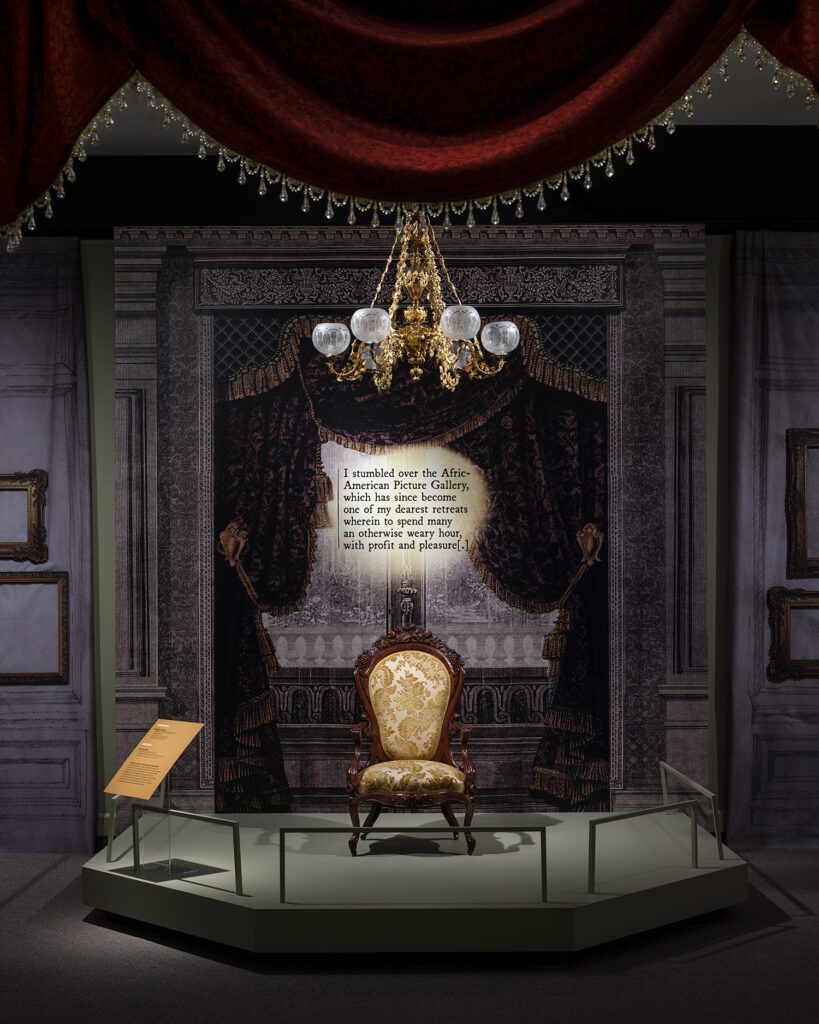
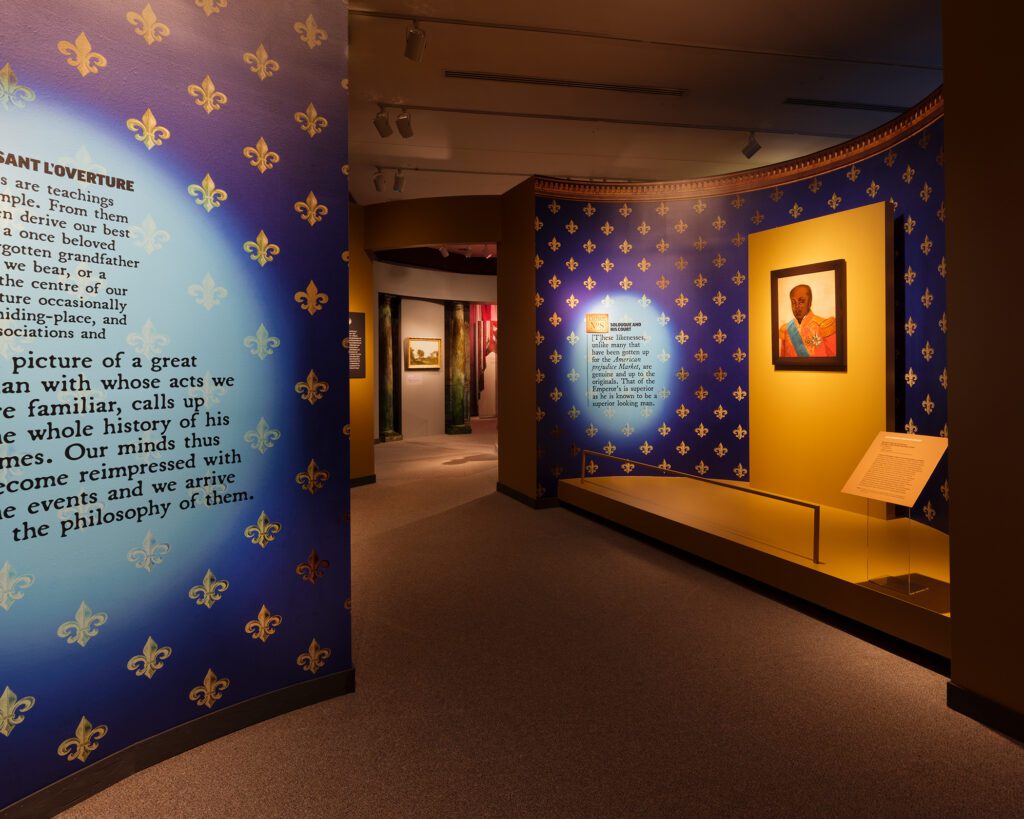
As you near the end of the Almost Unknown, The Afric-American Picture Gallery exhibition, you’ll see a large, red, white, and blue striped quilt. The colors may capture your attention at first, but many of its details are only seen up close.

Quilt, Germantown, Penn., 1861. Gift of Philip and Noelle Richmond 2020.0006

Priscilla (Ballenger) Leedom, a Quaker abolitionist and unionist, crafted the quilt in 1861 to protest the outbreak of the American Civil War. She wrote in her memoirs that Lewis Halbert, a free Black employee of her son, Dr. John Leedom, was the talented artist who drew the central motif for the quilt. In 1863, two years after drawing the eagle, he left Dr. Leedom’s employment to enlist in the Union Army.

Halbert’s drawing depicts an eagle clutching a leafy branch in its right talons and a bundle of arrows in its left. The eagle, projected on the wall beside the quilt in the Almost Unknown exhibition, reflects Halbert’s skills in intricate detail.

The quilt measures 81 inches high and 92 inches long. Its top was made from strips of plain weave red, white, and blue striped silk alternating with cream/gold-toned lighter-weight plain weave silk, finished with a gold silk fringe on three sides. It’s filled with thin cotton batting, and its backing is made of blue and white chambray. The center design features Lewis Halbert’s drawing joined with Priscilla Leedom’s sewing in an embroidered eagle worked in silk floss. The eagle’s body is sewn in white, while its eye and nostril are sewn in black and gold/brown. Halbert’s eagle is surrounded by Leedom’s quilted stars and ivy borders worked in white.

Halbert’s pencil design shows through in several areas under the embroidery, and the gray and blue chalk lines reveal Leedom’s quilting pattern. Interestingly, the needlework-quilted eagle acts as the thread that holds the entire textile together.

Priscilla Leedom’s father was an abolitionist who hid self-emancipated Black Americans in the family’s southern New Jersey home. Priscilla’s formal education in Philadelphia included attending various prestigious schools and studying drawing. The Ballenger and Leedom families employed Black domestic workers from the community of Free Black Americans who lived in Philadelphia. Priscilla Leedom spoke fondly of many of these family employees in her memoirs, and she and other women abolitionists created fancy goods, some depicting abolitionist motifs, to sell at anti-slavery fairs. The money they raised went to support the cause of abolition and those fighting to emancipate themselves and their families.

As you wend your way through the exhibition, be on the lookout for this remarkable quilt. Consider its meaning as marking a unique moment in history and how its story adds to the narrative of Almost Unknown, The Afric-American Picture Gallery.

Becoming Peale

Opening September 28, 2027

Meet the first family of American artists who depicted the dawn of the nation and forged a lasting cultural legacy.

The enduring influence of the Peale family of artists on the nation’s art, innovation, and cultural identity is revealed in this landmark exhibition bringing together the museum’s collection of Peale art and archival treasures for the first time.

Garden Club of America Inducts Winterthur CEO Chris Strand as 2025 Honorary Member

WINTERTHUR, DE – May 20, 2025—The Garden Club of America (GCA) recently inducted Chris Strand, Charles F. Montgomery Director and CEO of Winterthur Museum, Garden & Library, as one of its four new honorary members for 2025.

Since 1916, the GCA has recognized the extraordinary achievements of more than 400 honorary members who have made significant contributions in the fields of horticulture, conservation, or whose knowledge and interests align with and help achieve the GCA’s purpose.

Kim Cory, GCA awards committee chair and president of the Albemarle Garden Club in Virgina, formally introduced Strand as an honorary member at the GCA’s Annual Meeting on April 28 in Ponte Vedra, Fla.

The GCA selects a small number of individuals each year for the honor from among 12 geographic zones. Candidates are nominated by GCA member clubs nationwide and undergo a thorough review by the Awards Committee and Executive Board.

The Garden Club of Wilmington in Wilmington, Del., proposed Strand for induction as a national honorary member and President Wendy Mahoney Russell endorsed him. The nomination was seconded by The Gardeners in Villanova, Pa., and endorsed by its President Michele Jameson.

One nomination letter for Strand noted that he combines “horticulture knowledge with vision and determination” and “is an ideal ambassador for horticulture at Winterthur and beyond.” 

Throughout his career, Strand has demonstrated a unique ability to connect people with gardens. His work has included initiatives that supported community gardeners and farmers markets in Virginia; guiding summer interns and educational programs at Callaway Gardens in Georgia; and creating meaningful experiences for visitors of all ages at Winterthur.

“I am very grateful and humbled for this extraordinary honor. My journey through gardens has been an exceptional privilege. From the historic landscapes of the Arnold Arboretum to the breathtaking grounds of Winterthur, each step has been an opportunity to connect people with wonder-inspiring narratives written in leaves, branches, and blooming landscapes,” said Strand upon being inducted.

“Whether working with community gardeners, guiding summer interns, or coordinating volunteer programs, I have always believed that gardens are more than collections of plants,” he added. “They are living classrooms, sources of inspiration, and bridges between human experience and the natural environment.”

In 2021, Strand became the first Winterthur director and CEO to rise through the organization’s ranks—an achievement reflecting his dedication, leadership, and deep understanding of its mission.

Prior to becoming CEO, he served as the Brown Harrington Director of Garden and Estate at Winterthur for almost 16 years. In that role, Strand managed Winterthur’s 60-acre wild garden and nearly 1,000 acres of woodlands, meadows and waterways, working with the horticulture, natural lands, facilities, and security teams.

Significant contributions include working with the garden team to maintain and preserve what founder Henry Francis du Pont created throughout Winterthur’s naturalistic garden, which was inspired by William Robinson’s wild garden style. The garden team also began planting trees again in the early 2000s, ending a hiatus of several decades following du Pont’s death in 1969. For example, the team propagated two new trees from the pair of Sargent cherry trees that have graced Garden Lane since Charles Sargent gifted them to du Pont in 1918. Doing so ensures future generations can enjoy these specimens once the original trees meet the end of their lifecycle.

“Gardens are fragile,” said Strand. “We’re trying to hold onto the way this was designed even as climate is changing, life cycles of plants are changing, and even as fashion changes. We’ve been pretty good at navigating. There’s always that pressure for us to make sure the garden is recognized as the garden he created.”

Before joining Winterthur, Strand was director of Green Spring Gardens in Fairfax County, Va., from 1998 to 2005, where he managed the garden’s continuing evolution from a private property to a public garden and historic site. He was an outreach horticulturalist at the Arnold Arboretum at Harvard University from 1993 to 1998, where he oversaw a 265-member volunteer corps.

Strand earned a bachelor’s degree in Environmental, Population, and Organismic Biology from the University of Colorado in 1989. He also earned a master’s degree in Public Horticulture Administration with a certificate in Museum Studies through the Longwood Graduate Program Fellowship of the University of Delaware in 1992.

In 1956, the GCA awarded du Pont with a Medal of Honor for outstanding service to horticulture. The awards committee lauded his knowledge of plants, placement, and use of rare specimens planted with taste and discrimination throughout Winterthur, “where he established a botanical garden of dramatic beauty” that’s regarded as “one of the world’s great gardens.”

In accepting the award, du Pont highlighted his horticultural beginnings, how the garden progressed over six-plus decades, and his more recent work. He closed with an invitation: “I’m counting on your visiting Winterthur many times to see what I am trying to do.”

After Strand’s induction as an honorary member, he echoed that sentiment to 600 members in attendance at the GCA 2025 annual meeting. “I am fortunate to be a steward of Winterthur,” said Strand. “Let me repeat Mr. du Pont’s invitation. We hope that you will visit us and see what Henry Francis du Pont was trying to do. Thank you for this. This honor is not just a recognition of my work, but a celebration of every gardener, volunteer, and passionate individual who understands and promotes the transformative power of gardens.”

###

About the Garden Club of America
Founded in 1913, the GCA is a nonpartisan, issue-oriented advocate for a beautiful, healthy planet. It is a nonprofit national organization recognized for leadership in horticulture, conservation, creative arts, historic preservation, and environmental protection. Its mission is to bring its 200 member clubs together to cultivate a bond among people, plants, and the environment. The GCA member clubs consist of 18,000 club members who devote energy and expertise to projects in their communities and across the country. For more information about The Garden Club of America and its honorary members, visit www.gcamerica.org.

About Winterthur Museum, Garden & Library
Winterthur—known worldwide for its preeminent collection of American decorative arts, naturalistic garden, and research library for the study of American art and material culture—offers a variety of tours, exhibitions, programs, and activities throughout the year. Admission includes a self-paced house tour, exhibitions, a narrated tram ride (weather and space permitting), and the Winterthur Garden.

Winterthur is located on Route 52, six miles northwest of Wilmington, Delaware, and five miles south of U.S. Route 1. Winterthur is committed to accessible programming for all. For information, including special services, call 800.448.3883 or visit winterthur.org. Winterthur is closed seasonally from early January through late February.
Lessons from Winterthur’s Gardens on Design

By Allie Kochinsky | @TheGrandmillennialLifestyle

Set among the rolling hills of Delaware, the garden at Winterthur is more than beautiful—it’s a layered, living lesson in how landscape can shape how we live and design. Henry Francis du Pont, the visionary behind Winterthur Museum, Garden & Library, didn’t simply create a garden; he orchestrated an immersive experience that merged horticulture with heritage and elegance with ecology.

And maybe that’s what makes the garden at Winterthur so enduring; it isn’t just a backdrop to a historic home—it’s part of the story.

Design with the Season in Mind

Du Pont’s garden is a masterclass in seasonality. Each turn of the path reveals something new depending on the time of year–azaleas in spring and woodland textures in winter. This intentional progression reminds us to think seasonally in our own spaces. Whether through tabletop florals or rotating textiles, embracing the rhythm of the seasons brings a home to life.

Embrace Naturalistic Textures

Winterthur’s landscape flows—soft borders, curving paths, texture, and tone layers. Translating this into interiors invites us to blend materials, textures, and periods in thoughtful, storied ways. Rooms feel richer when they echo nature’s complexity.

Federal Parlor

Let the Outdoors Lead

Du Pont believed gardens should inform what happens inside the house, too. The blooms outside Winterthur’s windows often inspired floral motifs in upholstery, the palette of a room, or even a table setting. This principle is powerful for those of us drawn to heirloom living: let your home’s landscape whisper to your interiors. A pink camellia blooming out the window might be your next napkin color.

Continue reading on The Grandmillennial Lifestyle blog, and listen to my interview with Alexandra Deutsch, Director of Collections, on Grandma’s Silver.

New Membership Program FAQ

What is Winterthur’s new membership program? 

Our new streamlined membership program has all the great benefits our Members know and love plus new flexible visiting options to fit each Member’s unique needs. Memberships can be shared between people living in different households and any named Member can bring guests to Winterthur as long as the number of adults and children doesn’t exceed the limit of daily admissions based on your membership level. You may also use a guest pass.

When does the new membership program begin? 

  • July 1, 2025

I am a current Member. What happens to my membership on July 1? 

All current Members will retain their membership status with the new program. Your current membership level will switch to the closest corresponding level in the new program at no additional cost, with the expiration date remaining the same. When renewing, you will need to renew at a level in the new program.

Why did the program change? How did you decide on the changes? 

We are always striving to better the Winterthur experience for Members. In response to Member feedback, we are evolving our Member program to provide you with more flexibility.

What is new? 

All of the benefits you love will continue. The new feature of our membership program is the ability to bring a guest at any time at the Winterthur 2 and up level. These levels allow the corresponding number of people to visit on the membership as long as 1 named cardholder is present.

What will the new levels be?

  • Winterthur 1: for one person 
  • Winterthur 2: for two people
  • Winterthur 2 plus kids: for two people and up to four additional children under the age of 18
  • Winterthur 3: for three people and up to four additional children under the age of 18
  • Winterthur 4: for four people and up to four additional children under the age of 18

Winterthur 2 and up may have up to 2 named cardholders. One cardholder must be present.

I am a current Member, what will be my new level be?

  • Young Adult and Individual Members—Winterthur 1 Members
  • Dual Members—Winterthur 2 Members 
  • Family Members—Winterthur 2 plus kids Members
  • Contributor Members—Winterthur 3 Members
  • Family Plus Members—Winterthur 4 Members

Your membership number and expiration date remain the same.

What if I would like to upgrade to a different level?

You may upgrade your membership online, over the phone, or on-site.

If you wish to upgrade within the first six months of your membership:

  • You will be asked to pay the difference between your current level and the level you wish to upgrade to. You will receive all of the benefits of the membership level you have upgraded to and your expiration date will remain the same. 

If you wish to upgrade after the first six months of your membership:

  • You will be asked to pay the full price of the upgraded membership. The upgraded membership will start on the date of the upgrade purchase, and we will extend your Membership a full year from that expiration date.

What if I have children?

A child can be the second guest on the Winterthur 2 level. If you need to accommodate additional children, the Winterthur 2 + kids and above levels all include up to 4 additional children along with the additional Member cards. 

I am a current Member; will I receive cards with my new level after July 1?

New membership cards for the updated program will not be automatically distributed. Your current membership card and Member number will continue to give you access to the estate and your other benefits. Your membership card will be updated either a) when you renew or upgrade after July 1 or b) on your next visit, by request.

Will my membership level as a Patron, Benefactor, or Friend of Winterthur change?

Along with the pride of supporting Winterthur, our Patron, Benefactor and Friends of Winterthur memberships will retain all the current benefits plus will receive the flexibility granted at the Winterthur 4 level.

Will my benefits change?

No, Winterthur 2 and above level Members may have up to 2 named cardholders. One cardholder must be present. Our Patron, Benefactor, and Friends of Winterthur memberships will retain all the benefits plus will inherit the guest flexibility granted at the Winterthur 4 level.

Do I have to have a secondary cardholder?

Winterthur 2 and above may have up to two cardholders. Full membership benefits apply only to named cardholders. If your membership includes a secondary cardholder, we strongly recommend that you name a second cardholder to take advantage of all the benefits of the level of membership you selected, such as discounts in the store and café, special event invitations, and most notably, the ability to bring a guest at the Winterthur 2 and above level. 

For example, if Henry and Ruth are both named on the Winterthur 2 Membership, the following visiting scenarios* apply:

  • Ruth can visit with one friend, family member, or child. 
  • Henry can visit with one friend, family member, or child.
  • Ruth and Henry can visit together.

If Henry and Ruth are both named on a Winterthur 2 plus kids membership, 

  • Ruth can visit with one friend, family member, and up to four children.  
  • Henry can visit with one friend, family member, and up to four children. 
  • Ruth and Henry can visit together and bring up to four children.

*These scenarios do not account for any single-use digital guest passes a Member may have. 

Will I receive guest passes? 

In addition to the flexible guest options, all Members will receive single-use digital guest passes that are linked to their membership account, although the number of passes varies with each membership level. Members at the Winterthur 2 level and above can bring a guest at any time depending on the selected level.

More questions?

Visit our general Membership FAQ to find answers to questions such as how to set up a login, how to upgrade your membership, and more. 

Membership

Membership Means More!

Members help sustain Winterthur’s world-renowned collections, garden, and library—ensuring that future generations can explore the beauty and stories of America’s past.  In return, Members receive exclusive dawn-to-dusk access to our rolling meadows, waterways, stone bridges, and woodlands that surround a garden carefully designed to celebrate each season with a burst of color. Membership also includes a variety of exclusive benefits to enrich every visit and create lasting memories.

Membership Levels

Membership pays for itself in 2–3 visits! All Members enjoy the following benefits: 

  • Daily sunrise-to-sunset access to the garden
  • Free general admission 
  • Free or reduced-price admission to events and programs
  • Free admission to Yuletide
  • Members-only events
  • Reciprocal benefits through the American Horticultural Society

Simply select your level based on the number of people you choose to include:

Winterthur 1 ($85)

  • General admission benefits for 1 named cardholder
  • 2 one-time-use digital guest passes
  • 10% discount in the café and museum store

Join Now

Winterthur 2 ($115)

  • General admission benefits for 2 (1 named cardholder must be present
  • 2 one-time-use digital guest passes
  • 10% discount in the café and museum store

Join Now

Winterthur 2 Plus Kids ($135)

  • General admission benefits for 2 (1 named cardholder must be present) and up to 4 additional children
  • 2 one-time-use digital guest passes
  • 10% discount in the café and museum store

Join Now

Winterthur 3 ($185)

  • General admission benefits for 3 (1 named cardholder must be present) and up to 4 additional children
  • 4 one-time-use digital guest passes
  • Reciprocal admission benefits through NARM and ROAM
  • 10% discount in the café and 15% discount in the museum store

Join Now

Winterthur 4 ($200)

  • General admission benefits for 4 (1 named cardholder must be present) and up to 4 additional children
  • 4 one-time-use digital guest passes
  • Reciprocal admission benefits through NARM and ROAM
  • 10% discount in the café and 15% discount in the museum store

Join Now

Support Winterthur

Your membership helps:

  • Protect an unparalleled collection of 90,000 masterpieces of American antiques
  • Preserve America’s premier 60-acre naturalistic garden and surrounding landscape of 1,000 acres
  • Enhance the library’s renowned collection of rare books, manuscripts, and photographs

Support Winterthur at our Patron, Benefactor, and Friends of Winterthur levels!

Patron ($285)

All benefits of Winterthur 4, plus

  • 20% discount on an individual subscription to Winterthur Portfolio: A Journal of American Material Culture 
  • Complimentary admission for 2 to the Delaware Antiques Show 
  • Complimentary admission for 2 to a Director’s Reception
  • Object Research Assistance on 1 object

Join Now

Benefactor ($500)

All benefits of the Patron level, plus

  • Object Research Assistance on 2 objects
  • Complimentary one-year subscription to Incollect Magazine

Join Now

Friends of Winterthur ($1,000)

All benefits of the Benefactor level, plus

  • Object Research Assistance on 3 objects
  • Opportunity to host a private event at select Winterthur locations

Join Now


Memberships start the date they are purchased. Membership contributions are tax deductible to the extent allowed by law. Memberships are nonrefundable and nontransferable. Pricing, terms, and conditions are subject to change without notice.

You may pay for a membership via a Donor Advised Fund, IRA, or family foundation. Please note that all memberships paid through these methods will automatically have benefits marked declined, which includes waiving guest passes, and will be fully tax deductible.

Winterthur 2 and up may have up to 2 named cardholders. One cardholder must be present. Full membership privileges are reserved for card holders. * Children refers to those ages 18 and under. Children ages 2 and under are free.

Guest Code of Conduct

We commit to providing a safe, secure, and welcoming experience for all. Guests will be treated in a consistent, professional, and courteous manner by all staff. For more information, please review our complete Guest Code of Conduct.

Member Resources

Make the Most of Your Membership

Learn more about our Member perks, programs, and partnerships to unlock the full value of your Membership!

Member Programs and Events

Event: Director’s Garden Walk
Event start date
Feb.
14
Event time 1:00 pm-
2:30 pm

Audience: Member

Exclusively for Members! Take a walk through the garden with Chris Strand,…

Event: Wellness Yoga
Event start date
Feb.
17
Event time 9:00 am-
10:00 am

Audience: Member

Activate your internal energy and strengthen your body and spirit as you…

Event: Inside Winterthur: The Garden
Event start date
Feb.
24
Event time 11:00 am-
12:00 pm

Audience: Member

Exclusively for Members! Join us for a series of Members-only events looking…

Event: Member Bloom Report Guided Garden Walk
Event start date
Mar.
05
Event time 3:00 pm-
4:00 pm

Audience: Member

Exclusively for Members! Discover the beauty of the winter garden on a…

Event: Member Bonus Shopping Days
Event start date
Mar.
13
Event time 10:00 am-
5:00 pm

Audience: Member

Members receive an additional 10% off purchases at the Museum Store, Friday–Sunday.

Event: America’s Tapestry Project Demonstration
Event start date
Mar.
14
Event time 10:30 am-
4:30 pm

Audience: Adult, Family, Member

Be a part of America’s 250th anniversary. America’s Tapestry is a project…
Event: America’s Tapestry Project Demonstration
Event start date
Apr.
01
Event time 10:30 am-
4:30 pm

Audience: Adult, Family, Member

Be a part of America’s 250th anniversary. America’s Tapestry is a project…
Member Activities

Relax with an online puzzle or enjoy backgrounds for your Zoom calls and wallpapers for your desktop.
Learn More

Reciprocal Admission Benefits

All Winterthur Members receive free admission and additional benefits when a valid Winterthur Membership card is presented at botanical gardens, arboreta, and conservatories that participate in the American Horticultural Society’s Reciprocal Admissions Program.

Learn More

Retail Partnerships

We are pleased to offer Winterthur Members a variety of discounts from local retailers, museums, and gardens.

Learn More

Your Membership Matters

Thank you for your support of Winterthur as a Member! Members help sustain our world-renowned museum, garden, and library collections and help us pursue our vision to inspire exploration of American culture and landscapes.

“Even after all these years as a longtime Winterthur member, I still discover new gifts of beauty every time I visit these magnificent and magical gardens.”

–Winterthur Member

“I wanted to acknowledge how much I have enjoyed walking at Winterthur particularly in the last several months—it has been a wonderful respite. The peace and serenity of the garden is something I’ve appreciated for many years, and I will continue to enjoy many more walks through the seasons.”

–Winterthur Member


Memberships start the date they are purchased. Membership contributions are tax deductible to the extent allowed by law. Memberships are nonrefundable and nontransferable. Pricing, terms, and conditions are subject to change without notice.

You may pay for a membership via a Donor Advised Fund, IRA, or family foundation. Please note that all memberships paid through these methods will automatically have benefits marked declined, which includes waiving guest passes, and will be fully tax deductible.

Winterthur 2 and up may have up to 2 named cardholders. One cardholder must be present. * Children refers to those ages 18 and under. Children ages 3 and under are free. Full membership privileges are reserved for card holders. 

Guest Code of Conduct

We commit to providing a safe, secure, and welcoming experience for all. Guests will be treated in a consistent, professional, and courteous manner by all staff. For more information, please review our complete Guest Code of Conduct.

Shedding a Light on Winterthur

By Lauren Ullman

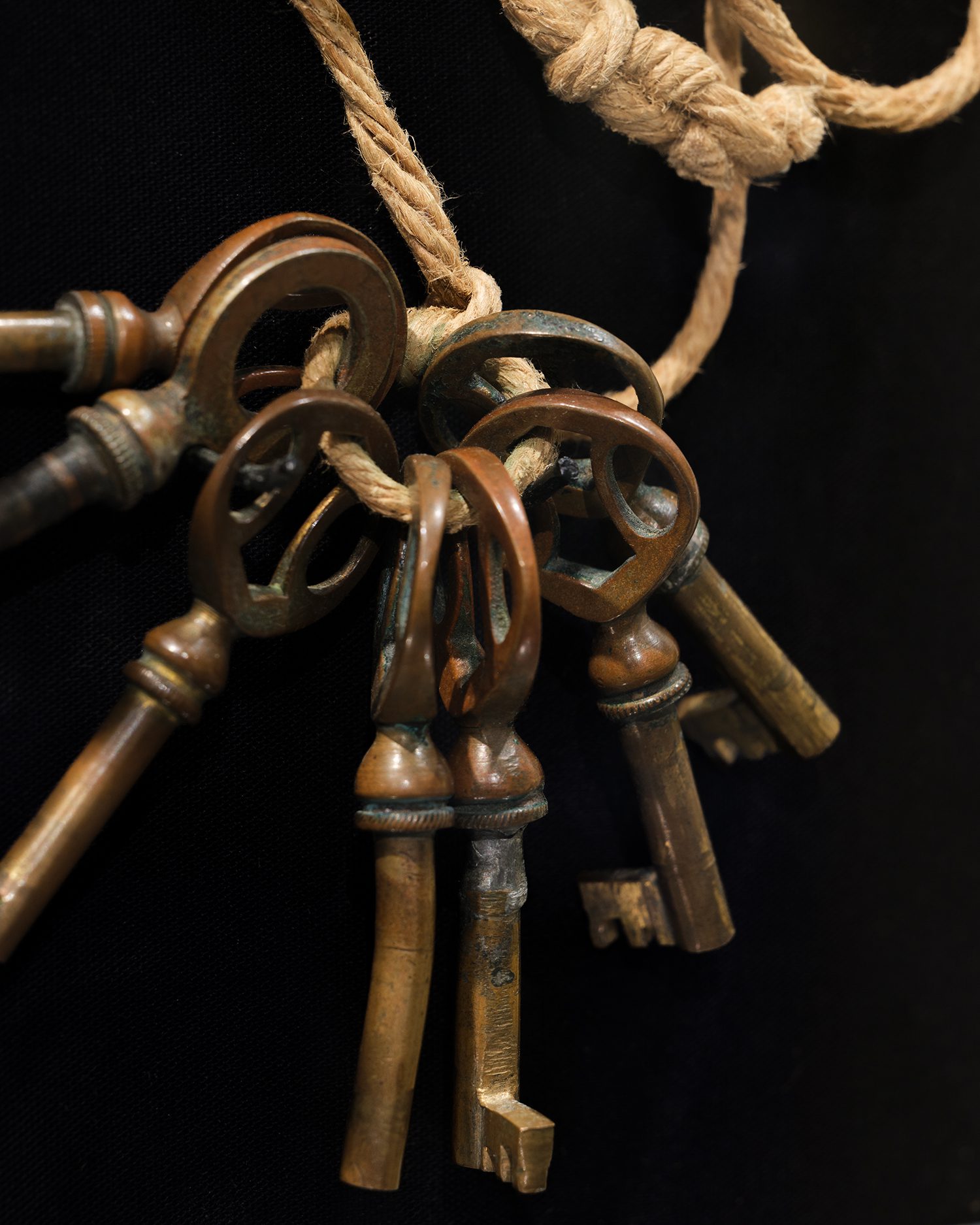
When you enter the house on a tour and admire the objects and their placement, have you ever considered how beautifully lit the rooms are? Have you noticed the many historic light fixtures throughout? Let’s explore lighting in the house and look at a few of the fascinating lighting fixtures at Winterthur.

American merchants in the colonial era sold imported chandeliers, candlesticks, snuffers with trays, and other essential items, often made of iron, copper, and tin. These historically expensive and sometimes exotic goods caught the eye of Henry Francis du Pont, who added them to his museum rooms. 

Triton Candlestick, Staffordshire, Eng., 1791–1818. Bequest of Henry Francis du Pont 1957.0794

In 1958, du Pont acquired his first Argand lamp. Created in 1780 by French physicist Aimé Argand, these lamps revolutionized lighting with their incredible light output four-to-ten-times brighter than a candlestick. Du Pont also purchased a few dozen fat lamps, an ancient form of lighting traditionally presented to young brides as wedding gifts by their parents. This example, created in 1848 by John Long of Lancaster, Pennsylvania, features his maker’s name and the year, the name of the woman it was designed for, and a brass bird embellishment.

Du Pont also collected elaborate chandeliers and candlesticks. Prior to the invention of the self-consuming wick in the mid-19th century, a candlewick had to be trimmed every seven minutes. While that task was simple for handheld objects, it was difficult in an elevated, delicate chandelier, so they were mainly owned by people who could afford to have footmen and servants tend them. 

Candlestick, Hamburg, Ger., 1777–1817. Gift of Henry Francis du Pont 1956.0038

Winterthur’s collection boasts many redesigned chandeliers, some purchased already altered, while others were sent to du Pont’s connections around the world to alter. One such chandelier hangs in the Chinese Parlor, which can be seen on the self-guided tour. Likely created in 1780, it contains various English elements that were added prior to du Pont’s purchase, including a receiver bowl (once a dessert dish) and a lower canopy (once the foot of a glass candlestick).

In the Readbourne Parlor hangs a rare silver chandelier from Ireland, which was crafted by Galway goldsmith Mark Fallon. It is engraved with dedications to the Dominican monastery for the Order of Preachers and names two sisters, Bridget and Ann Lynch. On the lower ball of the chandelier, the sisters’ names are joined by that of their brother, John Lynch.

Candlestick, Staffordshire, Eng., 1800–1820. Bequest of Henry Francis du Pont 1958.1174

Candlesticks also fill many of the museum rooms, and there is even a room just for candlesticks. Some of these include a pewter candlestick crafted by German artist Hinrich Gottfried Wellman in 1794, a Triton candlestick made by potter Enoch Wood and chandler James Caldwell, and a black basalt dolphin candlestick created by Wedgwood and Sons in the early 1800s. 

Relighting 175 Rooms 

When the museum first opened, it was lit by electrified candles and daylight, and tour guides equipped with flashlights led guests through the rooms. The rooms were dim, and window filters added later decreased the ambient light even more. 

In 1997, Winterthur began the House Lighting Project to address these issues. A delicate and monumental undertaking, the project required all the objects in each room to be carefully packed and stored. Phased closure of each floor in the house allowed for extensive reconstruction. Electrified candles and lamps were replaced since the original versions designed during du Pont’s time did not pass the current safety code. 

Today, lighting is organized by zones, designed in layers, and controlled with handheld remotes. Each room appears to be lit from windows and candlelight, undisturbed by the modern world. 

Daily maintenance, careful consideration, and years of study inform the lighting in each museum room at Winterthur. Various implements in the house demonstrate methods of lighting throughout history and the artistry of each creator. The next time you take a tour in the house, notice how the lighting in each room contributes to your experience. If you’re interested in the history of lighting, the mural across from the entrance to the Touch-It Room, painted by artist Elizabeth Lindsay, depicts the history of lighting fixtures in America.

Links:

  1. Argand lamp, Matthew Boulton’s Soho Manufactury, Birmingham, Eng., 1784–86. Bequest of Henry Francis du Pont 1958.2950
  2. Chandelier, England, 1900–1930. Bequest of Henry Francis du Pont 1959.1483
  3. Chandelier, Galway, Ire., 1742. Bequest of Henry Francis du Pont 1956.0519 A-GG
  4. Candlestick, Hamburg, Ger., 1777–1817. Gift of Henry Francis du Pont 1956.0038
  5. Triton Candlestick, Staffordshire, Eng., 1791–1818. Bequest of Henry Francis du Pont 1957.0794
  6. Candlestick, Staffordshire, Eng., 1800–1820. Bequest of Henry Francis du Pont 1958.1174