A question we often hear this time of year is, “When should I prune my spring flowering shrubs?” Azaleas and forsythia, for example, can take us by surprise in spring by how much they have grown. You may need to prune your shrubs to restore their shape or to reclaim a path or part of a bed. In general, the correct time to prune these shrubs is right after flowering. Prune by removing weak or damaged wood and by cutting flowering branches back to areas of vigorous growth. Be sure to keep an eye on the shape and habit of the plant by stepping back and reviewing your work frequently. By pruning right after flowering, you allow the plants to develop replacement shoots that will mature and flower the next season. If you delay pruning too late into the growing season, or into the winter, new shoots won’t develop or they will not ripen enough to produce flowers. This rule of thumb can be used as a general guide for azaleas, forsythia, corylopsis, flowering quince, lilacs, and most other shrubs that flower in spring.

On the second Saturday of each month, one of our staff members leads a walk highlighting something special in the garden or on the estate. These
‘Second Saturdays Walks’ are free to
Members and are included in the Garden & Galleries pass for nonmembers. The walks have become a great way for us to meet and share the landscape with our supporters. This Saturday’s walk will highlight
winter hazels and azaleas, but will also include many of the other spectacular sights in the garden.
In case of inclement weather, call 302.888.4915 after 10:00 am. Walks last approximately 90 minutes and begin at the Visitor Center.
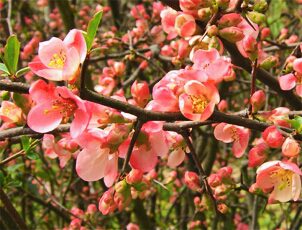
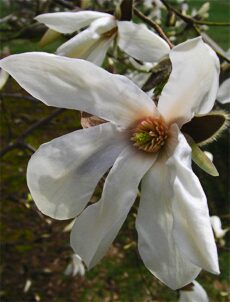
The blossoms of flowering quince are a sure sign that Winterthur’s Sundial Garden is about to come into its own. In the Sundial Garden, April is like a fireworks show—light the fuse and stand back. This part of the Winterthur Garden was not designed to offer multiple seasons of interest; instead, it was created to look its best in April. With the warmth of the last couple of days, magnolia, quince, and spiraea have begun their display. Presiding over this colorful performance is one of Winterthur’s finest specimen trees, a large, cloud-like Magnolia called ‘Wada’s Memory.’
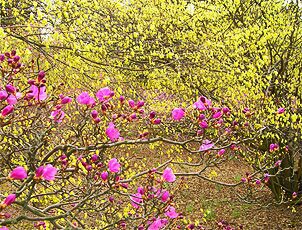
One of the most spectacular plant combinations in the Winterthur Garden is near its peak; the Winter Hazel Walk is a collage in shades of purple and pale yellow. The Walk combines the butter yellow of winter hazel (
Corylopsis spp.) with the pink to purple flowers of the Korean azalea (
Rhododendron mucronulatum). Hellebores, evergreens, and shrubs like the cherry prinsepia (
Prinsepia sinensis), play supporting roles. A visit in the morning or evening is a perfect time to enjoy the azaleas backlit against thousands of winter hazel blossoms.
More information about the garden and a
bloom calendar.
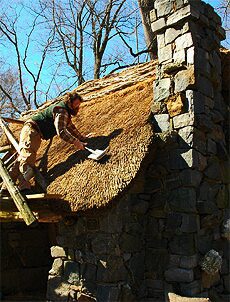
I am pleased to announce that the Faerie Cottage in
Enchanted Woods has been re-thatched. Our thatcher, William Cahill, spent several weeks replacing the mossy and worn roof on the cottage with fresh thatch. In the spirit of recycling and conservation, our new thatch roof uses phragmites, a common wetland grass found throughout the area that is considered by many to be a nuisance. Our phragmites roof should last much longer than a traditional reed thatch and uses a local weed that many consider fit only for the landfill.

Spring has arrived in the Winterthur Garden. The birds are singing, the flowers are blooming, and the white arrows have come out of hibernation to direct guests through the garden for Spring Tour. The route starts at the Visitor Center, meanders through the garden highlighting weekly seasonal changes, and ends at the Dorrance Gallery by the Reflecting Pool. Come out to see some old favorite floral combinations and perhaps a few hidden treasures!
Welcome to Winterthur’s Garden Blog. This is the first of what we hope will be many posts, with news and information about the garden and grounds of
Winterthur Museum & Country Estate in Winterthur, Delaware.