Search Site

Winterthur Bloom Report

Bloom Report #08

February 23, 2022

67 F, Cloudy
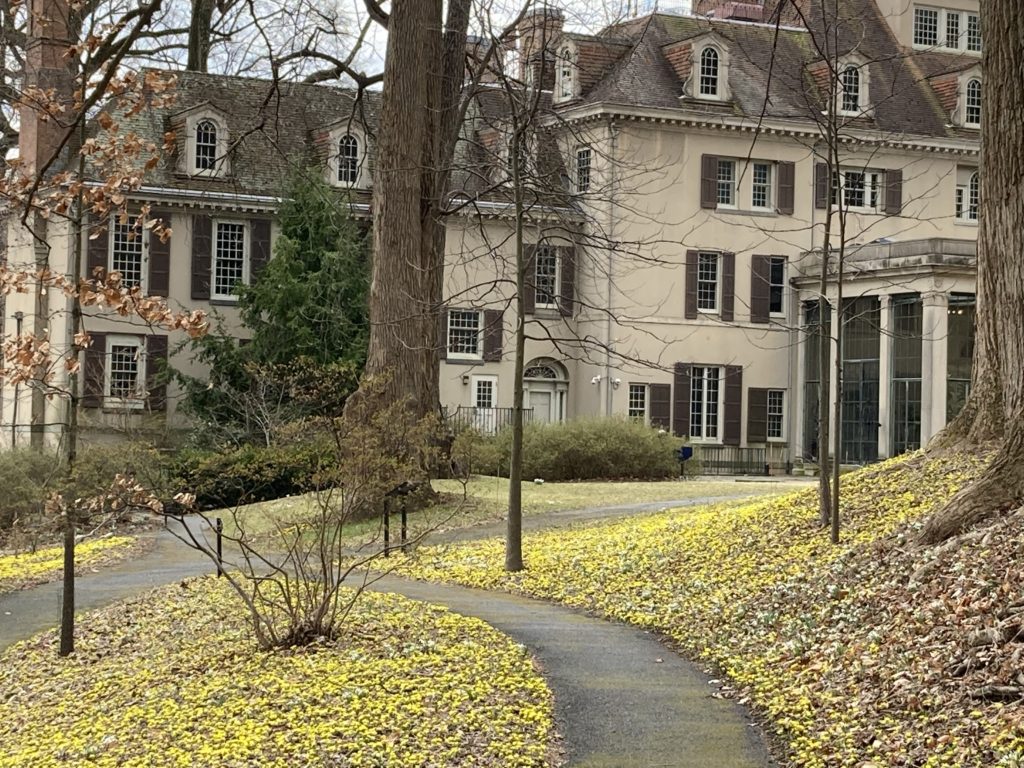
View of the duPont House from March Walk
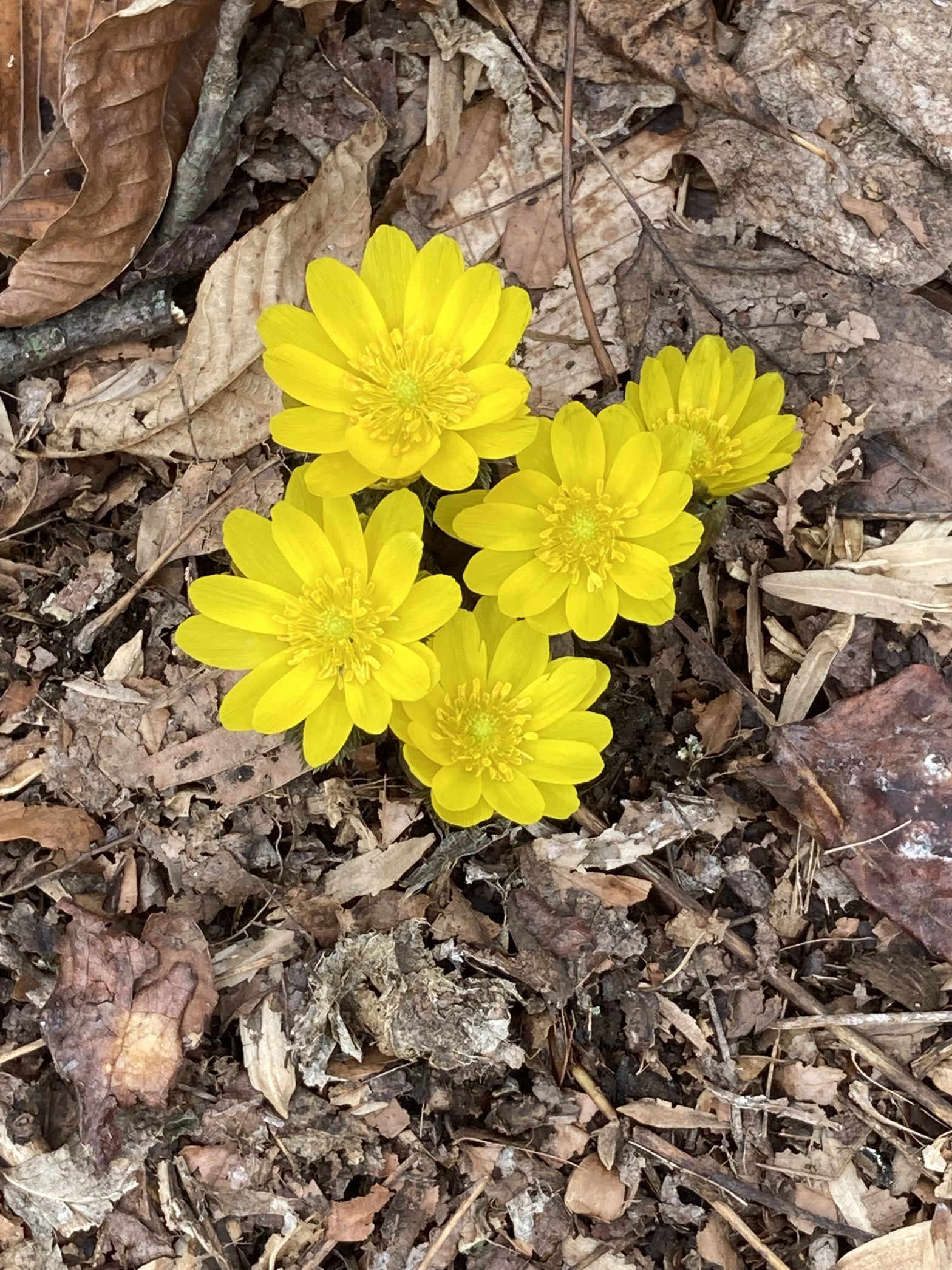
Winter aconites (Eranthis hyemalis)

Check these out:

  • Terrific Tapestries of color:
    • The early crocus, ‘Tommies’ (Crocus tommasianus) are blooming throughout the gardens and are carpeting the East Upper Terrace of the Museum lawn in lavender and silver.
    • The winter aconites (Eranthis hyemalis) are creating a carpet of gold from Garden Lane across the lawn down to the East Upper Terrace of the Museum and also along the March Bank, in Azalea Woods, and along the walk to the Glade and koi ponds, in Enchanted Woods and in many other places in the gardens.
    • The yellow winter aconites and golden yellow Amur adonis (Adonis amurensis) merge into the white carpet of snowdrops (Galanthus elwesii & Galanthus nivalis) along the March Bank.
  • Snowdrops:  
    • Snowdrops (Galanthus elwesii & Galanthus nivalis) are blooming throughout the estate, from the great drifts along the March Bank to small clumps and even individual flowers.
    • Many varieties of snowdrops (Galanthus varieties) in the collection in the raised beds along the East Museum terrace are in full bloom.
  • Witch hazel (Hamamelis species & varieties) are in full bloom in the Visitor Center lawn, in the Gallery lawn along Clenny Run, and on the Clenny Run side of the Museum Store, waving their blossoms that look like clusters of tiny ribbons.  They look and smell magnificent!

LAGOONS

ber       Celastrus scandens (American bittersweet – yellow husks, orange berries)

PARKING AREA TO VISITOR CENTER

fb         Crocus tommasinianus (‘Tommies’ – lavender and silver)

fb         Galanthus nivalis (Common snowdrop – white)

fb         Galanthus nivalis ‘Flore Pleno’ (Double snowdrop variety – white & green)

fb         Galanthus species (Snowdrop – white)

fb         Hamamelis mollis ‘February Gold’ (Chinese witch hazel variety – yellow ‘ribbons’)

WALK FROM VISITOR CENTER TO UNDERPASS

fb         Eranthis hyemalis (Winter aconite – yellow)

fb         Galanthus elwesii (Giant snowdrop – white)

b          Galanthus nivalis (Common snowdrop – white)

b          Galanthus nivalis ‘Flore Pleno’ (Double snowdrop variety – white & green)

fb         Hamamelis vernalis (Vernal witch hazel – rusty gold ‘ribbons’)

fb         Hamamelis mollis ‘Pallida’ (Pale Chinese witch hazel – yellow ‘ribbons’)

fb         Hamamelis ‘Wisley Supreme’ (Chinese witch hazel variety – yellow ‘ribbons’)

WALK FROM UNDERPASS TO MUSHROOM

fb         Eranthis hyemalis (Winter aconite – yellow)

fb         Galanthus elwesii (Giant snowdrop – white)

fb         Galanthus nivalis (Common snowdrop – white)

b          Leucojum vernum (Spring snowflake – white ‘bells’)

SLOPE DOWN TOWARDS MUSEUM

fb,+     Eranthis hyemalis (Winter aconite – yellow)

fb         Galanthus elwesii (Giant snowdrop – white)

b          Galanthus nivalis (Common snowdrop – white)

PEONY GARDEN

fb         Crocus tommasinianus (‘Tommies’ – lavender and silver – along lower end of walkway)

pf         Galanthus ‘Faringdon Double’ (Snowdrop variety – white – along walkway at end of Brown Center)

fb         Galanthus species (Snowdrop – white)

AZALEA WOODS

fb,+     Eranthis hyemalis (Winter aconite – yellow)

fb         Galanthus elwesii (Giant snowdrop – white)

b          Galanthus nivalis (Common snowdrop – white)

LOWER AZALEA WOODS

b          Eranthis hyemalis (Winter aconite – yellow)

b          Galanthus elwesii (Giant snowdrop – white)

UPPER/EAST TERRACE AND STEPS  

b          Camellia japonica ‘April Remembered’ (Camellia cultivar ‘April Remembered‘ – white to pale pink)

fb,+     Crocus tommasinianus (‘Tommies’ – lavender and silver)

fb         Galanthus ‘Alan’s Treat’ (Snowdrop variety – white – 1 flower)

fbb       Galanthus ‘Blonde Inge’ (Snowdrop variety – white – 1 bud)

b          Galanthus ‘E.A. Bowles’ (Snowdrop variety – white)

fb         Galanthus ‘Gloria’ (Snowdrop variety – white – 1 flower)

fb         Galanthus ‘Louise Ann Bromley’ (Snowdrop variety – white)

fb         Galanthus ‘Madelaine’ (Snowdrop variety – white)

fb         Galanthus ‘Phantom’ (Snowdrop variety – white)

pf         Galanthus ‘Potter’s Prelude’ (Snowdrop variety – white)

fbb       Galanthus ‘Primrose Warburg’ (Snowdrop variety – white)

fb         Galanthus ‘Puck’ (Snowdrop variety – double white)

fb         Galanthus ‘Starling’ (Snowdrop variety – double white)

fb         Galanthus ‘Trymlet’ (Snowdrop variety – white)

fb         Galanthus ‘Wasp’ (Snowdrop variety – white)

fb         Galanthus ‘Yashmak’ (Snowdrop variety – white)

fb         Hamamelis ‘Princeton Gold’ (Witch hazel variety – yellow ‘ribbons’)

fb         Jasminum nudiflorum (Winter jasmine – yellow)

b          Lonicera fragrantissima (Fragrant honeysuckle – white)

fbb       Pieris japonica ‘Dorothy Wycoff’ (Andromeda cultivar – rosy pink buds)

EAST FRONT OF MUSEUM & Around Corner

fb         Galanthus ‘Castlegar’ (Snowdrop variety – white)

fb         Galanthus ‘Cowhouse Green’ (Snowdrop variety – white)

fb         Galanthus elwesii (Giant snowdrop – white – behind Bath House)

fb         Galanthus elwesii ‘Green Brush’ (Giant snowdrop variety – white)

fb         Galanthus elwesii ‘Grumpy’ (Giant snowdrop variety – white)

fb         Galanthus elwesii ‘Natalie Garton’ (Giant snowdrop variety – white)

fb         Galanthus elwesii var. monostichtus (Giant snowdrop variety – white)

fb         Galanthus ‘Fieldgate Prelude’ (Snowdrop variety – white)

fb         Galanthus ‘Fieldgate Superb’ (Snowdrop variety – white)

pb        Galanthus ‘Gabriel’ (Snowdrop variety – white)

fb         Galanthus ‘Galatea’ (Snowdrop variety – white)

fb         Galanthus ‘George Elwes’ (Snowdrop variety – white)

fb         Galanthus ‘Imbolc’ (Snowdrop variety – white)

fb         Galanthus ‘John Gray’ (Snowdrop variety – white)

fb         Galanthus ‘Mrs. Thompson’ (Snowdrop variety – white)

fb         Galanthus ‘Mrs. Wrighton’s Double’ (Snowdrop variety – white – 1 flower)

fb         Galanthus species (Snowdrop – white – behind Bath House)

fbb       Galanthus ‘Spindlestone Surprise’ (Snowdrop variety – white – 1 bud)

fb         Galanthus nivalis ‘Elfin’ (Common snowdrop cultivar – white)

fb         Galanthus plicatus ‘Diggory’ (Snowdrop variety – white)

fb         Galanthus plicatus ‘Percy Picton’ (Snowdrop variety – white)

fb         Galanthus samothracus (Aegean snowdrop – white)

fb         Helleborus ‘Brandywine’ (Lenten rose varieties – pink, wine, white)

fb         Lonicera fragrantissima (Fragrant honeysuckle – white – along Garden Lane across from Bath House)

WALK FROM GLASS CORRIDOR TO REFLECTING POOL         

fb         Crocus tommasinianus (‘Tommies’ – lavender and silver)

fb         Eranthis hyemalis (Winter aconite – yellow)

fb         Galanthus elwesii (Giant snowdrop – white)

b          Galanthus nivalis (Common snowdrop – white)

WALK FROM FISH PONDS – THE GLADE – TO BRIDGE  

fb,+     Eranthis hyemalis (Winter aconite – yellow)

b          Galanthus nivalis (Common snowdrop – white)

fb         Galanthus nivalis ‘Flore Pleno’ (Double snowdrop variety – white & green)

fb         Galanthus species (Snowdrop – white)

b          Leucojum vernum (Spring snowflake – white ‘bells’)

MARCH BANK

fb,+     Adonis amurensis (Amur adonis – golden yellow)

fb,+     Eranthis hyemalis (Winter aconite – yellow)

fb,+     Galanthus elwesii (Giant snowdrop – white)

b,+       Galanthus nivalis (Common snowdrop – white)

b          Galanthus nivalis ‘Flore Pleno’ (Double snowdrop variety – white & green)

fb         Leucojum vernum (Spring snowflake – white ‘bells’)

MAGNOLIA BEND AND WALK ON SOUTH SIDE OF STREAM

fb         Eranthis hyemalis (Winter acontie – yellow)

fb         Galanthus elwesii (Giant snowdrop – white)

fbb       Galanthus nivalis (Common snowdrop – white)

b          Leucojum vernum (Spring snowflake – white ‘bells’)

GARDEN LANE

fbb       Viburnum farreri (Fragrant viburnum – pale pink to white)

WINTERHAZEL WALK

b          Helleborus foetidis (Bear’s foot hellebore – greenish)

fbb       Helleborus x hybridus (Lenten rose – pink, white – few flowers)

ICEWELL TERRACE

fb         Adonis amurensis (Amur adonis – golden yellow)

fb         Eranthis hyemalis (Winter aconite – yellow)

fb         Galanthus elwesii (Giant snowdrop – white)

fb         Galanthus placatus ‘Trym’ (Snowdrop variety – white)

fb         Galanthus plicatus ‘Trymposter’ (Snowdrop variety – white)

fb         Galanthus plicatus variety (Snowdrop variety – white)

fb         Galanthus species (Snowdrop – white)

b          Leucojum vernum (Spring snowflake – white ‘bells’)

PINETUM

fb         Eranthis hyemalis (Winter aconite – yellow)

fbb       Helleborus x hybridus (Lenten rose – pink, white – few flowers)

ENCHANTED WOODS

fb         Eranthis hyemalis (Winter aconite – yellow)

fb         Galanthus elwesii (Giant snowdrop – white)

b          Galanthus nivalis (Common snowdrop – white)

b          Galanthus species (Snowdrop – white)

fb         Hamamelis virginiana (American witch hazel – yellow ‘ribbons’)

b          Helleborus x hybridus (Lenten rose – dark pink – few flowers)

OAK HILLEast Side

fb          Eranthis hyemalis (Winter aconite – yellow)

fb         Galanthus elwesii (Giant snowdrop – white)

fb          Galanthus nivalis (Common snowdrop – white)

QUARRY, ADJACENT WALKS, AND OUTLET STREAM

b          Cornus officinalis (Japanese cornel – yellow)

b          Galanthus nivalis (Common snowdrop – white)

b          Galanthus species (Snowdrop – white)

fbb       Mahonia bealei (Leatherleaf mahonia – green)

fbb       Pieris ‘Forest Flame’ (Andromeda variety – dark rosy-pink buds)

b          Scilla siberica ‘Spring Beauty’ (Siberian squill – royal blue – 1 plant)

SYCAMORE HILL

ber       Cotoneaster salicifolia (Cotoneaster – bright red berries)

fb         Galanthus elwesii (Giant snowdrop – white)

fb         Galanthus nivalis (Common snowdrop – white)

WEST FRONT OF MUSEUM, COTTAGE, AND CLENNY RUN

fb         Chimonanthus praecox ‘Lutea’ (Wintersweet variety – pale yellow)

fb         Galanthus elwesii (Giant snowdrop – white)

fb,+     Hamamelis mollis (Chinese witch hazel – yellow ‘ribbons’)

fb         Hamamelis x intermedia ‘Sunburst’ (Witch hazel hybrid – yellow ‘ribbons’)

fbb       Helleborus x hybridus ‘Pine Knot Select-Our Best’ (Hellebore varieties/Lenten Rose – apricot, pink, pink spotted)

GREENHOUSE AREA

b       Galanthus woronowii (Snowdrop – white)

fbb       Helleborus x hybridus (Lenten rose – pink)

Bloom Report presented by: Pauline Myers

Winterthur Bloom Report

Bloom Report #06

February 9, 2022

45 F, Sunny

Magnolia Tree Trichomes

Check these out:

  • Snowdrops:  Snowdrops (Galanthus species and varieties) are in bud or in bloom throughout the gardens. Some blooms can be seen in the Peony Garden along the walkway at the end of the Brown Center, in the Boxwood Garden on the Museum upper terrace, along the March Walk, and in the raised bed in the Museum east courtyard.
  • Winter color:  The willow-leaf cotoneaster (Cotoneaster salicifolia) has brilliant red berries and dark purple leaves for a great show of color in winter.
  • Furry ‘winter coats’:  The buds of the magnolias at Magnolia Bend and in the Sundial Garden are covered by fuzzy bud scales.  The hairs that create the furry look are called trichomes.    

.

ENTRANCE DRIVE AND PARKING AREA

ber       Catalpa species (Catalpa – long, bean-like brown seed pods)

pb        Hydrangea paniculata ‘Grandiflora’ (Pee Gee hydrangea – brown)

LAGOONS

ber       Celastrus scandens (American bittersweet – yellow husks, orange berries)

SUMMER SHRUB SLOPE

pb        Hydrangea paniculata ‘Grandiflora’ (Pee Gee hydrangea – brown)

PARKING AREA TO VISITOR CENTER

b          Galanthus species (Snowdrop – white)

WALK FROM VISITOR CENTER TO UNDERPASS

fbb       Galanthus elwesii (Giant snowdrop – white)

fb         Hamamelis vernalis (Vernal witch hazel – rusty gold ‘ribbons’)

fb         Hamamelis mollis ‘Pallida’ (Pale Chinese witch hazel – yellow ‘ribbons’)

fb         Hamamelis ‘Wisley Supreme’ (Chinese witch hazel variety – yellow ‘ribbons’)

WALK FROM UNDERPASS TO MUSHROOM

fbb       Galanthus elwesii (Giant snowdrop – white)

PEONY GARDEN

fb         Galanthus ‘Faringdon Double’ (Snowdrop variety – white – along walkway at end of Brown Center)

b          Galanthus species (Snowdrop – white)

AZALEA WOODS

fbb       Galanthus elwesii (Giant snowdrop – white)

pb        Hydrangea arborescens (Smooth hydrangea – brown)

LOWER AZALEA WOODS

b          Galanthus species (Snowdrop – white)

UPPER/EAST TERRACE AND STEPS  

fbb       Camellia variety (Camellia variety – pink-tinged buds)

fbb       Galanthus ‘Alan’s Treat’ (Snowdrop variety – white – 1 bud)

fbb       Galanthus ‘E.A. Bowles’ (Snowdrop variety – white)

fbb       Galanthus ‘Gloria’ (Snowdrop variety – white)

fb         Galanthus ‘Louise Ann Bromley’ (Snowdrop variety – white)

fbb       Galanthus ‘Madelaine’ (Snowdrop variety – white)

b          Galanthus ‘Phantom’ (Snowdrop variety – white)

pf         Galanthus ‘Potter’s Prelude’ (Snowdrop variety – white)

fbb       Galanthus ‘Puck’ (Snowdrop variety – white)

b          Galanthus ‘Starling’ (Snowdrop variety – white)

fbb       Galanthus ‘Trymlet’ (Snowdrop variety – white)

fbb       Galanthus ‘Wasp’ (Snowdrop variety – white)

b          Jasminum nudiflorum (Winter jasmine – yellow)

fbb       Lonicera fragrantissima (Fragrant honeysuckle – white)

fbb       Pieris japonica ‘Dorothy Wycoff’ (Andromeda cultivar – rosy pink buds)

EAST FRONT OF MUSEUM & Around Corner

fb         Galanthus ‘Castlegar’ (Snowdrop variety – white)

fbb       Galanthus ‘Cowhouse Green’ (Snowdrop variety – white)

b          Galanthus elwesii ‘Green Brush’ (Giant snowdrop variety – white)

fb         Galanthus elwesii ‘Grumpy’ (Giant snowdrop variety – white)

fbb       Galanthus elwesii ‘Natalie Garton’ (Giant snowdrop variety – white)

b          Galanthus elwesii var. monostichtus (Giant snowdrop variety – white)

fb         Galanthus ‘Fieldgate Prelude’ (Snowdrop variety – white)

b          Galanthus ‘Fieldgate Superb’ (Snowdrop variety – white)

fb         Galanthus ‘Gabriel’ (Snowdrop variety – white)

fbb       Galanthus ‘Galatea’ (Snowdrop variety – white)

fbb       Galanthus ‘George Elwes’ (Snowdrop variety – white)

fb         Galanthus ‘Imbolc’ (Snowdrop variety – white)

b          Galanthus ‘John Gray’ (Snowdrop variety – white)

fbb       Galanthus ‘Mrs. Thompson’ (Snowdrop variety – white)

fb         Galanthus ‘Mrs. Wrighton’s Double’ (Snowdrop variety – white – 1 plant, 1 flower)

fbb       Galanthus plicatus ‘Diggory’ (Snowdrop variety – white)

fbb       Helleborus ‘Brandywine’ (Lenten rose varieties – pink, white)

ber       Ilex opaca (American holly – red berries – behind Bath House)

fbb       Lonicera fragrantissima (Fragrant honeysuckle – white – along Garden Lane across from Bath House)

WALK FROM GLASS CORRIDOR TO REFLECTING POOL         

fbb       Galanthus elwesii (Giant snowdrop – white)

pb        Hydrangea paniculata ‘Tardiva’ (Panicle hydrangea cultivar – brown)

WALK FROM FISH PONDS – THE GLADE – TO BRIDGE  

b          Galanthus species (Snowdrop – white)

pb        Hydrangea arborescens (Smooth hydrangea – brown)

MARCH BANK

b          Galanthus elwesii (Giant snowdrop – white)

MAGNOLIA BEND AND WALK ON SOUTH SIDE OF STREAM

fbb       Galanthus elwesii (Giant snowdrop – white)

pb        Hydrangea arborescens (Smooth hydrangea – brown)

pb        Hydrangea quercifolia (Oak leaf hydrangea – brown)

GARDEN LANE

ber       Crataegus viridis (Green hawthorn – red berries – few left)

ber       Koelreuteria paniculata (Golden rain tree – brown seed pods)

fbb       Viburnum farreri (Fragrant viburnum – pale pink to white)

ICEWELL TERRACE

b          Galanthus species (Snowdrop – white)

TRAFFIC CIRCLE

ber       Viburnum dilatatum ‘Xanthocarpum’ (Linden viburnum variety – ‘rusty’-yellow berries)

ENCHANTED WOODS

b          Galanthus elwesii (Giant snowdrop – white)

b          Galanthus species (Snowdrop – white)

pb        Hamamelis virginiana (American witch hazel – yellow ‘ribbons’)

pb        Hydrangea arborescens ‘Annabelle’ (Smooth hydrangea – brown)

pb        Hydrangea arborescens ‘Grandiflora’ ‘Hills of Snow’ (Smooth hydrangea – brown)

pb        Hydrangea quercifolia (Oakleaf hydrangea – brown)

OAK HILLEast Side

b          Galanthus elwesii (Giant snowdrop – white)

b          Galanthus nivalis (Common snowdrop – white)

ber       Viburnum dilatatum ‘Xanthocarpum’ (Linden viburnum variety – ‘rusty’-yellow berries)

QUARRY, ADJACENT WALKS, AND OUTLET STREAM

b          Galanthus species (Snowdrop – white)

fbb       Mahonia bealei (Leatherleaf mahonia – green to brown buds)

fbb       Pieris ‘Forest Flame’ (Andromeda variety – dark rosy-pink buds)

SYCAMORE HILL

ber       Catalpa species (Catalpa – long, bean-like brown seed pods)

ber       Cotoneaster salicifolia (Cotoneaster – bright red berries)

fbb       Galanthus elwesii (Giant snowdrop – white)

WEST FRONT OF MUSEUM, COTTAGE, AND CLENNY RUN

fb         Chimonanthus praecox ‘Lutea’ (Wintersweet variety – pale yellow)

fb         Galanthus elwesii (Giant snowdrop – white)

pb        Hydrangea arborescens (Smooth hydrangea – brown)

pb        Hydrangea quercifolia (Oakleaf hydrangea – brown)

GARDEN LANE MEADOW – below Brown’s Woods

ber       Catalpa species (Catalpa – long, bean-like brown seed pods)

Bloom Report presented by: Pauline Myers

Managing Mercury

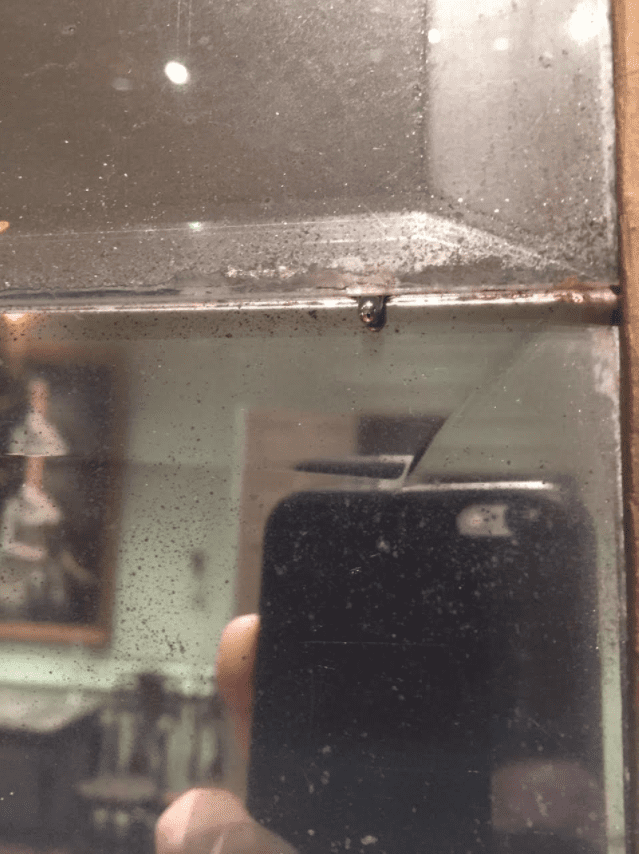
From the end of the 15th to the mid-19th century, tin-mercury amalgams were most often used to create the reflective surfaces on mirrors. Scientists at Winterthur have found that at least two-thirds of the mirrors in the collection contain these amalgams. Unfortunately, they are inherently unstable. Over time, the amalgam deteriorates, producing dark spots and a less reflective surface due to corrosion of the tin and reversion of the mercury to its natural liquid form.

As the mercury drips from the mirrors, it scatters on surfaces below and evaporates. Due to the toxicity of the mercury, that process is a health and safety concern.

For many years, dripping mercury mirrors in storage have been placed inside plastic bags to contain mercury droplets. Recent projects by conservation students revealed that mercury vapor levels are elevated to unsafe ranges inside storage bags. The mirrors are now stored on wire racks with an acid-free corrugated tray below. The open storage provides airflow around the mirror, preventing buildup of mercury vapors, while the tray captures mercury droplets so they don’t fall onto the floor below.

If you have these mirrors in your collection, be sure to handle them with nitrile gloves and keep them in the display orientation. After handling, dispose of the gloves and thoroughly wash your hands.

Masking a Stain

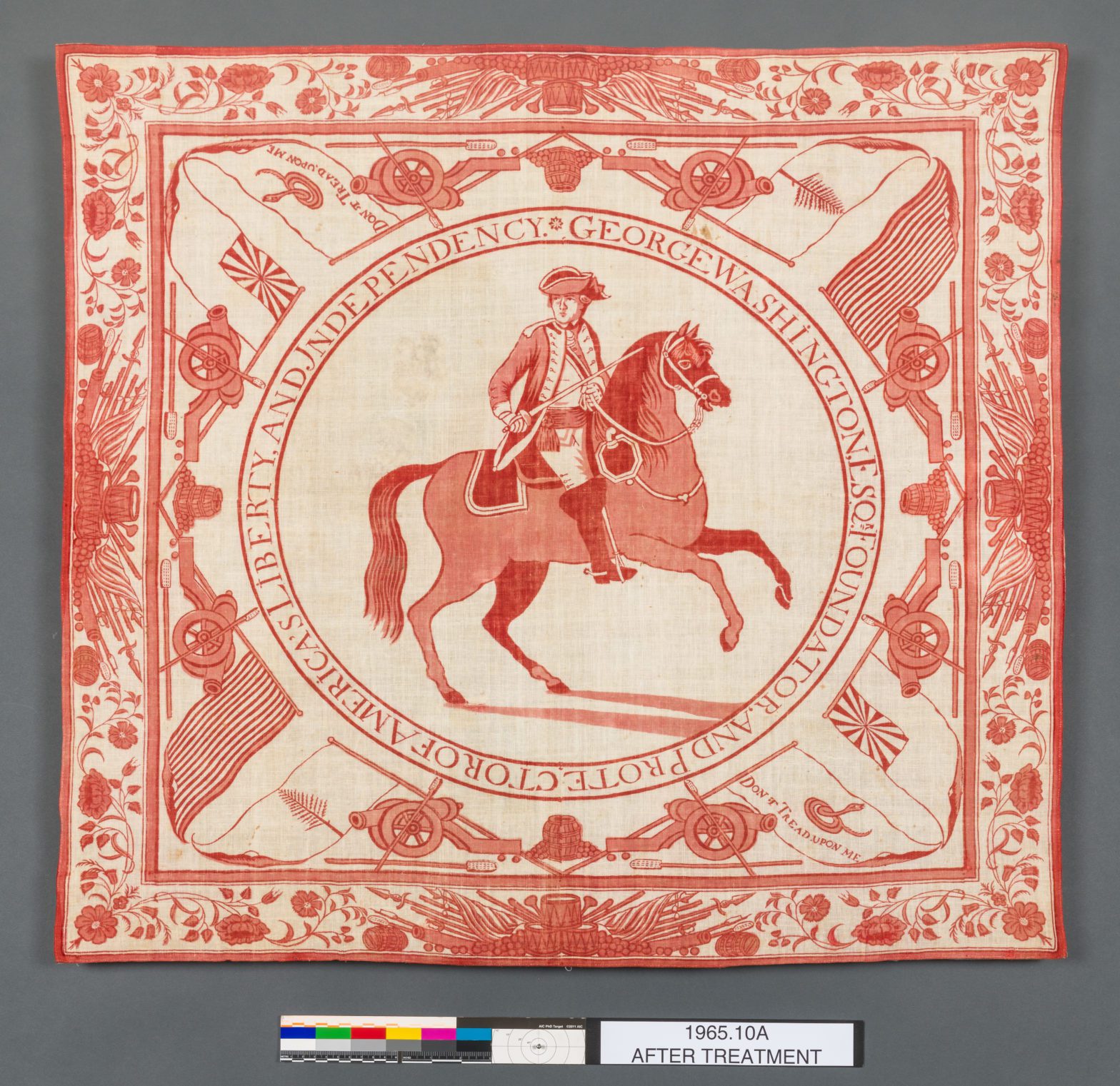
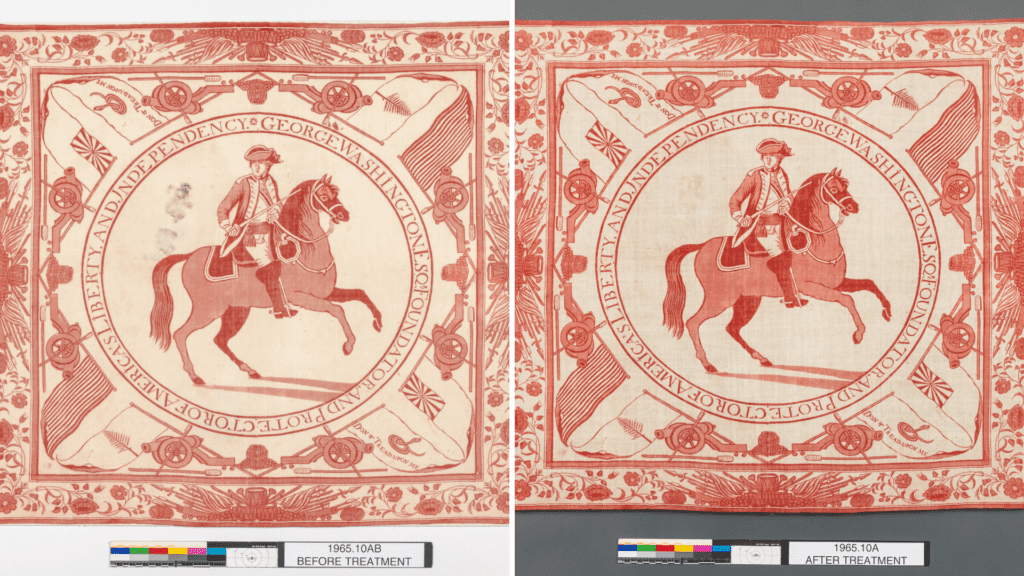
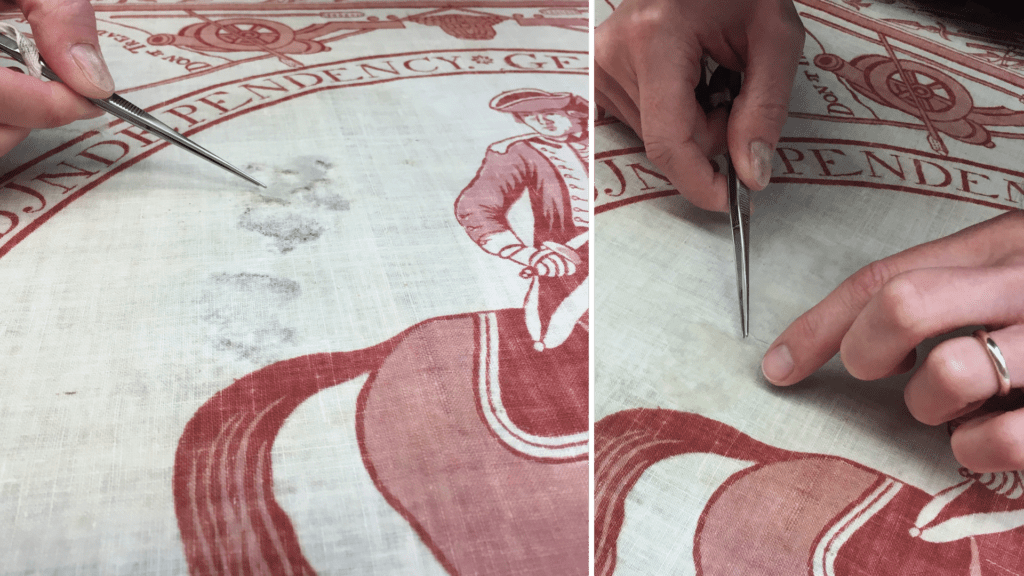
This rare, red-on-white printed handkerchief from the late 18th century shows General George Washington on horseback—and a large gray stain we wanted to reduce before it was exhibited in Hamilton & Burr: Who Wrote Their Stories? in 2019.

Past attempts to reduce the discoloration were minimally successful, so an unsightly muslin patch had been stitched over it. To improve its appearance, conservators need an exacting treatment to match the exacting block printing on both sides of the handkerchief.

Conservators first applied a series of poultices of cleaning solutions, chelators, and enzymes to the stain. The poultices reduced the gray coloration only minimally, so masking the stain remained the best treatment option.

Conservators created the mask by tinting a sheer Japanese tissue and super-fine silk crepeline with fabric paints and dyes to match the color of the handkerchief. They shaped the tissue with a small, damp brush, then pulled the wet tissue apart to feather the edges. The shaped tissue was fixed over the darkest areas with a water-soluble paste of methyl cellulose and wheat starch, then a patch of crepeline was pasted over the entire stain.

The treatment successfully reduced the appearance of the discoloration while allowing the weave of the fabric to show through. A layer of gray fabric between the handkerchief and its support mount further reduces the appearance of staining. The water-based paste can be reactivated, which makes the treatment reversible.

After its display in Hamilton & Burr, the handkerchief—inconclusively attributed to textile printer John Hewson, of Philadelphia—was returned to its original location in the house in Bertrand Hall.

Uncovering Undercover Toxins

After discovering arsenic in some vintage books, a conservator spreads the word on safety. 

Some people believe the ideas in books are dangerous, but sometimes it’s not the words but the books themselves that are toxic.  

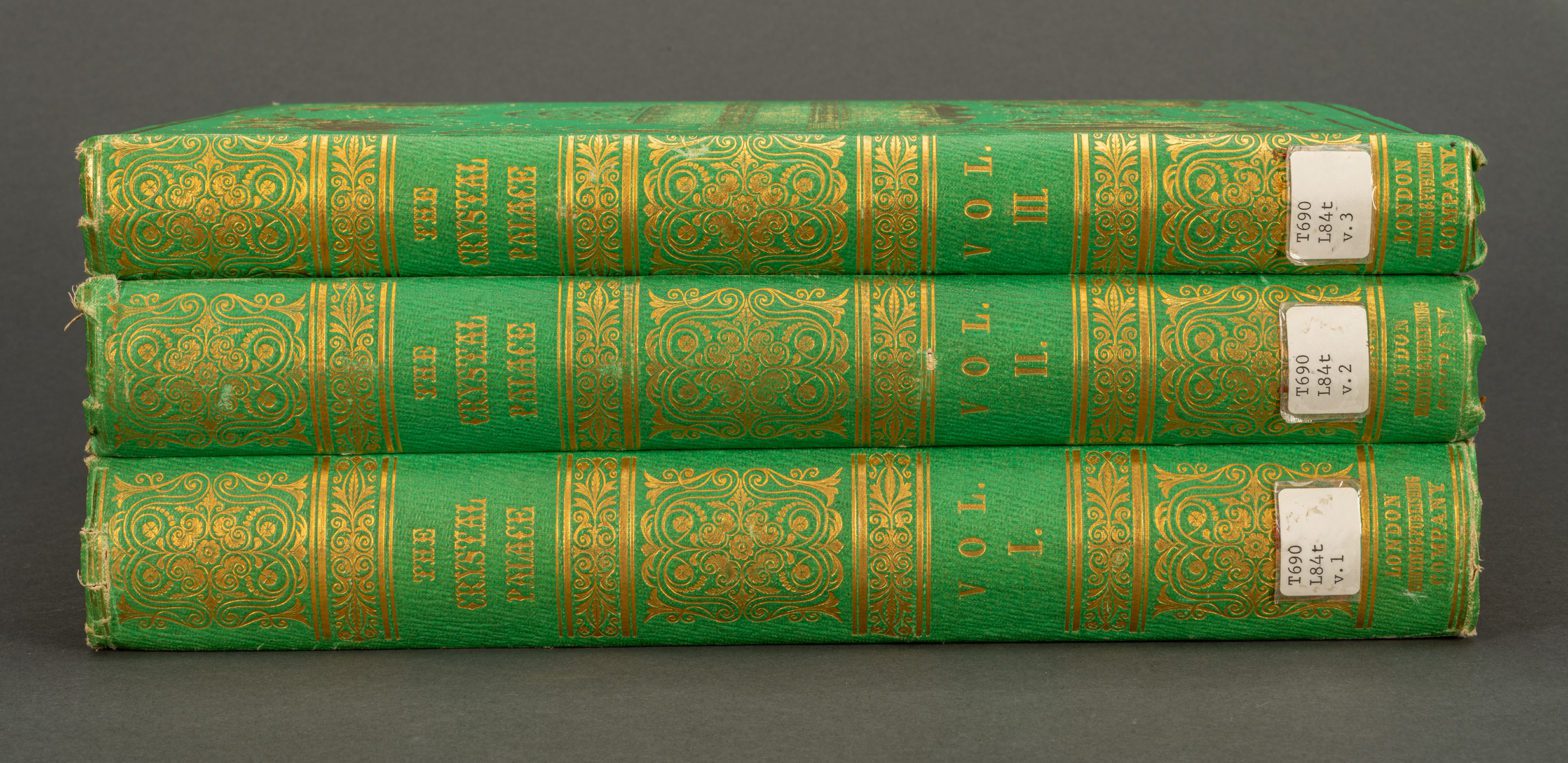
Dr. Melissa Tedone, head of the book and library materials conservation lab, was examining the green cloth on a second edition of Rustic Adornments for Homes of Taste from the Winterthur Library when she noticed the starched coating wasn’t behaving like other dyed cover cloths. She knew about widespread use of a pigment called emerald green in wallpapers of the 19th century, and she was familiar with recent literature about its toxicity. She wondered if the book cloth contained the same poisonous compound.  

X-ray fluorescence of Rustic Adornments, conducted by Dr. Rosie Grayburn, head of the Scientific Research and Analysis Laboratory at Winterthur, revealed dangerous copper acetoarsenite, which gives emerald green pigment its peculiar hue. Emerald green was widely used in the 19th century by wallpaper manufacturers and textile makers and caused widespread health problems and even deaths in Europe. Subsequent testing of Tedone’s initial sample revealed toxic levels of arsenic. “It was a lot more than we expected,” Tedone says. 

Testing of other green books in Winterthur’s circulating collection turned up four volumes with the toxic pigment, while another five volumes in the Rare Book Collection tested positive. All were of similar vintage (1840s–1860s) and of American or English imprint.  Further tests revealed that the pigment is highly friable, meaning it offsets easily when handled.   

A later visit to The Library Company of Philadelphia to scan green books of similar vintage revealed 28 arsenical books in its collection, which confirmed the trend. The height of popularity for emerald green pigment in book cloth was in the 1850s in England and the United States. “These bindings are very common in libraries and private collections,” Tedone says.  

Owing to the color’s popularity at the time, an untold number of books could contain the compound, and those volumes are highly desired for their beautiful color and gold-decorated covers. Collectors and others need to know the health risks, as do library professionals and other users.  

Tedone presented her initial findings and then further research at the Smithsonian Safety and Culture Heritage Summit in October 2019, the American Institute of Conservation Annual Meeting in May 2020, The Grolier Club in May 2021, and the Friends of the University of Delaware Library in November 2021. She is currently working with staff at the University of Delaware Library and the British Library to analyze their collections while working with health and safety experts to develop safe strategies for storing and using these books.   

To help librarians, collectors, and booksellers identify arsenical books in their own collections, Winterthur has printed emerald-green color swatch bookmarks with information on identifying and handling these books. 

For more information about the project, including how to request a color swatch bookmark, and safe handling tips for arsenical books, visit the frequently updated Poison Book Project site. 

Object of the Month: Duncanson Painting

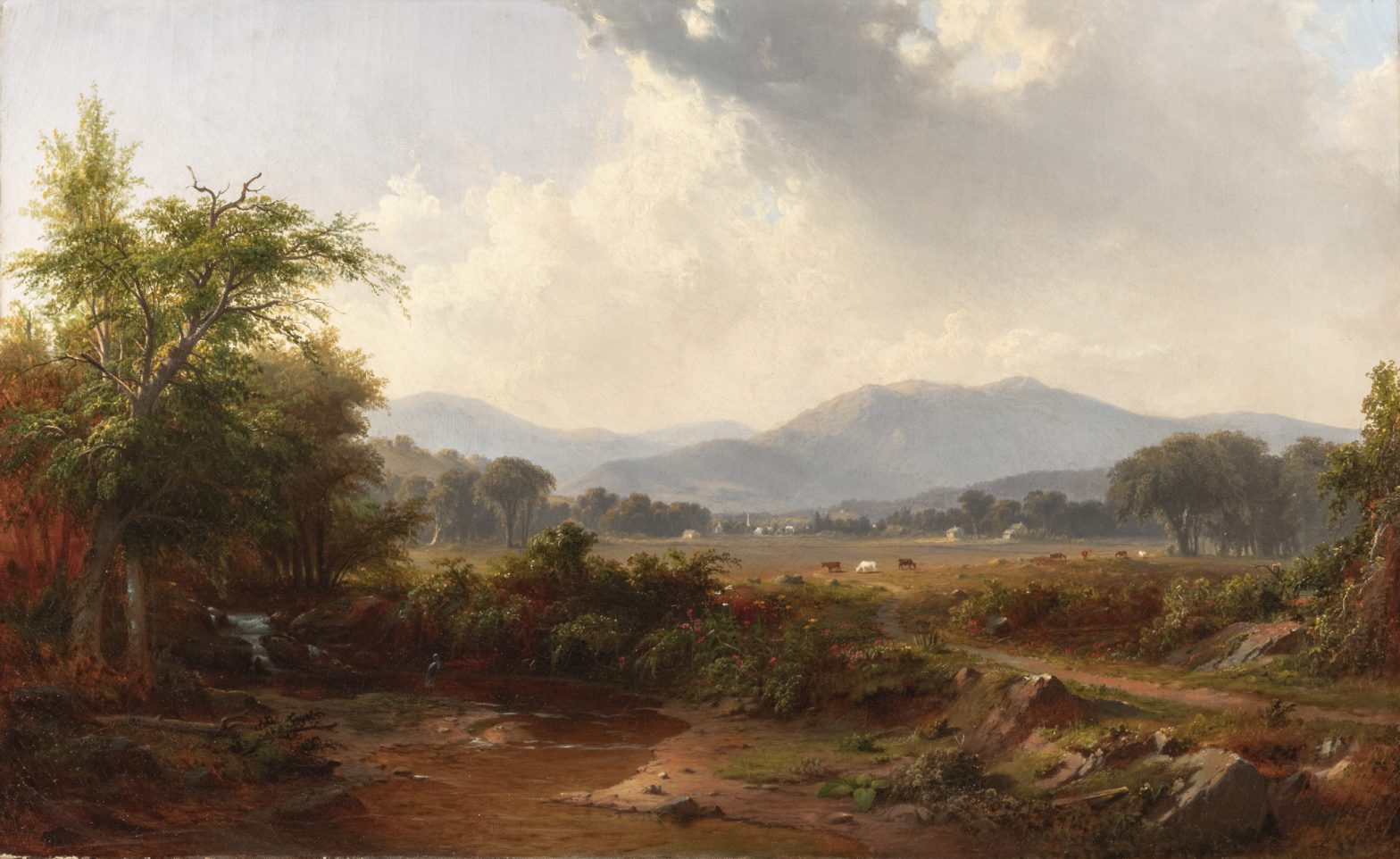
Landscape in the Smoky Mountains, Tennessee

To me, there are works of art that, because of their technique, novelty, aesthetic, history, or the force of their makers’ vision, are amazing to behold. Robert S. Duncanson’s Landscape in the Smoky Mountains, Tennessee is one of them. The beauty of this painting—the bucolic scene, the easy naturalism, the artist’s amazing technique—make it a standout compared to anything else in its class. I marvel, for example, at the elegant cursive that Duncanson uses to render the riffle and heron in the creek. I love the romantic quality, the way Duncanson amalgamated various parts of different landscapes to create something that is naturally impossible but utterly convincing. And it is so palpable. You can feel the humidity building under the clouds. 

I see Duncanson’s body of work as evidence of a powerful will to self-actualize. His adopted home of Cincinnati was considered an art capital when he lived there in the mid-1800s. While working as a sign painter, he taught himself to paint a la the Hudson Valley School. He surely met the leading Black artists of the city. Supported by the abolitionist community, Duncanson would go on to travel extensively through the South to paint landscapes, which stokes my curiosity about him. I can’t help wondering what would compel a free Black man to risk his life and liberty simply to make art. 

Duncanson may have been trying to build his reputation and increase the value of his work, despite the danger. (Some scholars believe his mixed ancestry may have reduced the risk by allowing him to pass as white.) Perhaps, as some scholars believe, he communicated abolitionist messages to enslaved people through metaphors and visual references in his painting. 

I’m no scholar, so I can’t say. I simply prefer to think Duncanson’s life and work says something about the desire for beauty and the force of the creative urge. Is the drive to make art, is the experience itself, worth all risk? Naively, perhaps, I like to believe Duncanson thought so.

Mark Nardone, communications manager

Robert Seldon Duncanson, Landscape in the Smoky Mountains, Tennessee, Circa 1851–53

Museum purchase 2018.0037A


On Tour: Lafayette, America’s Revolutionary Rock Star

September 24, 2024–June 1, 2025

Celebrate one of America’s first celebrities with Winterthur Museum’s latest exhibition, On Tour: Lafayette, America’s Revolutionary Rock Star. Commemorating the 200th anniversary of the Marquis de Lafayette’s 1824–25 “Farewell Tour” of the United States, the exhibition explores Lafayette’s incredible impact on the young nation through a fascinating selection of Winterthur memorabilia and objects honoring the Revolutionary War hero.

This small exhibition officially opens September 24, 2024, with a special event on September 29 in collaboration with People to People of Delaware, an organization dedicated to enhancing international understanding and friendship through educational, cultural, and humanitarian activities. The day will feature interactive activities that celebrate Lafayette’s enduring legacy and the deep bonds of friendship he forged between the U.S. and France.

Lafayette: A Revolutionary Icon

At just 19 years old, Marie-Joseph Paul Yves Roch Gilbert du Motier—known to history as the Marquis de Lafayette—left his home in France to fight for American independence. He played a pivotal role in key battles, such as the Battle of Brandywine (1777) and the decisive Battle of Yorktown (1781), where his leadership helped secure victory for the colonies. A close confidant of George Washington, Lafayette came to be seen not just as a military hero but as a symbol of the revolutionary spirit.

The Farewell Tour: A National Sensation

By the time Lafayette returned to the United States in 1824, he was hailed as a national treasure. His “Farewell Tour” took him across the country, where he was celebrated by people of every background, class, and community. To commemorate his visit, Americans produced an array of souvenir items, from buttons and medallions to handkerchiefs and ceramics. These and other objects are featured in Winterthur’s exhibition.

A Legacy Preserved at Winterthur

Winterthur founder Henry Francis du Pont, a passionate collector of Americana, amassed an extensive collection of objects related to Lafayette. Winterthur’s items related to Lafayette are surpassed only by the number of items related to George Washington and Benjamin Franklin. Visitors to On Tour: Lafayette, America’s Revolutionary Rock Star will have the rare opportunity to see these cherished pieces up close and explore the fascinating intersection of history, patriotism, and popular culture.

ABOUT WINTERTHUR MUSEUM, GARDEN & LIBRARY

Winterthur—known worldwide for its preeminent collection of American decorative arts, naturalistic garden, and research library for the study of American art and material culture— offers a variety of tours, exhibitions, programs, and activities throughout the year.

Winterthur is located on Route 52, six miles northwest of Wilmington, Delaware, and five miles south of U.S. Route 1. Winterthur is committed to accessible programming for all. For information, including special services, call 800.448.3883 or visit winterthur.org.