Bloom Report #38
September 21, 2022
80 F, Sunny
Check these out:
- Autumn Crocus: Not a true crocus, the lavender-pink blossoms of autumn crocus (Colchicum byzantium & Colchicum ‘Giant’) are blooming profusely on Oak Hill and at the base of the witch hazel tree at the lower side of The Cottage. They can also be found among the grasses in the field along Gray Building Drive just past the intersection with Cutting Garden Lane.
- White Clouds: The airy white spikes of fairy candles (Bugbane/Actaea acerina) are lighting up the ‘triangle’ in Azalea Woods and the edge of Enchanted Woods.
- Beautiful Begonias: The pale pink and white hardy begonias (Begonia grandis) are blooming in Enchanted Wood, creating a magical ground-level pastel mist.
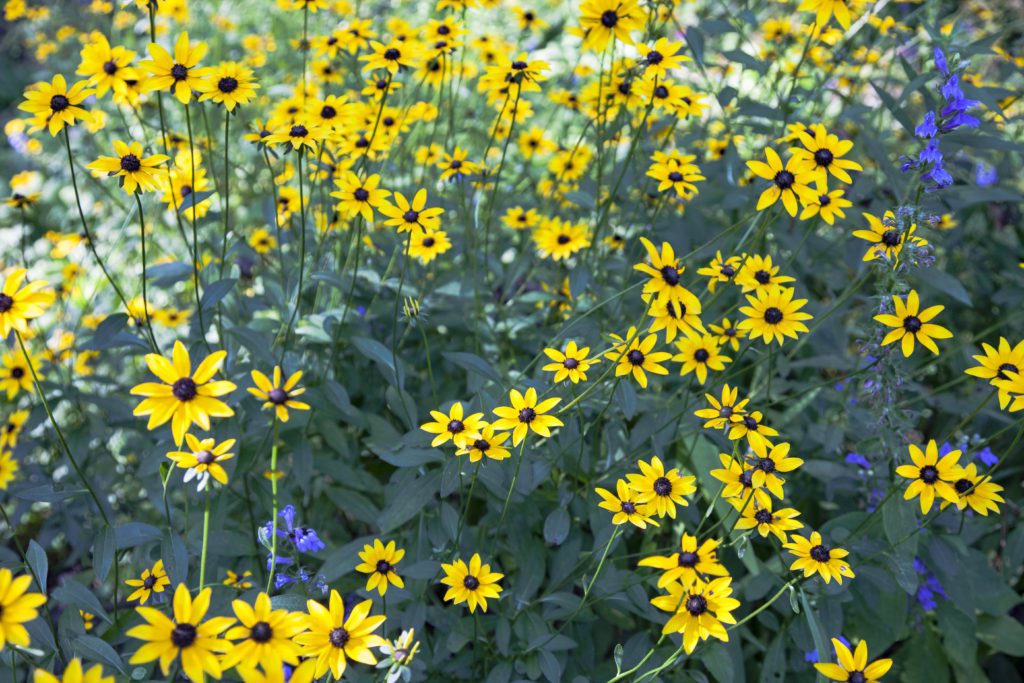
- Golden Glow: The waves of goldenrod (Solidago species) in the fields are echoed by the golden yellow black-eyed-Susan (Rudbeckia hirta) and ligularia (Ligularia sibirica var. speciosa) blooming in the Quarry.
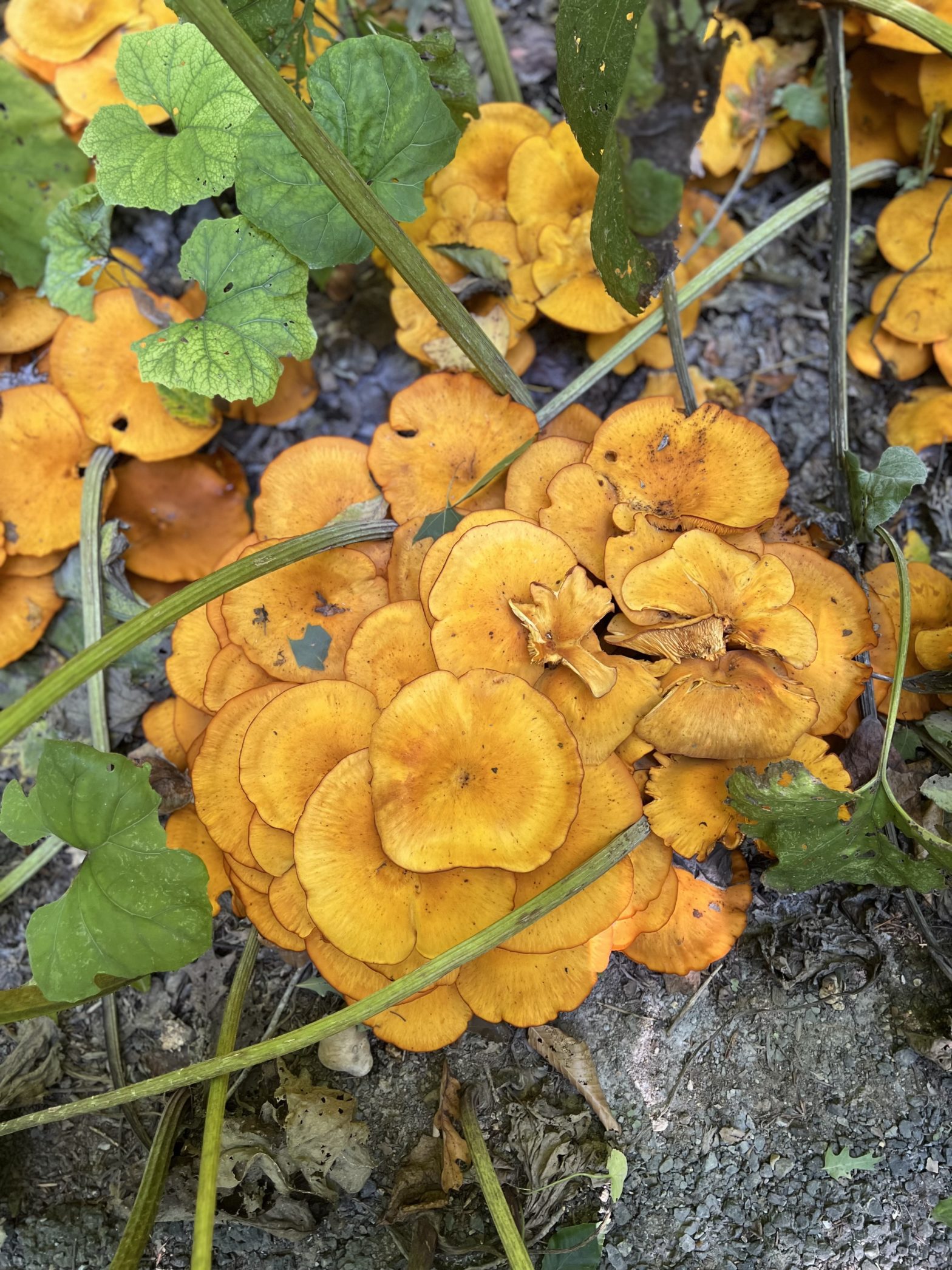
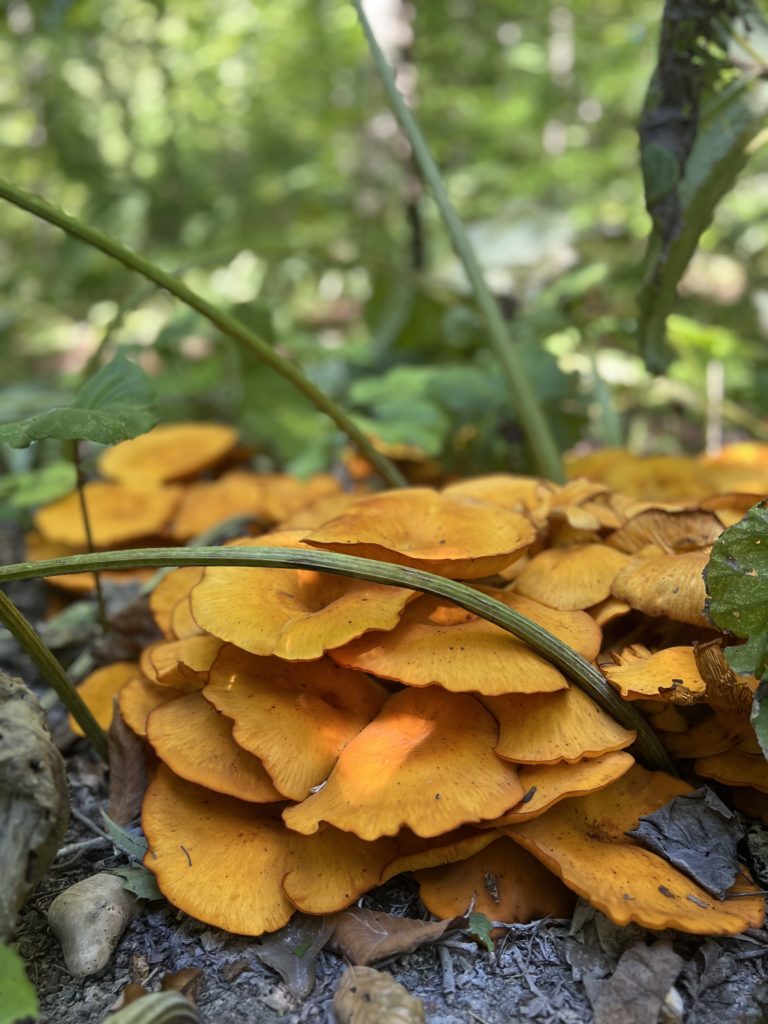
- Mushrooms in autumn colors: Clusters of orange mushrooms decorate the ground around the trees at the exit from the Visitor Center patio to the walking path.
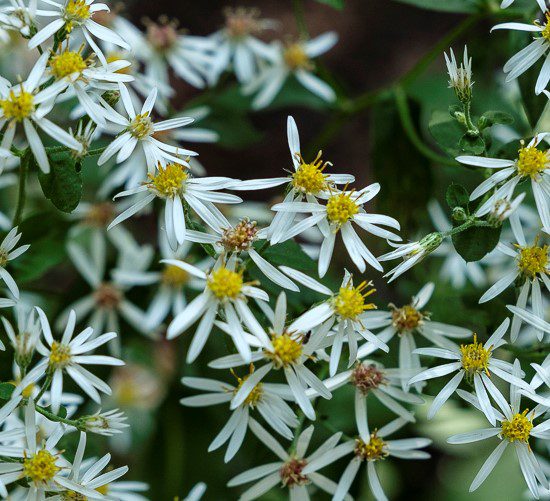
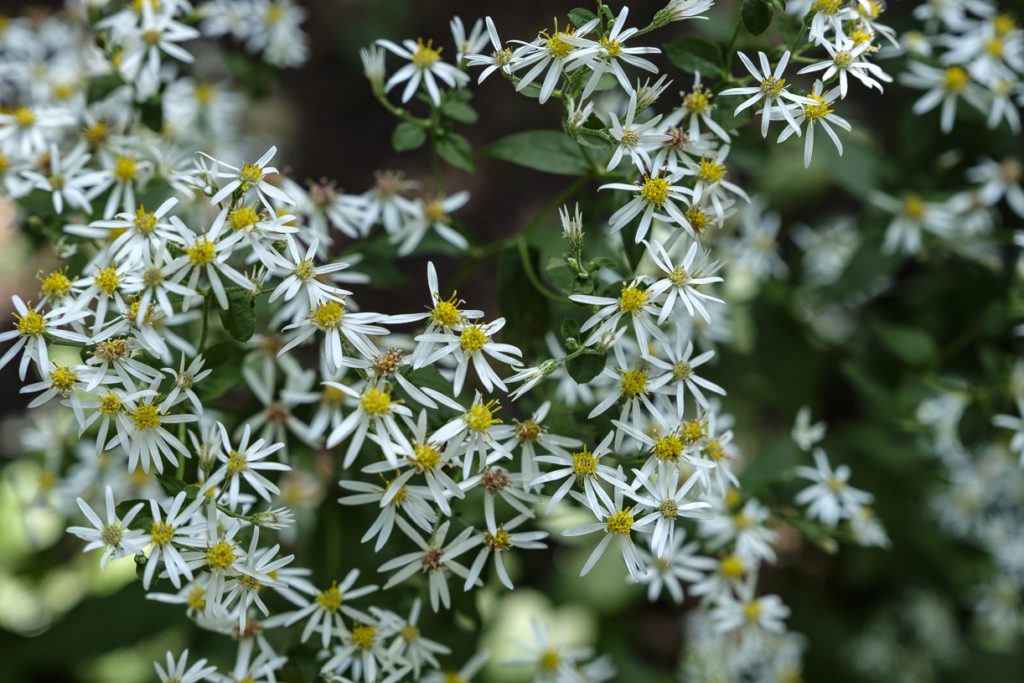
- Throughout: White wood asters (Eurybia divaricata/Aster divaricatus) are blooming throughout the Gardens & Estate. The small white daisies are creating a low-lying white cloud at the Visitor Center Garden Tram stop.
ENTRANCE DRIVE AND PARKING AREA
pf Abelia x grandiflora (Glossy abelia – soft pink)
fb Ageratina altissima (Eupatorium rugosum/White snake root – white)
ber Catalpa species (Catalpa – long, bean-like green to brown seed pods)
pf Heptacodium miconioides (Seven son tree – white)
pf Hydrangea paniculata ‘Grandiflora’ (Pee Gee hydrangea – greenish)
ber Paulownia tomentosa (Princess tree – clusters of round yellow-green seed pods)
fb Solidago juncea (Early goldenrod – yellow)
fb Solidago species (Plume goldenrod – yellow)
LAGOONS
fb Ageratina altissima (Eupatorium rugosum/White snake root – white)
fb Aster novae-angliae (New England aster – purple)
pb Cicorium intybus (Chicory – blue)
fb Convolvulus species (Morning-glory vine – pink, white)
pb Coronilla varia (Crown-vetch – pink)
pb Cuscuta gronovii (Dodder – tiny white flowers on orange ‘strings’)
pb Daucus carota (Queen Anne’s lace – white)
fb,+ Eurybia divaricata (Aster divaricatus/White wood aster – white) – along Clenny Run
fb,+ Impatiens capensis (Jewel weed – orange)
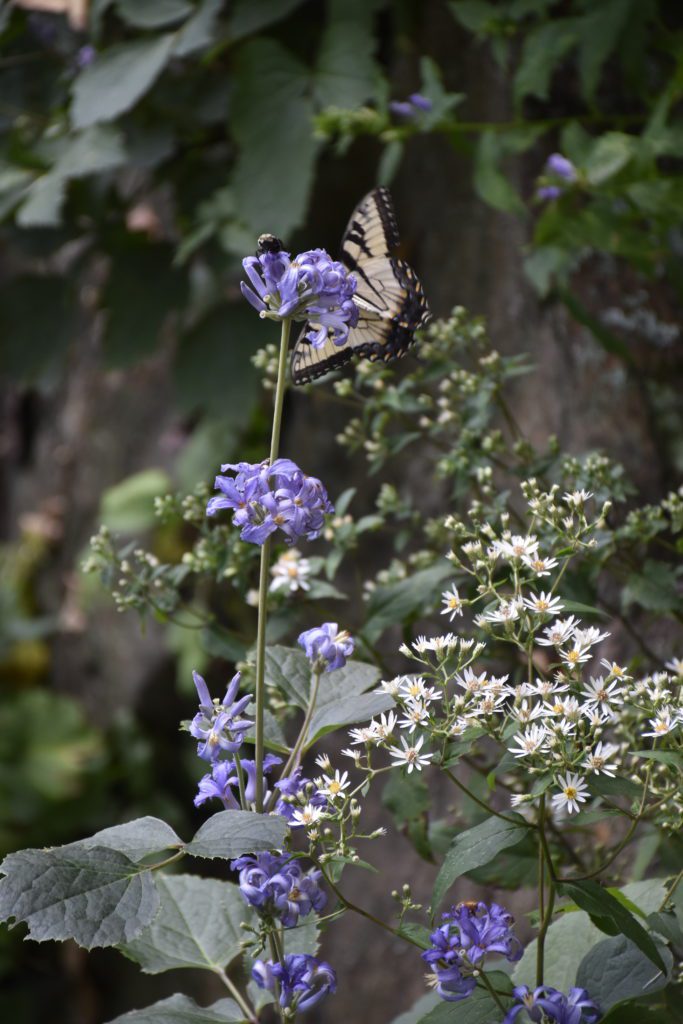
pf Lobelia siphilitica (Great blue lobelia – purple)
ber Maclura pomifera (Osage orange – ‘pebbly’ softball-sized green fruits – along Clenny Run)
ber Phytolacca americana (Pokeweed – green berries turning dark purple on bright red stems)
pf Prunella vulgaris (Self-heal – purple)
pb Rudbeckia hirta (Black-eyed-Susan – yellow)
pf Solidago graminifolia (Lance-leaved goldenrod – yellow)
fb Solidago juncea (Early goldenrod – yellow)
fb Solidago species (Plume goldenrods – yellow)
fb Symphyotrichum ericoides (Aster ericoides/Heath aster – white)
b Symphyotrichum lateriflorum (Aster lateriflorus/Calico aster – white)
fb Symphyotrichum novae-angliae (Aster novae-angliae/New England aster – purple)
fb Symphyotrichum species (Aster – lavender)
fb Tovara virginiana (Virginia knotweed – tiny greenish-white flowers along wiry stems)
pb Trifolium pratense (Red clover – reddish-purple)
SUMMER SHRUB SLOPE
pb Buddleia davidii (Butterfly bush – white)
b Hibiscus syriacus (Rose of Sharon – rosy purple)
fb Hydrangea paniculata ‘Grandiflora’ (Pee Gee hydrangea – white)
pb Lagerstroemia ‘Biloxi’ (Crape myrtle cultivar – dark pink)
pb Vitex agnus-castus (Chaste tree – blue, pink)
PARKING AREA TO VISITOR CENTER
fb Eurybia divaricata (Aster divaricatus/White wood aster – white)
pb Hydrangea quercifolia (Oakleaf hydrangea – brown)
b Kirengeshoma palmata (Wax bells – yellow)
fb Prenanthes species (Rattlesnake-root – green closed-tube flowers)
ber Smilacina racemosa (Maianthemum racemosum/False Solomon’s seal – pinkish berries turning red)
fb Tovara virginiana (Virginia knotweed – tiny greenish-white flowers along wiry stems)
WALK FROM VISITOR CENTER TO UNDERPASS
fb,+ Eurybia divaricata (Aster divaricatus/White wood aster – white)
b Hosta lancifolia (Narrow-leaved hosta – purple)
pf Hosta ‘Royal Standard’ (‘Royal Standard’ hosta – white)
fb Impatiens capensis (Jewel weed – orange)
fb Tovara virginiana (Virginia knotweed – tiny greenish-white flowers along wiry stems)
WALK FROM UNDERPASS TO MUSHROOM
b Ageratina altissima (Eupatorium rugosum/White snake root – white)
fb Eurybia divaricata (Aster divaricatus/White wood aster – white)
pb Hosta ‘Royal Standard’ (‘Royal Standard’ hosta – white)
b Solidago flexicaulis (Zig-zag goldenrod – yellow)
PEONY GARDEN
fb Eurybia divaricata (Aster divaricatus/White wood aster – white)
AZALEA WOODS
fb,+ Actaea acerina (Fairy candles/bugbane – white)
b Ageratina altissima (Eupatorium rugosum/White snake root – white)
fb Collinsonia canadensis (Horse balm – small yellow flowers)
fb Eurybia divaricata (Aster divaricatus/White wood aster – white)
pf Gentiana clausa (Closed gentian – dark blue)
pf Hydrangea arborescens (Smooth hydrangea – greenish)
fb Lobelia siphilitica (Great blue lobelia – purple)
fb Phlox paniculata (Garden phlox – pink)
pb Solidago flexicaulis (Zig-zag goldenrod – yellow)
fb Tovara virginiana (Virginia knotweed – tiny greenish-white flowers along wiry stems)
LOWER AZALEA WOODS
fbb Actaea acerina (Fairy candles/bugbane – white)
fb Ceratostigma plumbaginoides (Plumbago – intense blue)
fb Collinsonia canadensis (Horse balm – small yellow flowers)
fb Epifagus virginiana (Beechdrops – brown ‘twigs’)
fb,+ Eurybia divaricata (Aster divaricatus/White wood aster – white)
b Solidago flexicaulis (Zig-zag goldenrod – yellow)
UPPER/EAST TERRACE AND STEPS
fb Abelia x grandiflora (Glossy abelia – soft pink)
pb Hosta ‘Royal Standard’ (‘Royal Standard’ hosta – white)
pb Liriope muscari (Lily-turf – purple ‘beads’)
ber Magnolia grandiflora (Southern magnolia – grey-green to pinkish fuzzy ‘cones’)
EAST FRONT OF MUSEUM & Around Corner
pf Abelia x grandiflora (Glossy abelia – soft pink)
ber Callicarpa species (Beautyberry – berries turning purple)
fb Eurybia divaricata (Aster divaricatus/White wood aster – white – behind Bath House)
fb Hosta lancifolia (Narrow-leaved hosta – purple – behind Bath House)
pb Hosta ‘Royal Standard’ (‘Royal Standard’ hosta – white – along Clenny Run)
pb Lagerstroemia x ‘Sioux’ (Crape myrtle – dark pink)
fb Lespedeza species (Bush clover – rosy-pink)
ber Magnolia grandiflora (Southern magnolia – grey-green to pinkish fuzzy ‘cones’)
fbb Symphyotrichum cordifolium (Aster cordifolius/Blue wood aster – light blue – behind Bath House)
WALK FROM GLASS CORRIDOR TO REFLECTING POOL
fb Abelia x grandiflora (Glossy abelia – soft pink)
fb Ageratina altissima (Eupatorium rugosum/White snake root – white)
fb Begonia grandis (Hardy begonia – pink)
fb Clematis ‘Candida’ (Large-flowered clematis – white)
fb Erigeron annuus (Fleabane – white)
fb Eurybia divaricata (Aster divaricatus/White wood aster – white)
pb Hosta ‘Royal Standard’ (‘Royal Standard’ hosta – white)
fb Hydrangea paniculata ‘Tardiva’ (Panicle hydrangea cultivar – white turning pinkish)
pf Hydrangea quercifolia (Oakleaf hydrangea – white turning pinkish)
pf Liriope muscari (Lily-turf – purple ‘beads’)
pf Sedum spectabile (Showy stonecrop – pink – in container at lower courtyard fountain)
fb Solidago species (Plume goldenrod – yellow)
WALK FROM FISH PONDS – THE GLADE – TO BRIDGE
fbb Actaea acerina (Fairy candles/Bugbane – white)
b Ageratina altissima (Eupatorium rugosum/White snake root – white)
fb Begonia grandis (Hardy begonia – pink)
fb Collinsonia canadensis (Horse balm – small yellow flowers)
pb Egeria densa (Elodea – white – in upper Koi Pond)
fb Eurybia divaricata (Aster divaricatus/White wood aster – white)
pf Hosta ‘Royal Standard’ (‘Royal Standard’ hosta – white)
pf Hydrangea arborescens (Smooth hydrangea – greenish – mophead/hortensia + lacecap)
pf Lobelia siphilitica (Great blue lobelia – purple)
pb Phlox paniculata (Garden phlox – pink, white)
fb Solidago flexicaulis (Zig-zag goldenrod – yellow)
fbb Symphyotrichum cordifolium (Aster cordifolius/Blue wood aster – light blue)
fb Tovara virginiana (Virginia knotweed – tiny greenish-white flowers along wiry stems)/
pb Tricyrtis species (Toad lily – white)
b Tricyrtis species (Toad lily – white with purple speckles)
MARCH BANK
fb Collinsonia canadensis (Horse balm – small yellow flowers)
fb Eurybia divaricata (Aster divaricatus/White wood aster – white)
pb Phlox paniculata (Garden phlox – pink, white)
fb Solidago flexicaulis (Zig-zag goldenrod – yellow)
fb Tovara virginiana (Virginia knotweed – tiny greenish-white flowers along wiry stems)
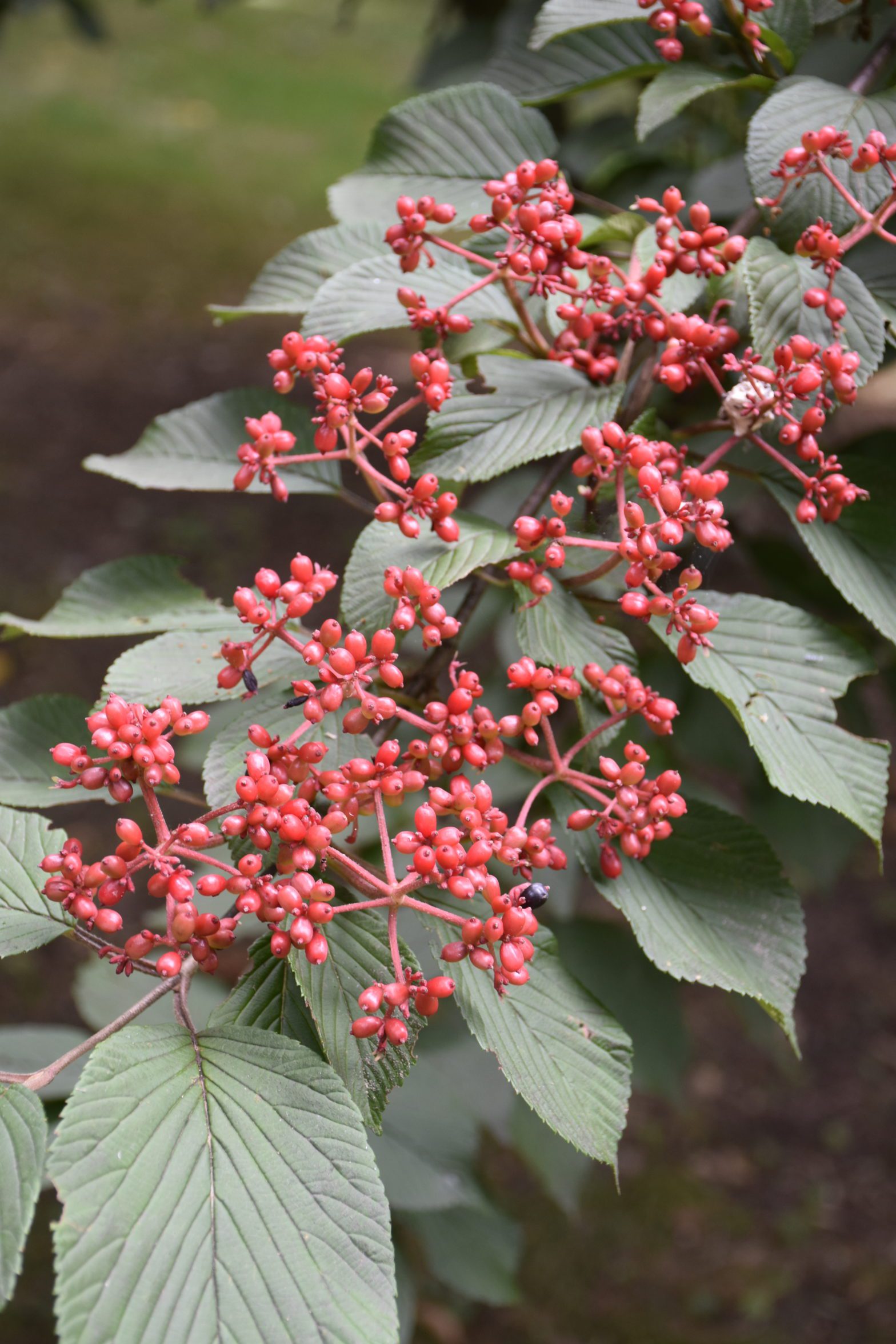
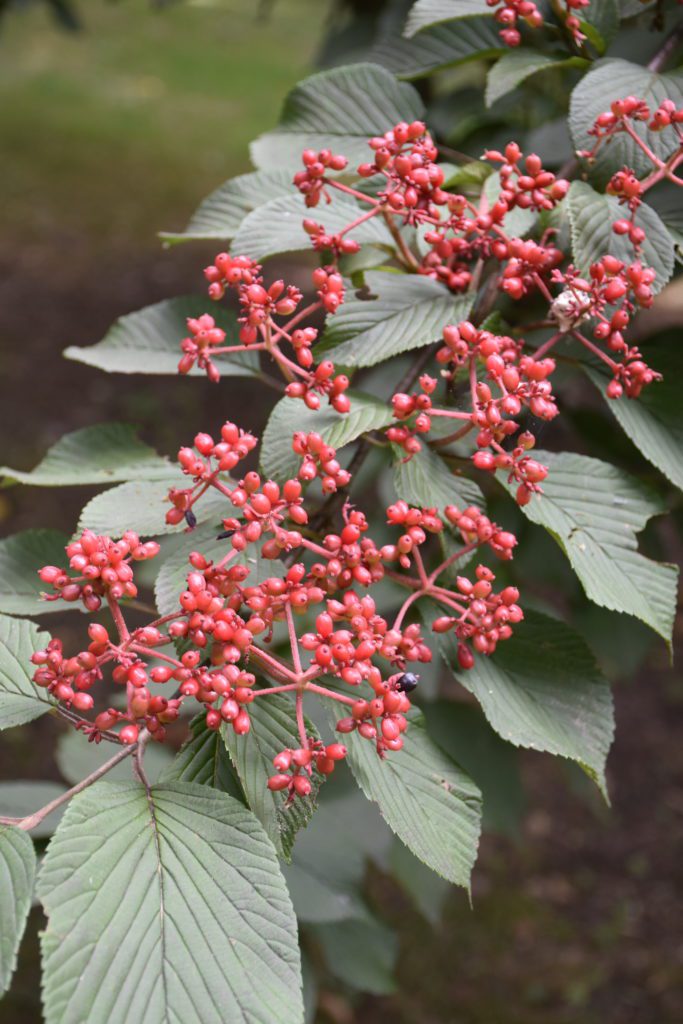
ber Viburnum sieboldii (Siebold viburnum – bright red berries)
MAGNOLIA BEND AND WALK ON SOUTH SIDE OF STREAM
fb Ageratina altissima (Eupatorium rugosum/White snake root – white)
fb Chelone glabra (Turtlehead – white)
fb Collinsonia canadensis (Horse balm – small yellow flowers)
fb Eurybia divaricata (Aster divaricatus/White wood aster – white)
pf Hydrangea arborescens (Smooth hydrangea – greenish turning brown)
pf Hydrangea quercifolia (Oakleaf hydrangea – pink turning brown)
pf Lobelia siphilitica (Great blue lobelia – purple, white)
pb Magnolia x soulangeana (Saucer magnolia – dark pink)
pf Phlox paniculata (Garden phlox – pink)
fb Solidago flexicaulis (Zig-zag goldenrod – yellow)
ber Koelreuteria paniculata (Golden rain tree – brown seed pods)
ber Paulownia tomentosa (Princess tree – clusters of round yellow-green seed pods)
WINTERHAZEL WALK
fb Ageratina altissima (Eupatorium rugosum/White snake root – white)
fb,+ Eurybia divaricata (Aster divaricatus/White wood aster – white)
pf Lobelia siphilitica (Great blue lobelia – purple)
ICEWELL TERRACE
b Ageratina altissima (Eupatorium rugosum/White snake root – white)
ber Aralia racemosa (Spikenard – greenish berries turning wine red)
pf Collinsonia canadensis (Horse balm – small yellow flowers)
fb Eurybia divaricata (Aster divaricatus/White wood aster = white)
pb Gentiana clausa (Closed gentian – dark blue)
pb Hosta ‘Royal Standard’ (‘Royal Standard’ hosta – white)
pb Phlox paniculata (Garden phlox – pink, white)
ber Smilacina racemosa (Maianthemum racemosum/False Solomon’s seal – red berries)
fb Solidago flexicaulis (Zig-zag goldenrod – yellow)
fb Tovara virginiana (Virginia knotweed – tiny greenish-white flowers along wiry stems)
PINETUM
ber Chaenomeles varieties (Flowering quince – green to wine red to yellow fruits)
fb,+ Eurybia divaricata (Aster divaricatus/White wood aster – white)
ber Malus species (Flowering crabapple – dark red berries)
fb Pilea pumila (Clearweed – greenish)
pb Viburnum macrocephalum ‘Sterile’ (Snowball viburnum – greenish white)
SUNDIAL GARDEN
pb Chaenomeles species (Flowering quince – red, red-orange)
ber Chaenomeles species (Flowering quince – green to yellow fruits)
ber Malus ‘Adams’ (Flowering crabapple – dark red berries)
b Syringa species (Lilac – lilac – re-blooming)
TRAFFIC CIRCLE
ber Viburnum dilatatum ‘Xanthocarpum’ (Linden viburnum variety – yellow berries)
ENCHANTED WOOD
fb,+ Actaea acerina (Fairy candles/bugbane – white)
fbb Ageratina altissima (Eupatorium rugosum/White snake root – white)
pf,++ Begonia grandis (Hardy begonia – white, pink)
pf Eupatorium maculatum (Joe Pye weed – pale lavender-pink)
fb Eurybia divaricata (Aster divaricatus/White wood aster – white)
pb Hosta ‘Royal Standard’ (‘Royal Standard’ hosta – white)
pf Hydrangea arborescens ‘Grandiflora’ ‘Hills of Snow’ (Smooth hydrangea variety – greenish turning brown)
b Hydrangea involucrata (Bracted hydrangea – blue or pink with white lacecap turning greenish – firm spherical buds)
pb Hydrangea macrophylla ‘Preziosa’ (Bigleaf hydrangea variety – greenish turning brown)
pf Hydrangea macrophylla ‘Veitchii’ (Bigleaf hydrangea variety – greenish lacecap; very large sterile florets)
pf Hydrangea paniculata (Panicle hydrangea – greenish white turning pink)
pf Hydrangea quercifolia (Oakleaf hydrangea – greenish turning pink)
pf Kirengeshoma palmata (Wax bells – yellow)
fb Prenanthes species (Rattlesnake-root – green closed-tube flowers)
fb Salvia koyamae (Japanese sage – soft yellow)
ber Smilacina racemosa (Maianthemum racemosum/False Solomon’s seal – bright red berries)
fb Solidago flexicaulis (Zig-zag goldenrod – yellow)
fb Tovara virginiana (Virginia knotweed – tiny greenish-white flowers along wiry stems)
OAK HIL–East Side
b Ageratina altissima (Eupatorium rugosum/White snake root – white)
ber Callicarpa species (Beautyberry – purple berries)
fb,+ Colchicum byzantium (Autumn crocus – lavender-pink with white center)
fb,+ Colchicum ‘Giant’ (Autumn crocus – lavender-pink)
pf Daucus carota (Queen Anne’s lace – white – in hillside meadow)
fb Eurybia divaricata (Aster divaricatus/White wood aster – white)
pf Hosta lancifolia (Narrow-leaved hosta – purple)
fb Hydrangea involucrata ‘Tama Azisai’ (Bracted hydrangea – white with blue, pink turning green)
pb Lobelia siphilitica (Great blue lobelia – purple)
ber Poncirus trifoliata (Hardy orange – green ‘fuzzy’ fruits turning yellow)
pb Rhododendron prunifolium (Plumleaf azalea – bright red)
ber Smilacina racemosa (Maianthemum recemosum/False Solomon’s seal – red berries)
b Solidago flexicaulis (Zig-zag goldenrod – yellow)
ber Styrax obassia (Fragrant snowbell – oval green berries)
fb Tovara virginiana (Virginia knotweed – tiny greenish-white flowers along wiry stems)
ber Viburnum dilatatum ‘Xanthocarpum’ (Linden viburnum variety – yellow berries turning red)
OAK HILL-West Side
fb Ageratina altissima (Wupatorium rugosum/White snake root – white)
fb Eurybia divaricata (Aster divaricatus/White wood aster – white)
ber Magnolia acuminata (Cucumber magnolia – pinkish to reddish cones)
ber Poncirus trifoliata (Hardy orange – green ‘fuzzy’ fruits turning yellow)
QUARRY, ADJACENT WALKS, AND OUTLET STREAM
fb Anemone x hupehensis (Anemone cultivar – light pink)
pb Clematis heracleifolia var. davidiana (Tube clematis – blue)
ber Cornus florida (Dogwood – red berries)
fb,+ Eurybia divaricata (Aster divaricatus/White wood aster – white)
fb Heuchera species (Alumroot – white)
fb Heuchera villosa (Hairy alumroot – creamy white)
pb Hosta ‘Royal Standard’ (‘Royal Standard’ hosta – white)
fb,+ Ligularia sibirica var. speciosa (Ligularia – yellow)
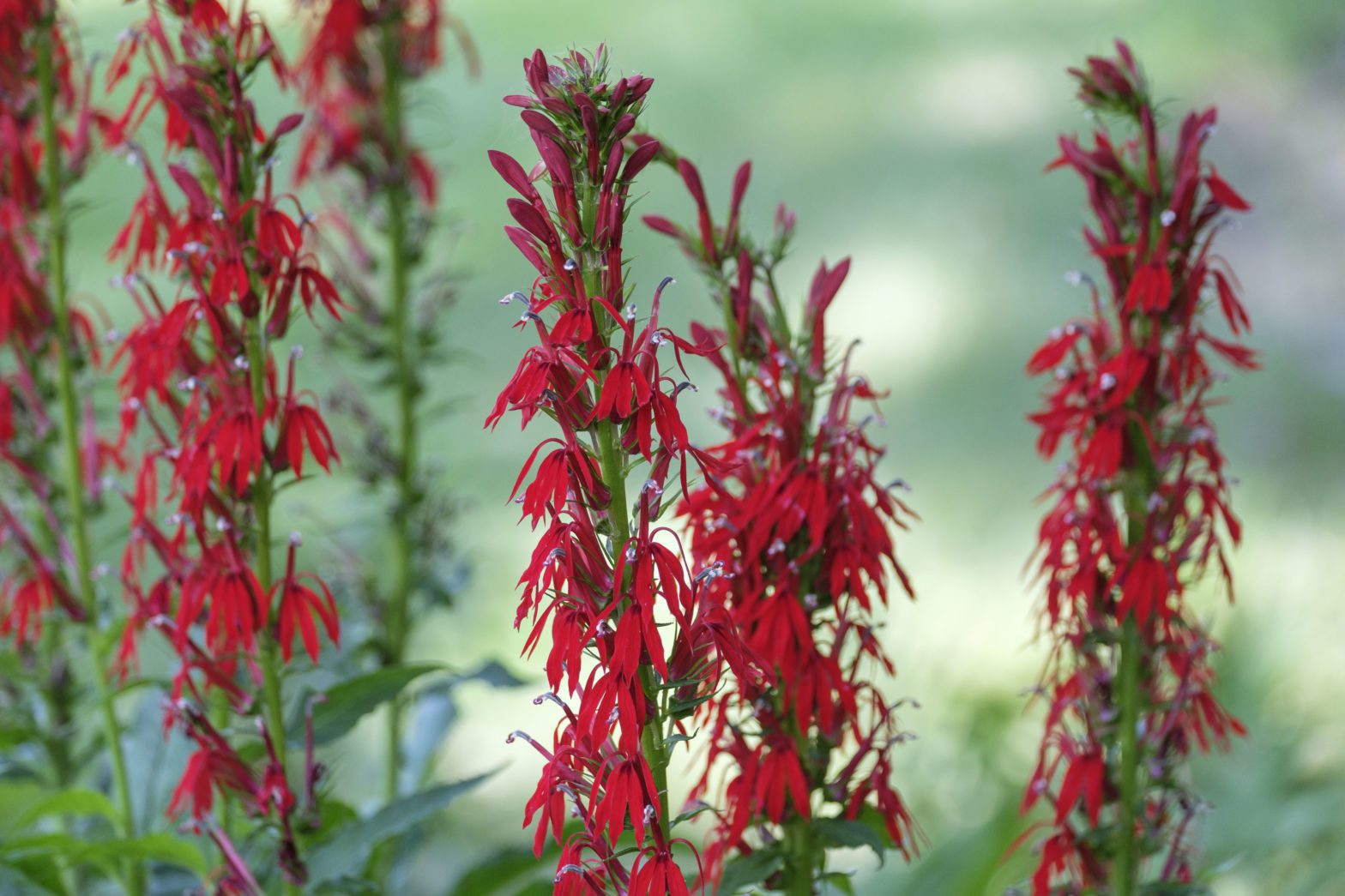
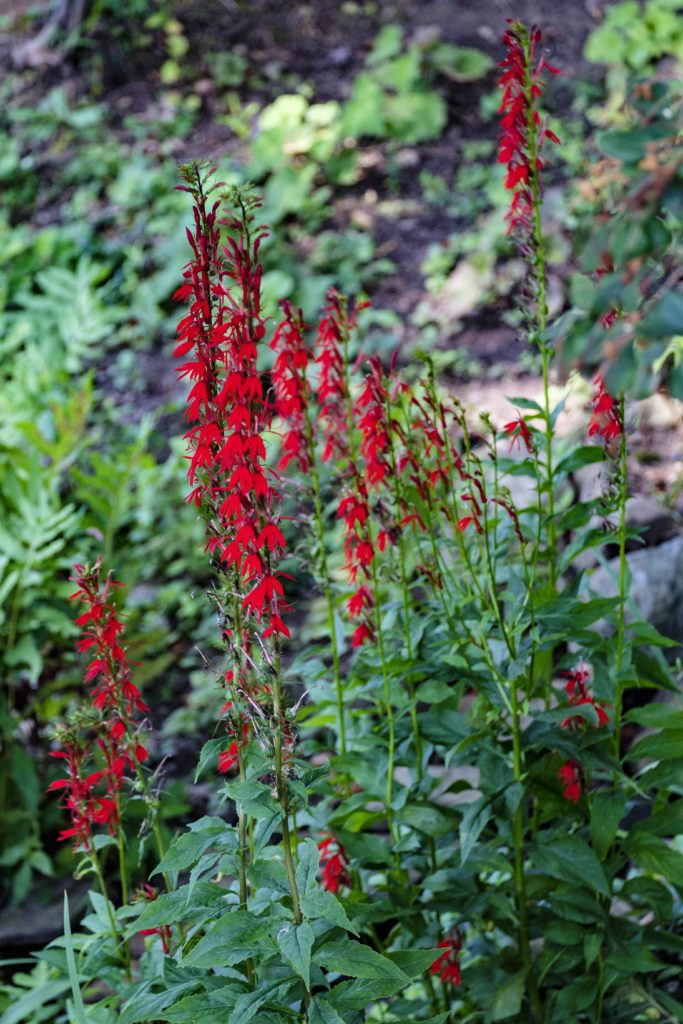
pb Lobelia cardinalis (Cardinal flower – red)
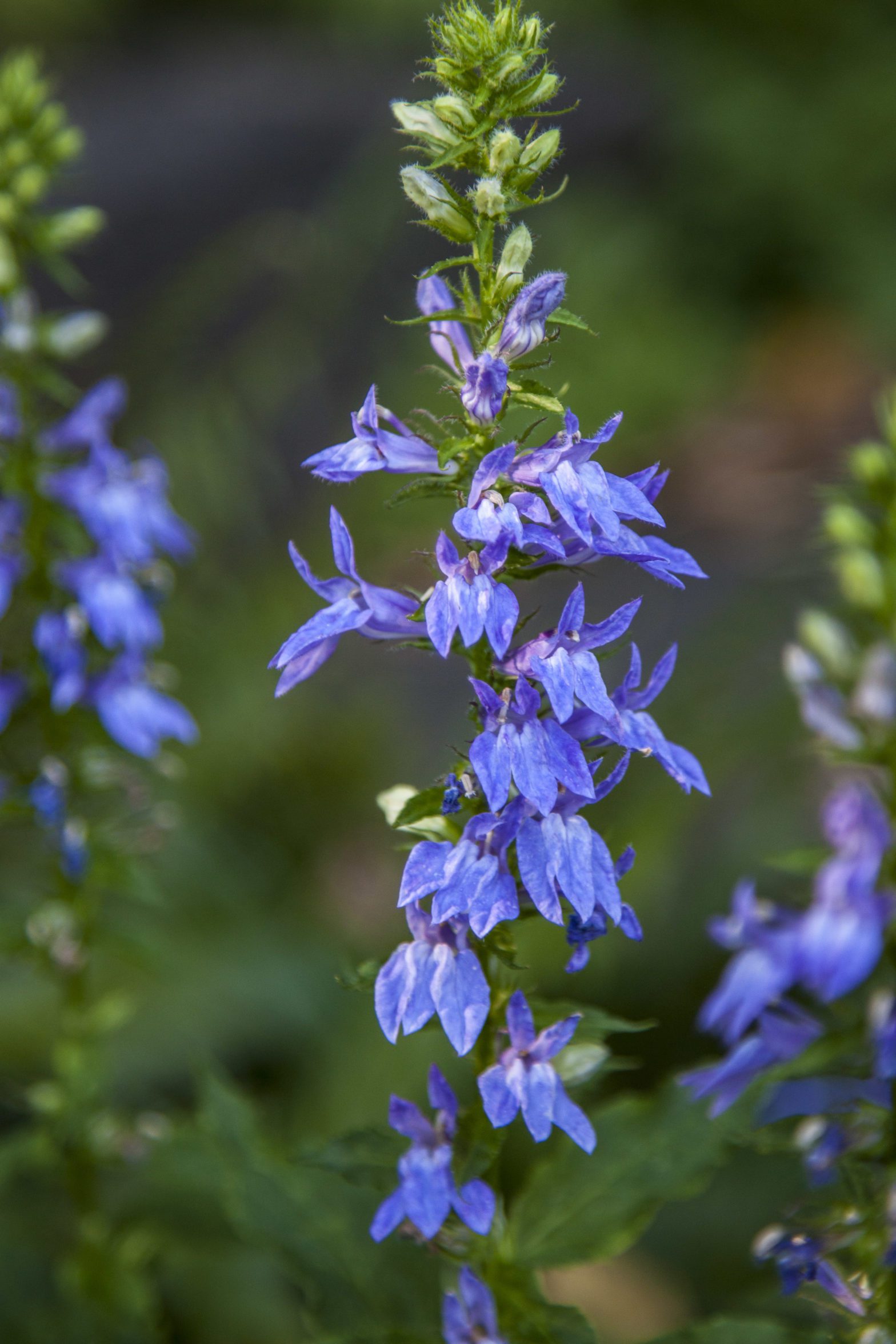
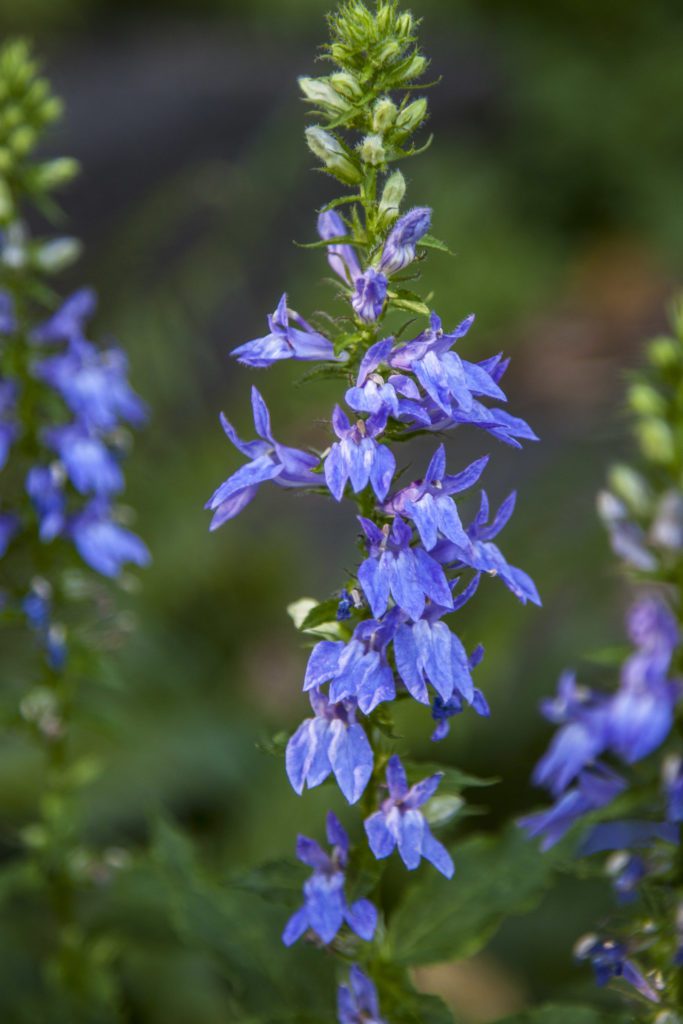
pb Lobelia siphilitica (Great blue lobelia – purple, rare white)
fb,+ Rudbeckia hirta (Black-eyed-Susan – yellow)
ber Smilacina racemosa (aianthemum racemosum/False Solomon’s seal – bright red berries)
b Solidago ‘Fireworks’ (Goldenrod – yellow)
fb Solidago flexicaulis (Zig-zag goldenrod – yellow)
fb Tricyrtis species (Toad lily – white)
SYCAMORE HILL
ber Aesculus pavia (Red buckeye – lumpy tan fruit)
ber Catalpa species (Catalpa – long, bean-like green to brown seed pods)
fb Colchicum byzantium (Autumn crocus – lavender-pink with white center – 3 flowers)
ber Cornus kousa (Kousa dogwood – ‘pebbly’ red fruit – few left)
fb,+ Heuchera villosa (Hairy alumroot – creamy white)
pf Hydrangea paniculata ‘Grandiflora’ (Pee Gee hydrangea – greenish turning brown)
pf Hydrangea paniculata ‘Unique’ (‘Unique’ panicle hydrangea – greenish turning brown)
b Leptodermis oblonga (Chinese leptodermis – lavender)
pb Lobelia siphilitica (Great blue lobelia – purple, white)
ber Magnolia sieboldii ‘Colossus’ (Oyama magnolia – lumpy, teardrop-shaped red fruit)
pb Rosa MEIvahn (Meidiland rose – white – at Brick Overlook folly)
pb Rosa ‘New Dawn’ (‘New Dawn’ rose – palest pink)
pb Rosa ‘Radwin’ (Winner’s Circle rose – red)
pb Spiraea x ‘Margaritae’ (Margarita spiraea – shades of pink to dark rose)
ber Styrax obassia (Fragrant snowbell – oval pale green, ‘fuzzy’ berries)
ber Viburnun burkwoodii (Burkwood viburnum – red berries)
b Viburnum rhytidophylloides (Leatherleaf viburnum – off-white)
ber Viburnum setigerum (Tea viburnum – orange berries turning red)
pb Weigela ‘Edith Rathke’ (Weigela variety – red)
WEST FRONT OF MUSEUM, COTTAGE, AND CLENNY RUN
fb Ageratina altissima (Eupatorium rugosum/White snake root – white – along Clenny Run)
fb Heptacodium miconioides (Seven-son tree – white)
pf Hydrangea arborescens (Smooth hydrangea – greenish turning brown)
b Hydrangea macrophylla ‘Fuji Waterfall’ (Bigleaf hydrangea cultivar – white)
pb Hydrangea quercifolia (Oakleaf hydrangea – brown – at Museum bridge)
ber Ilex verticillata (Winterberry holly – red berries)
fb Impatiens capensis (Jewel weed – orange – along Clenny Run)
pb Magnolia soulangeana (Saucer magnolia – dark pink)
fb Symphyotrichum species (Aster – lavender – along Clenny Run)
GREENHOUSE AREA
pf Echinacea species (Coneflower – pink)
fb Eurybia divaricata (Aster divaricatus/White wood aster – white)
b Hemerocallis ‘Happy Returns’ (Daylily variety – yellow)
pf,++ Hosta lancifolia (Narrow-leaved hosta – purple)
pf Hosta ‘Royal Standard’ (‘Royal Standard’ hosta – white)
pf Humulus lupulus (Hops – greenish turning brown)
pb Hydrangea macrophylla (Bigleaf hydrangea – rosy-brown)
fb Lablab purpureus (Hyacinth bean vine – purple)
ber Lablab purpureus (Hyacinth bean vine – shiny purple seed pods)
b Ricinus communis variety (Castor oil plant – small off-white flowers)
ber Ricinus communis variety (Castor oil plant – prickly red seed pods turning brown)
pf Sedum spectabile variety (Showy stonecrop – pink)
BACK MEADOW – Top of Sycamore Hill to back ponds
fb Ageratina altissima (Eupatorium rugosum/White snake root – white)
ber Apocynum androsaemifolium (Spreading dogbane – long green bean-like seed pods)
ber Asclepias syriaca (Common milkweed – prickly, green turning brown teardrop-shaped seed pods)
fb Centaurea maculata (Spotted knapweed – purple)
fb Cicorium intybus (Chicory – blue)
pb Cirsium arvense (Canada thistle – lavender)
pf Coronilla varia (Crown-vetch – pink)
pf Daucus carota (Queen Anne’s lace – white)
pb Erigeron annuus (Fleabane – white)
pf Eupatorium perfoliatum (Wetlands boneset – white)
fb Heuchera villosa (Hairy alumroot – creamy white – along Quarry outlet stream)
pb Hibiscus moscheutos ‘Luna White’ (Hardy hibiscus variety – white – along Quarry outlet stream)
fb Impatiens capensis (Jewel weed – orange)
pf Lobelia siphilitica (Great blue lobelia – purple – at Quarry outlet stream)
b Lonicera japonica (Honeysuckle – white)
fb Mentha species (Mint – lavender)
ber Phytolacca americana (Pokeweed – green berries turning dark purple on red stems)
fb Polygonum hydropiperoides (Mild water-pepper – tiny white flowers)
fb Polygonum species (Smartweed – tiny pink ‘beads’)
fb Rudbeckia hirta (Black-eyed-Susan – yellow – along Quarry stream)
fb Solidago caesia (Blue-stemmed plume goldenrod – yellow)
pb Solidago graminifolia (Lance-leaved goldenrod – yellow)
pf Solidago juncea (Early goldenrod – yellow)
fb Solidago species (Plume goldenrods – yellow)
b Symphyotrichum ericoides (Aster ericoides/Heath aster – white)
b Symphyotrichum puniceum (Aster puniceus/Red-stemmed aster – lavender)
fb Symphiotrichum species (Aster – lavender)
pb Trifolium pratense (Red clover – reddish-purple)
fb Typha latifolia (Cattail – dark brown ‘hot dog’)
GARDEN LANE MEADOW – below Brown’s Woods
fb Ageratina altissima (Eupatorium rugosum/White snake root – white)
ber Apocynum androsaemifolium (Spreading dogbane – long green bean-like seed pods)
ber Asclepias syriaca (Common milkweed – prickly, green turning brown teardrop-shaped seed pods)
ber Cornus florida (Dogwood – red berries – at edge of Brown’s Woods)
pf Daucus carota (Queen Anne’s lace – white)
pb Erigeron annuus (Fleabane – white)
fb Oenothera biennis (Evening primrose – yellow)
ber Phytolacca americana (Pokeweed – green berries turning dark purple on red stems)
fb Polygonum species (Smartweed – tiny pink ‘beads’)
fb Rudbeckia hirta (Black-eyed-Susan – yellow)
fb Solidago graminifolia (Lance-leaved goldenrod – yellow)
fb Solidago species (Plume goldenrods – yellow)
b Symphyotrichum ericoides (Aster ericoides/Heath aster – white)
b Symphyotrichum species (Aster – purple)
pf Trifolium pratense (Red clover – reddish-purple)
Bloom Report presented by: Pauline Myers