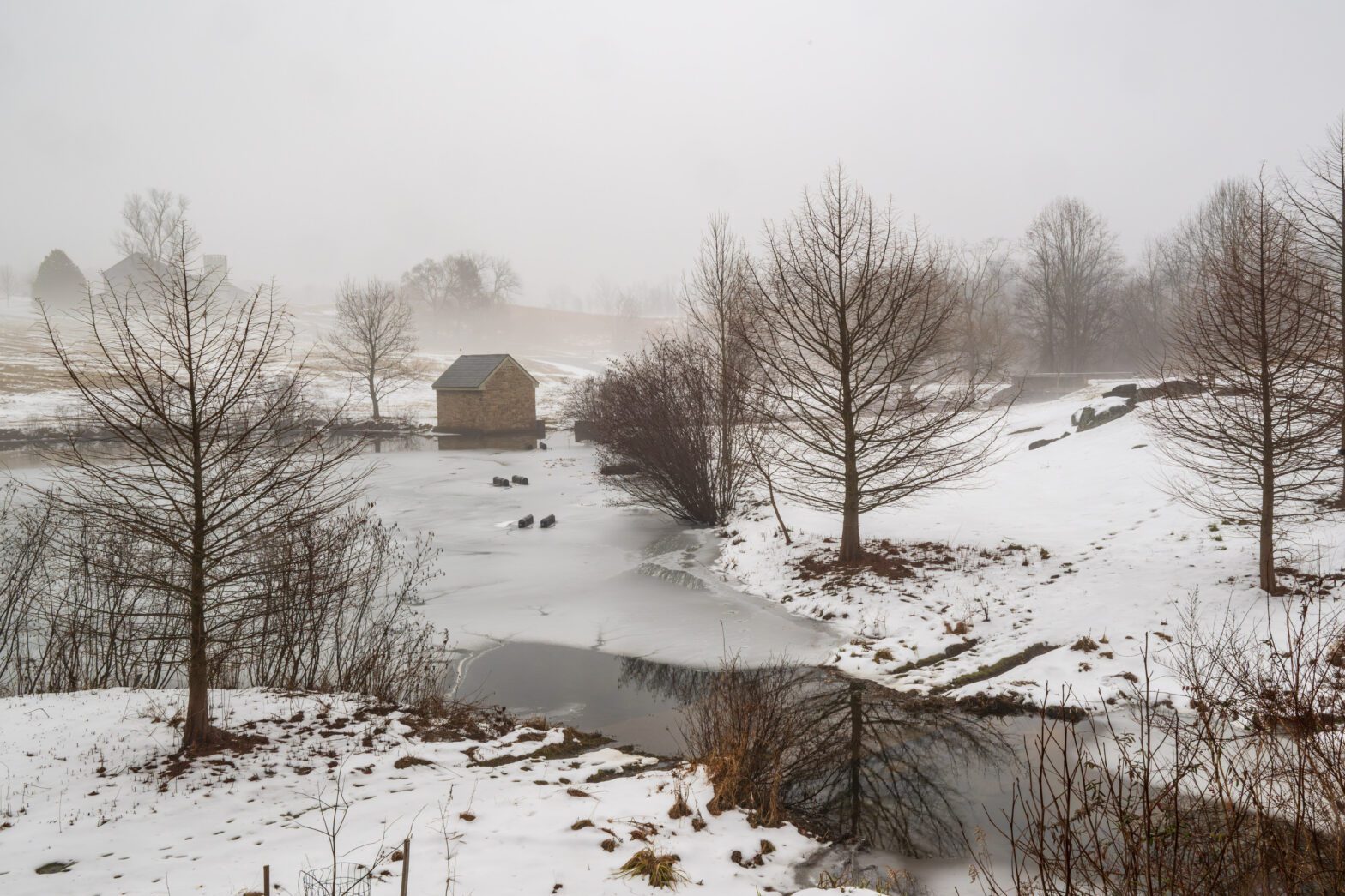
CLOSURE UPDATE: Due to unexpectedly heavy snowfall, Winterthur will be closed to Members and guests on Sunday, December 14. Guests with tickets for the Santa Brunch or general admission will be contacted regarding refunds. We apologize for the inconvenience and appreciate your understanding. Please stay safe. »
At Winterthur, Jacqueline Kennedy found priceless treasures and a great deal of inspiration.
First Lady Jacqueline Kennedy had already invited Winterthur founder Henry Francis du Pont to chair her Fine Arts Committee for her historic restoration of the White House when she visited Winterthur in May 1961. What did she see here? Many of the same iconic objects and spaces visitors see today, and they are all worthy of a president’s home. Here’s a short list.
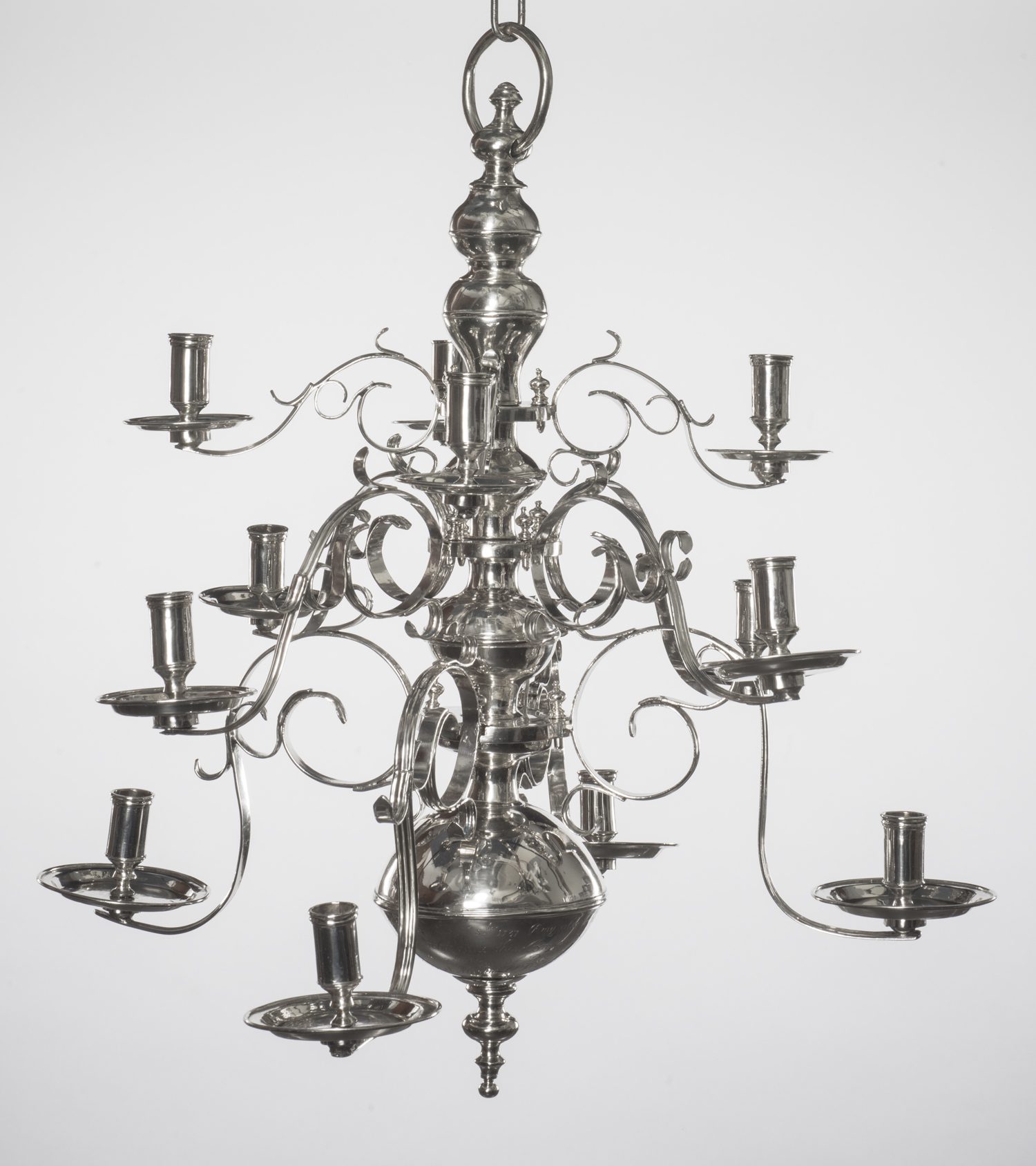
Silver Tankards by Paul Revere
The only known set of six matching silver tankards made by patriot Paul Revere Jr. has rested on a sideboard in the du Pont Dining Room since Winterthur became a museum in 1951. They are a special treasure even among Winterthur’s treasured silver collection. About 2,900 pieces are on view in the museum. Another 9,000 objects, mostly spoons, make up a reference collection of American silversmiths’ marks, an important resource for scholars and collectors. Other highlights of the collection include the first coins minted in Boston, the largest extant collection of British fused-plate lighting devices, and the Campbell’s collection of British, European and American soup tureens—though Mrs. Kennedy visited 35 years before the tureens entered the collection.
American Commissioners of the Preliminary Peace Negotiations with Great Britain
This painting by famed artist Benjamin West commemorates the Treaty of Paris, which ended the American Revolution. It hangs near Revere’s tankards. Dated 1783-1819, it depicts American patriots John Jay (standing), John Adams, Benjamin Franklin, Henry Laurens (standing), and William Templeton Franklin, but not the British delegates. West, appointed historical painter to the king of England in 1772 and surveyor of the royal pictures in 1790, never completed the painting. It was sold as part of his estate in 1819. Du Pont purchased the painting from the J.P. Morgan collection in 1948. A second version, presumably finished by West’s studio, is in the collections of the U.S. Department of State.
Washington at Verplanck’s Point
Like “American Commissioners” the full name of this famous painting by John Trumbull is a mouthful: Washington at Verplanck’s Point New York, 1782 Reviewing the French Troops after the Victory at Yorktown. Made in 1790, it is perhaps the most famous of the many paintings of Washington as commander-in-chief of the Continental Army. Washington gave the fortunate Trumbull 14 sittings, perhaps because Trumbull’s father was a wartime governor and trusted friend of the general, perhaps because the painting was a gift from Trumbull to Martha Washington. It originally hung in the dining room of the Washingtons’ Mount Vernon home.
Chionodoxa “Glory-of-the-snow”-photo by Lois Mauro
Check these out:
Heavenly Hellebores: The Lenten roses (Helleborus species & hybrids) are blooming in white, pink spotted, pink, & wine red in the Greenhouse sunken garden, in front of The Cottage, along Winterhazel Walk, at the edge of the Pinetum and in the raised bed in the Museum East courtyard.
A blizzard of snowflakes: Spring snowflakes (Leucojum vernum) are carpeting the sices of the walkway to Icewell Terrace. They are blooming in less dramatic numbers in other parts of the gardens.
The blue carpet is rolling out: The Museum Upper Terrace lawn is carpeted with lavender blue glory-of-the-snow (Chionoodoxa forbesii) which are also found throughout the gardens. The royal blue of Siberian squill (Scilla siberica) is carpeting the lawn adjacent to the walk from Winterhazel Walk to Icewell Terrace and areas of Azalea Woods and the sunken garden in the Greenhouse area. They dot the lawn sloping from Garden Lane to the Museum & are found in many other areas of the garden.
Magnificent Magnolias: The southern magnolias (Magnolia grandiflora) along the Library wall are in full bloom this week. Stand nearby to enjoy their fragrance.
Hydrangeas: Hydrangeas are starting to bloom throughout the gardens with the greatest variety of species in Enchanted Woods.
Everywhere: But, listed only here:
The tiny white-to-pale-pink daisies of fleabane (Erigeron annuus) are blooming throughout the Estate.
White clover (Trifolium repens) in the fields and lawns is providing nectar and pollen for the pollinators and nitrogen for the soil.
Magnificent Magnolias: The southern magnolias (Magnolia grandiflora) along the Library wall are in full bloom this week. Stand nearby to enjoy their fragrance.
Hydrangeas: Hydrangeas – with both mophead/hortensia and lacecap flowers, including bigleaf (Hydrangea macrophylla), smooth (Hydrangea arborescens), oakleaf (Hydrangea quercifolia) and mountain (Hydrangea serrata) – are blooming throughout the gardens with the greatest variety of species in Enchanted Woods.
Everywhere: But, listed only here:
The tiny white-to-pale-pink daisies of fleabane (Erigeron annuus) are blooming throughout the Estate.
White clover (Trifolium repens) in the fields and lawns is providing nectar and pollen for the pollinators and nitrogen for the soil.
ENTRANCE DRIVE AND PARKING AREA
fb Asclepias syriaca (Common milkweed – lavender)
fb Catalpa bignonioides (Common catalpa – white)
fb Galium mollugo (Wild madder – white ‘clouds’ of tiny flowers)
Lovely Lilies: This week the martagon lilies (Lilium martagon) are at their peak in Azalea Woods, Enchanted Woods, and, lesser numbers, in other areas of the garden. Catch them now. Their bloom is brief but beautiful.
Sycamore Hill Roses: The white Meidiland rose (Rosa MEIvahn) is in full bloom at the Brick Overlook Folly, and, along the fence, palest pink ‘New Dawn’ rose (Rosa ‘New Dawn’, white ‘White Dawn’ rose (Rosa ‘White Dawn’) and bright red Winner’s Circle rose (Rosa ‘Radwin’) are also in full bloom. Along the fence, red large flowered climber rose (Rosa ‘Bess Lovett’) still has some flowers as does the damask rose hybrid Rosa ‘Pink Leda’ at the Bristol Folly.
Everywhere: But, listed only here:
The tiny white-to-pale-pink daisies of fleabane (Erigeron annuus) are blooming throughout the Estate.
White clover (Trifolium repens) in the fields and lawns is providing nectar and pollen for the pollinators and nitrogen for the soil.
Chaenomeles cultivar “Flowering Quince”-photo by Eileen Tercha
Check these out:
Superb Sundial: Flowers of star magnolias (Magnolia stellata cultivars), saucer magnolias (Magnolia x soulangeana cultivars) and the magnificent Wada’s Memory magnolia (Magnolia ‘Wada’s Memory’) are underlined by theblooming garland spiraea (Spiraea x arguta).
It’s a Brief Show: The white flowers of bloodroot (Sanguinaria canadensis) are blooming in many areas of the garden this week. They are particularly abundant on the hill below the walkway at the lower edge of the Parking Area and in the Quarry Garden on the upper hillside facing Sycamore Hill. Their flowers last a very short time.
A River of Blue: It starts in Azalea Woods, flows down the lawn to the Museum including the upper East Terrace, down the March Bank and up the opposite side to the walkway from Winterhazel Walk to Icewell Terrace. It’s made up of lavender blue glory-of-the-snow (Chionodoxa forbesii), royal blue Siberian squill (Scilla siberica), and blue to white Italian anemone (Anemone apennina). The sunken garden in the Greenhouse area is a sea of intense blue and the rest of the gardens have blue accents in greater or lesser numbers.
Flowering Quince: The Quince Walk area of the Pinetum is filled with the bright red, red-orange, peach, and white blossoms of flowering quince (Chaenomeles species & cultivars).
Heavenly Hellebores: The Lenten roses (Helleborus species & hybrids) are blooming in white, pink spotted, pink, & wine red in the Greenhouse sunken garden, in front of The Cottage, along Winterhazel Walk, at the edge of the Pinetum and in the raised bed in the Museum East courtyard.
Hosta ventricosa or Blue Hosta with their lavender-purple flowers elegantly wash down from Azalea Woods and across both sides of the March Bank. Blue Hosta can also be found adorning the edge of Oak Hill.
The Quarry Garden’s hillside is covered in pale-lavender-to-white spikes of the hybrid Honeybells hostas aka Hosta Honeybells.
There are so many blooming Hosta, which makes for very happy Hummingbirds who visit to sip on their sweet nectar.
Learn more about the planting and care of Hostas from the Spruce.
Magnolia grandiflora Southern Magnolia
Did you know?
Southern Magnolias can live an average of 80 years, but many will age to 120 years old.
They top out at around 120 feet tall, categorizing the tree as a medium to large evergreen.
Magnolia flowers produce lots of pollen, but they do not produce nectar.
The flowers of the magnolia grandiflora are large and very fragrant.
Many cultures claim the magnolia as a symbol of many things, such as natural beauty, purity, strength, freedom, nobility and more.
Today, the southern magnolia symbolizes peace, harmony and hope for a better future.
The magnolia flower is considered a muse, a symbol, and a treasure by many. You will find numerous photos, paintings, poems and songs honoring the sweet southern magnolia.
Rhododendron prunifolium Plumleaf Azalea
The plumleaf azalea is one of the latest native azaleas to bloom each year. The large, showy deep orange to red flowers are gorgeous in the late summer garden. They bloom in clusters and are a great source of nectar to hummingbirds and varieties of butterflies.
Their common name comes from their deep green leaves that turn a warm plum shade in the cool fall weather. The plant grows to a height of 6-8′ and prefers partial shade.
Rhododendron prunifolium was winner of the 2014 south east region’s “Rhododendron of the Year” award; this honor was bestowed on the plant by the American Rhododendron Society.
Visit the plumleaf azalea in the Winterthur Garden today and you’ll understand why it’s an award winning rhododendron!!
Search the Winterthur Garden map to find your favorite garden area or to plot an exciting new area to explore!
What’s blooming at Winterthur now? Download the full report below:
Songbirds and butterflies are attracted to summersweet clethra for its nectar and seeds. This plant is prized for its four seasons of interest. In winter they produce dried seed capsules which are delicate and lovely to behold. In the spring summersweet delights with silky, showy green leaves; summer is the season when they show off most, with spiky white or pink fragrant flowers. And at last, fall is when you’ll find their green leaves turn a vivid golden yellow setting the garden floor ablaze with warmth. How could ask for anything more?
Clethra is native to the eastern United States and there are multiple cultivars, such as the Hummingbird cv. seen here.
The Hummingbird summersweet clethra grows 2 to 3 feet high and wide making it a more rounded cultivar with white flower clusters that are larger and open earlier than the true species.
Plant clethra in part shade to full sun and give it some room to spread out by its suckering root system. These pants like a moist to wet area and can be easily pruned to keep control of, especially since they flower on new wood.
Find Summersweet “Hummingbird” in Winterthur’s Enchanted Woods.
Daucus carota Queen Anne’s Lace
Did you know?
Queen Anne’s Lace, also known as “wild carrot”, is actually a cousin to the carrot, and it produces a carrot-like taproot, just like a carrot. Both carry the scientific name Daucus carota.
They are not native to North America; they were brought here by early European settlers.
Queen Anne’s Lace can be found growing in 48 N. American states and is listed as an invasive plant in fourteen of those states. It does grow wild and will take over so one should plan its planting with caution. Don’t let their growing habits scare you, as they will fill a meadow garden with elegant blooms that will surely delight you.
Queen Anne’s Lace looks very much like poison hemlock, giant hogweed and cow parsley. Hemlock and hogweed are poisonous to humans, livestock and pets; be sure you know what you are picking or digging out before you start!
There are many common names given to this plant, such as Wild Carrot, Bishop’s Lace, Bee’s Nest and Bird’s Nest Flower. Take your pick of which one you like best!
You probably guessed that the name Queen Anne’s Lace comes from Queen Anne, wife of King James I. The truth is unsure as there are multiple stories surrounding the name and how the flower was connected to royalty. Most believe that it actually stems from Queen Anne II. The stories are interesting, read more below:
Agapanthus is a perennial from the subfamily Agapanthoideae from the Amaryllidaceae family.
There are many cultivars of Agapanthus varying from white (shown here) to rich blue with a purple stripe and violet blue with a blue stripe.
The care and planting of this specimen depends completely on the variety plant you choose for your garden; are you planting a deciduous or an evergreen agapanthus? Knowing this makes all the difference when planning Lily of the Nile for your garden.
Find information on the care of Agapanthus by visiting The Spruce’s online site.
Search the Winterthur Garden map to find your favorite garden area or to plot an exciting new area to explore!
What’s blooming at Winterthur now? Download the full report below:
Songbirds and butterflies are attracted to summersweet clethra for its nectar and seeds. This plant is prized for its four seasons of interest. In winter they produce dried seed capsules which are delicate and lovely to behold. In the spring summersweet delights with silky, showy green leaves; summer is the season when they show off most, with spiky white or pink fragrant flowers. And at last, fall is when you’ll find their green leaves turn a vivid golden yellow setting the garden floor ablaze with warmth. How could ask for anything more?
Clethra is native to the eastern United States and there are multiple cultivars, such as the Hummingbird cv. seen here.
The Hummingbird summersweet clethra grows 2 to 3 feet high and wide making it a more rounded cultivar with white flower clusters that are larger and open earlier than the true species.
Plant clethra alnifolia in part shade to full sun and give it some room to spread out by its suckering root system. These pants like a moist to wet area and can be easily pruned to keep control of, especially since they flower on new wood.
Find Summersweet “Hummingbird” in Winterthur’s Enchanted Woods.
Daucus carota Queen Anne’s Lace
Did you know?
Queen Anne’s Lace, also known as “wild carrot”, is actually a cousin to the carrot, and it produces a carrot-like taproot, just like a carrot. Both carry the scientific name Daucus carota.
They are not native to North America; they were brought here by early European settlers.
Queen Anne’s Lace can be found growing in 48 N. American states and is listed as an invasive plant in fourteen of those states. It does grow wild and will take over so one should plan its planting with caution. Don’t let their growing habits scare you, as they will fill a meadow garden with elegant blooms that will surely delight you.
Queen Anne’s Lace looks very much like poison hemlock, giant hogweed and cow parsley. Hemlock and hogweed are poisonous to humans, livestock and pets; be sure you know what you are picking or digging out before you start!
There are many common names given to this plant, such as Wild Carrot, Bishop’s Lace, Bee’s Nest and Bird’s Nest Flower. Take your pick of which one you like best!
You probably guessed that the name Queen Anne’s Lace comes from Queen Anne, wife of King James I. The truth is unsure as there are multiple stories surrounding the name and how the flower was connected to royalty. Most believe that it actually stems from Queen Anne II. The stories are interesting, read more below:
Agapanthus is a perennial from the subfamily Agapanthoideae from the Amaryllidaceae family.
There are many cultivars of Agapanthus varying from white (shown here) to rich blue with a purple stripe and violet blue with a blue stripe.
The care and planting of this specimen depends completely on the variety plant you choose for your garden; are you planting a deciduous or an evergreen agapanthus? Knowing this makes all the difference when planning Lily of the Nile for your garden.
Find information on the care of Agapanthus by visiting The Spruce’s online site.
Search the Winterthur Garden map to find your favorite garden area or to plot an exciting new area to explore!
What’s blooming at Winterthur now? Download the full report below:
To the left you are viewing Hydrangea Macrophylla “Tokyo Delight”
Hydrangeas – with both mophead/hortensia and lacecap flowers, including bigleaf (Hydrangea macrophylla), smooth (Hydrangea arborescens), oakleaf (Hydrangea quercifolia) and mountain (Hydrangea serrata).
The Garden is filled with a rich variety of blooming Hydrangeas; the greatest variety of species can be found in Enchanted Woods.
Are you a Hydrangea enthusiast? Check out the American Hydrangea Society website to learn more about these incredible plants! https://americanhydrangeasociety.org/
Nepeta faasenii ‘Junior Walker’ (catmint blue)
COMMON NAME
JUNIOR WALKER CATMINT
Botanical Name
Nepeta faasenii Junior Walker
Zones
5, 6, 7, 8, 9
Light Required
Full Sun/ Part Shade
Flower Color
Purple
Flower Size
1″ Flowers
Mature Height
14-16″ Tall
Mature Spread
31-35″ Wide
Growth Rate
Medium
Bloom Time
Late Spring to Early Summer
Foliage
Blue-Green
Soil Type
Loamy, Sandy, Well-Drained
Soil Moisture
Dry-Average
Advantages
Bee friendly, attracts butterflies, deer resistant, easy to grow, fragrant flowers, good in containers, rabbit resistant.
Planting Time
Spring/Summer
Asclepias tuberosa Butterfly Milkweed
Butterfly weed is an herbaceous perennial that is easy to care for and also beloved for its ability to attract a variety of helpful and beautiful insects to the garden. Butterfly weed can be found growing as a native wildflower in many untamed environments, such as meadows, prairies, and forest clearings. Gardeners will plant butterfly weed, hoping to draw the namesake winged insects into their garden. This clump-forming perennial grows from tuberous roots to a height of one to two feet tall and is characterized by glossy-green, lance-shaped leaves and clusters of bright orange-to-yellow blooms that are rich with nectar and pollen.
Butterfly weed is generally planted in the warm soil of late spring and is fairly slow to become established. It does not bloom the first year and may even take as long as three years to bloom. Flowers bloom as clusters of bright orange-yellow and will display from late spring until late summer for about two months. Butterfly weed does not have caustic milky sap like other milkweeds, but it does produce the characteristic seed pods that release silky-tailed seeds.
You can find Butterfly Weed growing at the Lagoons near Clenny Run and in the meadows. Just follow the butterflies in flight or you may search the Winterthur Garden map to find the areas where Butterfly weed is blooming.
What’s blooming at Winterthur now? Download the full report below: