Early American Furniture and the Idea of Masterpiece
April 23–24, 2027
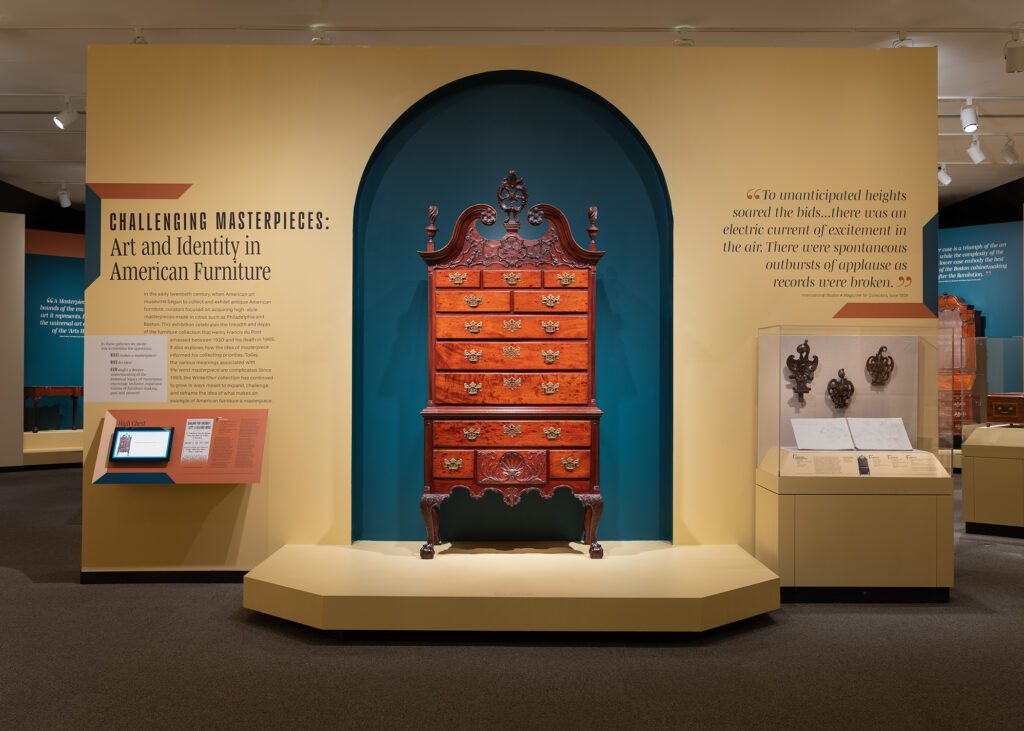
Challenging Masterpieces: Art and Identity in American Furniture highlights more than 70 standout pieces from the collection and invites you to explore what makes a “masterpiece” and how the concept has been interpreted by collectors, connoisseurs, and museums. In Early American Furniture and the Idea of Masterpiece, we will delve deeper into the design, craftsmanship, and history of antique collecting to engage furniture enthusiasts, experts, historians, museum professionals, and others interested in material culture and American history.
$325; Members $275. Scholarship opportunities available; students encouraged to apply. To apply, please complete the Scholarship Application Form. Questions? Email us at CommunityLearning@winterthur.org.
Program Schedule
Friday, April 23, 2027
8:30 am
Registration and coffee, Visitor Center Café
9:00 am
Welcome, Copeland Lecture Hall
Chris Strand, Charles F. Montgomery Director and CEO, Winterthur
9:15 am
Furniture for the Home, Furniture for the Future: Henry Francis du Pont’s Collecting Life
Joshua Lane, Lois F. and Henry S. McNeil Curator of Furniture, Winterthur
10:00 am
The Molding of Masterpieces: Charles Montgomery, Frank Sommer, and the Decorative Arts Canon
Allie Alvis, Curator of Special Collections, Winterthur
10:30 am
Break, Visitor Center Café
11:00 am
In Praise of Pimm and the Pickmans: Masterpieces of American Japanned Furniture
Alyce Englund, Curator of American Decorative Arts, American Wing, Metropolitan Museum of Art
11:45 am
Focused object presentation: Symonds Shop valuables box, 1676
Matthew Becue, Lois F. McNeil Fellow, Winterthur Program in American Material Culture
12:00 pm
Lunch—Offerings available for purchase in the Visitor Center Café
1:15 pm
Demonstration: Steam-bending wood
Don Williams, Conservator, Educator and Scholar, the Barn on White Run and Joshua Lane, Lois F. and Henry S. McNeil Curator of Furniture, Winterthur
2:15 pm
Focused object presentation: Campeche chair, 1740–1780
Amalia Pappa, Lois F. McNeil Fellow, Winterthur Program in American Material Culture
2:30 pm
Re-Surfacing Painted Decoration: Craftsmanship, Research, and Restoration from the Colonial Era to the Colonial Revival
Emelie Gevalt, Ph.D., Deborah Davenport and Stewart Stender Deputy Director and Chief Curatorial and Program Officer, American Folk Art Museum
3:15 pm
Break
3:45 pm
Focused object presentation: “Settin’ chair,” 1860–1920
Kayleigh Danowski, Lois F. McNeil Fellow, Winterthur Program in American Material Culture
4:00 pm
American by Craft: The Furniture of Olof Althin, 1880–1920
Erica Lome, Curator of Collections, Historic New England
4:45 pm
Conclusion and Saturday preview
Joshua Lane, Lois F. and Henry S. McNeil Curator of Furniture, Winterthur
5:00–6:30 pm
Reception, Visitor Center Café
Saturday, April 24, 2027
8:30 am
Coffee, Visitor Center Café
9:00 am
Announcements, Copeland Lecture Hall
Joshua Lane, Lois F. and Henry S. McNeil Curator of Furniture, Winterthur
9:05 am
Winterthur’s Refurbished Shaker Rooms: New Additions and Future Directions
Joshua Lane, Lois F. and Henry S. McNeil Curator of Furniture, Winterthur
9:30 am
Focused object presentation: Shaker desk, 1873
Alex May, Research and Publications Associate, Winterthur
9:45 am
Is Masterpiece a Choice?
Chris Storb, Furniture Conservator, Woodworking Historian, and Wood Artist
10:45 am
Break, Visitor Center Café
11:00 am
Informed Amateurs: Crafting Furniture in Post–WWII America
Catharine Dann Roeber, Director of Academic Affairs and Brock W. Jobe Associate Professor of Decorative Arts and Material Culture, Winterthur
11:45 am
Focused object presentation: Southern or English china table
Abigail Sullivan, Lois F. McNeil Fellow, Winterthur Program in American Material Culture
12:00 pm
Lunch—Offerings available for purchase in the Visitor Center Café
1:15 pm
Focused object presentation: Mi’kmaq chair, 1860–1910
Anna C. Wershbale, Lois F. McNeil Fellow, Winterthur Program in American Material Culture
1:30 pm
In the Hands of a Skilled Workman
Video viewing and commentary with Alan T. Miller, Antiques Consultant
2:45 pm
Conclusion of Program
3:00 pm
Board shuttle to Museum from Visitor Center circle drive or walk
Viewing of Challenging Masterpieces: Art and Identity in American Furniture, Winterthur Museum Galleries
Optional drop-in demonstration in the Rotunda
Creating the Illusion of Traditional Upholstery for Historic Seating Furniture
Kathy Gillis, former Elizabeth Terry Seaks Senior Furniture Conservator, Winterthur
Lectures & Speakers
Furniture for the Home, Furniture for the Future: Henry Francis du Pont’s Collecting Life
Joshua Lane, Lois F. and Henry S. McNeil Curator of Furniture, Winterthur Museum, Garden & Library
In October 1923, at age 43, Henry Francis du Pont abruptly decided to collect Americana. He had just returned from a trip to New England where he’d been struck by the epiphany that American antiques would perfectly suit his new summer home on Long Island. This decision set him on a life path to fill not only his summer home, Chestertown House, but also Winterthur, the family home he inherited in 1926. He furnished Winterthur’s rooms for his and his family’s private enjoyment—but also with an eye toward creating a future museum. This presentation focuses on pivotal acquisitions that help trace the arc of H. F. du Pont’s collecting career and introduces some of the individuals with whom he collaborated as he refined his collecting focus, connoisseurship, and vision.
About the Speaker
Joshua Lane joined the curatorial staff at Winterthur Museum in 2014 as curator of furniture. Previously he served as both curator of furniture and curator of Academic Programs at Historic Deerfield Inc. Most recently, he curated the exhibition Challenging Masterpieces: Art and Identity in American Furniture, featuring Winterthur’s collection. He taught courses in American studies and material culture at Yale University, Miami University of Ohio, and the University of Massachusetts, Amherst. He currently serves as affiliated professor in the University of Delaware/Winterthur Program in American Material Culture.
The Molding of Masterpieces: Charles Montgomery, Frank Sommer, and the Decorative Arts Canon
Allie Alvis, Curator of Special Collections, Winterthur
Those who established the Winterthur Library always intended its material to go beyond the masterpieces, ensuring that the story of the material culture of everyday American life was not limited to only certain Americans. In addition to creating a deep well of European and global context for how we understand American decorative arts, the early hands that shaped the library—those of Charles Montgomery and Frank Sommer—left an indelible imprint that continues to guide collecting practices that extend to all regions of the United States and the full spectrum of visual and material experiences. Drawing on decades of correspondence and acquisition records, this talk will dive into the history of the library and highlight some of its iconic and lesser-known collection items.
About the Speaker
Allie Alvis is curator of special collections at Winterthur Library and the editor of SHARP News Features. They formerly worked as a rare book cataloguer for Type Punch Matrix and as the special collections reference librarian of the Smithsonian Libraries and Archives. Their research is diverse and far-reaching, with interests in physical patterns of use in books, ephemera, and depictions of rare books in pop culture. Alvis has published on the history of rebinding illuminated manuscripts, the reuse of type ornaments in 16th- and 17th-century England, the work of bookbinders Douglas Cockerell and Son, and the use of arsenical green pigments in bookbinding. They are involved in the study and act of using social media for communicating book history, maintaining popular accounts across various platforms under the name “Book Historia.” Alvis received a B.A. in linguistics from the University of Kansas (2013), an M.Sc. in material culture and book history from the University of Edinburgh (2015), and an M.Sc. in information management from the University of Glasgow (2016).
In Praise of Pimm and the Pickmans: Masterpieces of American Japanned Furniture
Alyce Englund, Curator of American Decorative Arts, American Wing, Metropolitan Museum of Art
Alyce Perry Englund will examine the evolving discourse on japanned furniture, an artform cultivated by European and American tradesmen in the 16th to 18th centuries that was inspired by lacquer imports from Asia. American japanned finishes reflect the deep impact of global networks, the brilliant fusion of artistic traditions, and inventive technical methods employed by local craftsmen. She will share perspectives on the masterpieces of American japanned furniture at Winterthur and the Metropolitan Museum of Art, which have been informed by extensive documentary research and scientific analyses, and provide new insights on design inspiration and the British North American market for japanned furniture. She will also present recent discoveries of artist inscriptions on furniture that have prompted reattributions as well as vibrant descriptions of the workshops in which japanned furniture was produced.
About the Speaker
Alyce Perry Englund is curator of American Decorative Arts at the American Wing of the Metropolitan Museum of Art and oversees North American furniture (1600–1830) and Shaker collections. Prior to joining the Met in 2015, she had the privilege of working at the Wadsworth Atheneum, the Museum of Fine Arts, Boston, and Historic New England. She received a B.A. in art history from the University of Vermont, an M.A. from Winterthur’s Program in American Material Culture, and is an alumna of the Attingham Trust. She has organized many notable exhibitions including Sound and Sense: Poetic Musings in American Art (2015–2016) at the Wadsworth Atheneum, as well as Simple Gifts: Shaker at the Met (2016), Chippendale’s Director: The Designs and Legacy of a Furniture Maker (2018), The Calculated Curve: Eighteenth-Century American Furniture (2024), and Cottage Industry: The Val-Kill Furniture Shop (2026–2027) currently on view at the Met. Her devotion to japanning began at Winterthur and culminated in her thesis, Always Prepared: The Materials and Techniques of Boston Japanners, 1700–1775, followed by decades of investigation captured in The Magazine Antiques article “The Best ‘Blew’: A Rare American Blue-Japanned Tall-Case Clock” (May 2009) and most recently in “American Japanned Furniture at The Met,” for The Met Bulletin (Winter 2025).
Focused object presentation: Symonds Shop valuables box, 1676
Matthew Becue, Lois F. McNeill Fellow, Winterthur Program in American Material Culture
About the Speaker
Matthew Becue blends his love of 18th- and 19th-century American utilitarian ceramics and glass with an archaeologically informed approach in order to tell evocative material culture stories. Prior to coming to Winterthur, he earned his master’s in historical archaeology from University of Massachusetts, Boston, while also interning at the Massachusetts Historical Commission. At the University of Massachusetts, he enjoyed working on collaborative archaeological projects with the Hassanamisco Nipmuc and the Eastern Pequot tribal nations, while his thesis analyzed an assemblage of 19th-century bottle glass from a Central Massachusetts farmstead to examine the experiences of working-class farmers and shoemakers navigating rapid industrialization. At Winterthur his thesis research analyzes red earthenware dishes featuring slip-trailed inscriptions that were made in Norwalk, Connecticut, during the first half of the 19th century. His project investigates the producers and consumers of these objects, how these objects functioned in people’s homes, and the meanings and motivations for the wide array of slip inscriptions on them, revealing insights into aspects of consumer preference, food ways, religious convictions, and the overall material life of 19th-century New England and the surrounding region.
Demonstration: Steam-bending wood
Don Williams, Conservator, Educator, and Scholar, the Barn on White Run
Joshua Lane, Lois F. and Henry S. McNeil Curator of Furniture, Winterthur
About the Speaker
Don Williams is a conservator, educator, scholar, and all-around inquisitive guy, having worked on some of the most interesting objects and historic buildings in our nation’s public and private collections. He has developed, managed, and presented educational programming on an array of subjects in the fields of conservation, woodworking, and wood finishing, and has published and presented scholarly research on subjects like ancient coating materials and craft techniques, and created pioneering uses for traditional and modern materials, including some of his own invention.
In his spare time, he passionately pursues varied interests, including economics, metal casting, collecting obscure books and tools, Japanese gardening, and faith, all of which usually occur against a backdrop of either jazz or podcast lectures on various arcane topics. He and his wife have two brilliant and charming daughters who lovingly accept that their eccentric dad has dozens of different kinds of shellac in the basement, which will soon have a place of honor in his restored vintage timber framed barn alongside their cabin retreat in the mountains of rural Virginia.
Joshua Lane joined the curatorial staff at Winterthur Museum in 2014 as curator of furniture. Previously he served as both curator of furniture and curator of Academic Programs at Historic Deerfield Inc. Most recently, he curated the exhibition Challenging Masterpieces: Art and Identity in American Furniture, featuring Winterthur’s collection. He taught courses in American studies and material culture at Yale University, Miami University of Ohio, and the University of Massachusetts, Amherst. He currently serves as affiliated professor in the University of Delaware/Winterthur Program in American Material Culture.
Focused object presentation: Campeche chair, 1740–1780
Amalia Pappa, Lois F. McNeil Fellow, Winterthur Program in American Material Culture
About the Speaker
Growing up in the heart of Chicago, Amalia Pappa took full advantage of the amazing museums that surrounded her. At eight years old, while her friends were at the YMCA, she went to summer camp at the National Museum of Mexican Art. Amalia’s advocacy for museums as sites of identity formation and cultural connection can probably be traced back to the summer she made a shoebox ofrenda (altar). In college she spent her summers in much the same way, interning in the exhibitions department at the Art Institute of Chicago in 2023 and in the curatorial and education departments at the National Postal Museum in 2024. She graduated from Carleton College in 2025 with a B.A. in history and American studies. Her history thesis investigated the symbiotic relationship between uniform access and gendered perceptions of labor for female city letter carriers in the United States Postal Service, while her American studies thesis examined the cigarette as an emblem of coming-of-age in contemporary American society. As a second-year fellow in the Winterthur Program in American Material Culture, she is currently writing her master’s thesis on needlework samplers made by schoolgirls in 19th-century Mexico.
Re-Surfacing Painted Decoration: Craftsmanship, Research, and Restoration from the Colonial Era to the Colonial Revival
Emelie Gevalt, Ph.D., Deborah Davenport and Stewart Stender Deputy Director and Chief Curatorial and Program Officer, American Folk Art Museum
This presentation is a look at early paint-decorated furniture through the lens of multiple time periods, focusing on the pioneering work of Esther Stevens Brazer (1898–1945), a historian and practitioner of traditional paint decoration techniques. Among Brazer’s accomplishments were the founding of the still active Historical Society of Early American Decoration and a series of seminal articles on early Boston japanning and the exuberantly decorated group known as Taunton chests. Looking at examples from the collections of Winterthur, the American Folk Art Museum, and others, Gevalt will explore the multi-layered history of paint-decorated furniture, not only as standout examples of 18th-century creative vision but as objects of sustained interest in the 19th and 20th centuries—serving as touchstones of collective memory, a sense of artistic inheritance, and historical imagination.
About the Speaker
Dr. Emelie Gevalt is deputy director and chief curatorial and program officer at the American Folk Art Museum (AFAM) in New York City. Often looking at earlier material through the lens of 20th-century histories of collecting and collective memory, her work encompasses research interests in 18th- and 19th-century American art and material culture including especially portraiture, textiles, decorative painting, the Colonial Revival movement, and African American representation. Her research has been supported by grants from, among others, the Terra Foundation for American Art, the Andrew W. Mellon Foundation, the Craft Research Fund, the Decorative Arts Trust, and the National Endowment for the Arts. She publishes and lectures widely. Her exhibitions at AFAM include the critically acclaimed What that Quilt Knows About Me (2023) and Unnamed Figures: Black Presence and Absence in the Early American North (2023), heralded by The New York Times as “vitally important” and “deeply moving.” She received her B.A. in art history and theater studies from Yale University (magna cum laude and Phi Beta Kappa), her M.A. from the Winterthur Program in American Material Culture, and her Ph.D. in art history from the University of Delaware. Her two decades of art-world experience include positions at the Museum of Fine Arts, Boston, and Christie’s New York, where she served as a vice president in the Estates, Appraisals, and Valuations department.
Focused object presentation: “Settin’ chair,” 1860–1920
Kayleigh Danowski, Lois F. McNeil Fellow, Winterthur Program in American Material Culture
About the Speaker
Born in Northeast Ohio, Kayleigh Danowski began life in pursuit of becoming a ballet dancer. During her professional career, she had the opportunity to dance in many small towns across the United States, where she developed a strong interest in domestic architecture and historic objects, nurtured by neighborhood sightseeing and small-town thrifting. Upon retirement from ballet, she began her undergraduate studies and discovered that her love for storytelling through movement transcended the stage, taking new footing in the formal study of material culture. She graduated magna cum laude from Brown University with a Sc.B. in history of art and architecture and psychology, receiving the Ann Belsky Moranis Memorial Prize and departmental honors in art history. During a summer internship at the Lippitt House Museum in Providence, Rhode Island, she dove into archival research of late-Victorian local history, where she formed the foundation of her honors thesis that recovered the voice of dollhouse furniture maker and founder of Tynietoy, Marion Perkins (1872–1947). Through Perkins’s story, she explored intersections of historical feminism, the Arts and Crafts movement, and contemporary feminist theory. At Winterthur, she continues her investigation of how domestic spaces and everyday objects both reinforce and resist gendered expectations.
American by Craft: The Furniture of Olof Althin, 1880-1920
Erica Lome, Curator of Collections, Historic New England
In 1881, Swedish-born Olof Althin (1859–1920) arrived in Boston with a set of tools and a drive to succeed. He soon became one of the most accomplished cabinetmakers in the city, known for his “perfect and faultless” furniture. Althin steered a path through Boston’s competitive furniture industry by assimilating local tastes into his repertoire, designing and producing in his small shop custom-made pieces in a variety of fashionable styles.
Over the course of his career, Althin gained recognition for his sophisticated reproductions of early American furniture and later expanded his services to include restoration, repair, and appraisal. He worked closely with H. Eugene Bolles (1858–1910) and Charles Hitchcock Tyler (1863–1931), whose important collections of American antiques now belong to the Metropolitan Museum of Art and the Museum of Fine Art in Boston.
American By Craft draws from a rich and underexamined archive of furniture, tools, business papers, design drawings, photographs, and more to explore the career of an immigrant craftsman who personally shaped some of the “masterpieces” of American decorative arts.
About the Speaker
Dr. Erica Lome is curator of Collections at Historic New England, responsible for over 125,000 objects spread across thirty-eight historic properties. She was previously the Peggy N. Gerry Curatorial Associate at the Concord Museum, a position sponsored by the Decorative Arts Trust. She received her Ph.D. from the American civilization program at the University of Delaware and her M.A. in decorative arts, design history, and material culture from the Bard Graduate Center. Her recent exhibition was Myth and Memory: Stories of the American Revolution, held at the Eustis Estate in Milton, Massachusetts.
Winterthur’s Refurbished Shaker Rooms: New Additions and Future Directions
Joshua Lane, Lois F. and Henry S. McNeil Curator of Furniture, Winterthur Museum, Garden & Library
An overview of the Shaker Rooms will highlight recent significant donations. Prompting the overhaul of the exhibition space, these gifts have helped broaden Winterthur’s interpretation of Shaker material culture and life.
About the Speaker
Joshua Lane joined the curatorial staff at Winterthur in 2014 as curator of furniture. He previously served as both curator of furniture and curator of Academic Programs at Historic Deerfield Inc. Most recently he curated the exhibition Challenging Masterpieces: Art and Identity in American Furniture, featuring Winterthur’s collection. He taught courses in American studies and material culture at Yale University, Miami University of Ohio, and the University of Massachusetts, Amherst. He currently serves as affiliated professor in the University of Delaware/Winterthur Program in American Material Culture.
Focused object presentation: Shaker desk, 1873
Alex May, Research and Publications Associate, Winterthur Museum, Garden & Library
About the Speaker
Alex May has been with Winterthur since 2023, most recently as the curatorial research and publications associate for the Challenging Masterpieces exhibition and its associated catalogue. He is a graduate of the University of Delaware’s Hagley Program in the History of Capitalism, Technology, and Culture with research interests in material culture and the history of collecting. Prior to arriving at Winterthur, he interned at the Chester County History Center, the Newark Historical Society, and the Jewish Historical Society of Delaware.
Is “Masterpiece” a Choice?
Christopher Storb, Furniture Conservator, Woodworking Historian, and Wood Artist
A Philadelphia circa 1745 desk and bookcase acquired in 1971 by Stenton, the historic home of James and Sarah Logan, preserved and administered by the National Society of the Colonial Dames of America in the Commonwealth of Pennsylvania, has been referred to as the “grandest object” in its collection. Its authorship and provenance have been both pronounced as a fait accompli and as subjects for debate. However, spoken or written declarations of opinions of attribution or historical ownership of the desk and bookcase have not been subjected to critical review.
Recent research in the historical files for the desk and bookcase, along with a comprehensive and detailed examination of its physical characteristics and qualities of workmanship and materials, was performed during a data mining project of a select group of furniture highlights at Stenton. Information gathered during the project allows for a more accurate and nuanced picture of both the history of the desk and bookcase and its place in the history of Philadelphia furniture.
This talk will include a brief history of the evolution of the London desk and bookcases, a discussion of where Stenton’s desk and bookcase fit into that timeline, and its relation to contemporary Philadelphia furniture.
About the Speaker
Christopher Storb is a furniture conservator, woodworking historian, and wood artist in private practice. From 2012 to 2020, he worked for the Dietrich American Foundation Furniture at the Philadelphia Museum of Art. From 2003 to 2012, he was Project Furniture Conservator at the Philadelphia Museum of Art, and from 1986 to present, he has worked as proprietor of Christopher R. Storb Furniture Restoration.
Informed Amateurs: Crafting Furniture in Post-WWII America
Catharine Dann Roeber, Director of Academic Affairs and Brock W. Jobe Associate Professor of Decorative Arts and Material Culture at Winterthur
A craft woodworking revival occurred in the 1960s and ‘70s. What were the origins and inspiration for this flourishing of practitioners, publications and interest in furniture making by hand and at home? This talk mines Winterthur’s collections and community to trace this history from post–World War II home workshops to green woodworking to better understand the 20th-century foundations of craft woodworking today.
About the Speaker
Catharine Dann Roeber is the director of Academic Programs at Winterthur and Winterthur’s Research Fellowship Program. She teaches graduate courses for the Winterthur program including American Interiors, Exhibitions and Interpretation, British Design History, and additional field study courses. Her areas of research include decorative arts and material culture, culinary history, history of print and ephemera, and Pennsylvania material and architectural heritage. In addition to teaching and leading the academic affairs team at Winterthur, she is executive editor of Winterthur Portfolio: A Journal of American Material Culture. Her work centers on supporting, advocating for, and participating in endeavors to build a more equitable and inclusive future for cultural heritage, decorative arts, and material culture studies, and conservation through exhibitions, programs, teaching, mentoring, and community collaboration. She recently co-edited The Cambridge Handbook of Material Culture. She draws on her background of international experience with archeology departments, research libraries, museums and cultural non-profits in encouraging people to enjoy and study stuff. Other pursuits include researching built environments and landscapes, historic foodways, print culture, historic interiors, and collecting, collections, and museums.
Focused object presentation: Southern or English china table
Abigail Sullivan, Lois F. McNeill Fellow, Winterthur Program in American Material Culture
About the Speaker
Abigail Sullivan studies the material culture of the United States, with a focus on toolmaking and meaning in basketry. Her M.A. thesis will interrogate how iterative tools inform aesthetic and social experiences. Additionally, as a Southerner, she’s drawn to art objects that tell stories about the region.
She earned a B.A. cum laude in Art History from Barnard College (2025) before joining the Winterthur program. She previously interned at David Zwirner Gallery, the Whitney Museum, and the Metropolitan Museum’s American Wing.
Focused object presentation: Mi’kmaq chair, 1860–1910
Anna C. Wershbale, Lois F. McNeil Fellow, Winterthur Program in American Material Culture
About the Speaker
Anna C. Wershbale earned a B.A. in art history with a focus on built environments from the College of William and Mary and a minor in innovation and entrepreneurship from the Raymond A. Mason School of Business. At Winterthur, her research examines how commerce and identity intersect through souvenirs, including both relics and mass-manufactured objects. She primarily focuses on Indigenous-made souvenir materials designed to appeal to settler-colonial tourism from the late 19th to the early 20th centuries. Her graduate thesis examines Mi’kmaq quillwork chairs from the Victorian period and their living history of production, sale, and display. Across her studies, she often interrogates the cultural heritage industry’s impact on ecology and local economies. Her scholarship also explores commercial built environments such as gift shops and department stores, collage art, consumer-altered or “curiosity” furniture, and advertising ephemera.
Movie Viewing: In the Hands of a Skilled Workman
Alan T. Miller, Antiques Consultant
About the Speaker
Alan Miller is an antique furniture consultant. He ran a furniture restoration shop in the Quakertown, Pennsylvania, area for more than forty-five years and has been in the American antiques field for more than fifty-five. He specializes in research, carving, authentication, representation at auction, and brokering. His shop’s restoration projects include the Van Pelt and Patuxent Bedroom high chests and the Duffield clock at Winterthur, when he was a member of Winterthur’s Treasures Project and the first outside conservator hired by that institution.
His studies of carving, construction techniques, and period tool technology, as well as a long-term familiarity with the techniques of modern restorers and fakers, are the bases of his methods as a professional authenticator. He has lectured on topics that include construction methods, authentication and fakes, restoration, Philadelphia furniture and carvers, Boston and New York furniture, and presented at Winterthur furniture forums.
He is on the editorial board of American Furniture, the yearly journal published by the Chipstone Foundation for which he has written several articles. His current show, In the Hands of a Skilled Workman (the Milwaukee Art Museum) for the Chipstone Foundation, features the work of several prominent 18th-century colonial American carvers, and he is working on a series of videos on the same subject with Chipstone, Jon Prown, Glenn Adamson, and Echo Pictures with Marc Doyle.
As an agent and consultant for collectors, museums, dealers, and auction houses, he brings vast experience both technical and aesthetic, as well as a long memory and familiarity with the market.
Demonstration: Creating the Illusion of Traditional Upholstery for Historic Seating Furniture
Kathy Gillis
About the Speaker
Kathy Z. Gillis is the former Elizabeth Terry Seaks Senior Furniture Conservator at Winterthur. A 1993 graduate of the Winterthur/University of Delaware Program in Art Conservation, she specialized in furniture conservation and has held positions at the Colonial Williamsburg Foundation, the J. Paul Getty Museum, The Oakland Museum of California, the Virginia Museum of Fine Arts, and the Asian Art Museum in San Francisco. She is currently retired and continuing her research into the Hamilton chairs as well as the furniture of John Henry Belter.
Transportation
Winterthur is approximately 45 minutes from Philadelphia International Airport and 15 minutes from the Amtrak Station in Wilmington.
Cabs and rideshare services must be pre-arranged. Pick-up and drop-off must take place at the Visitor Center, accessed via the Route 52 entrance to the Winterthur property.
Free parking is available on-site.